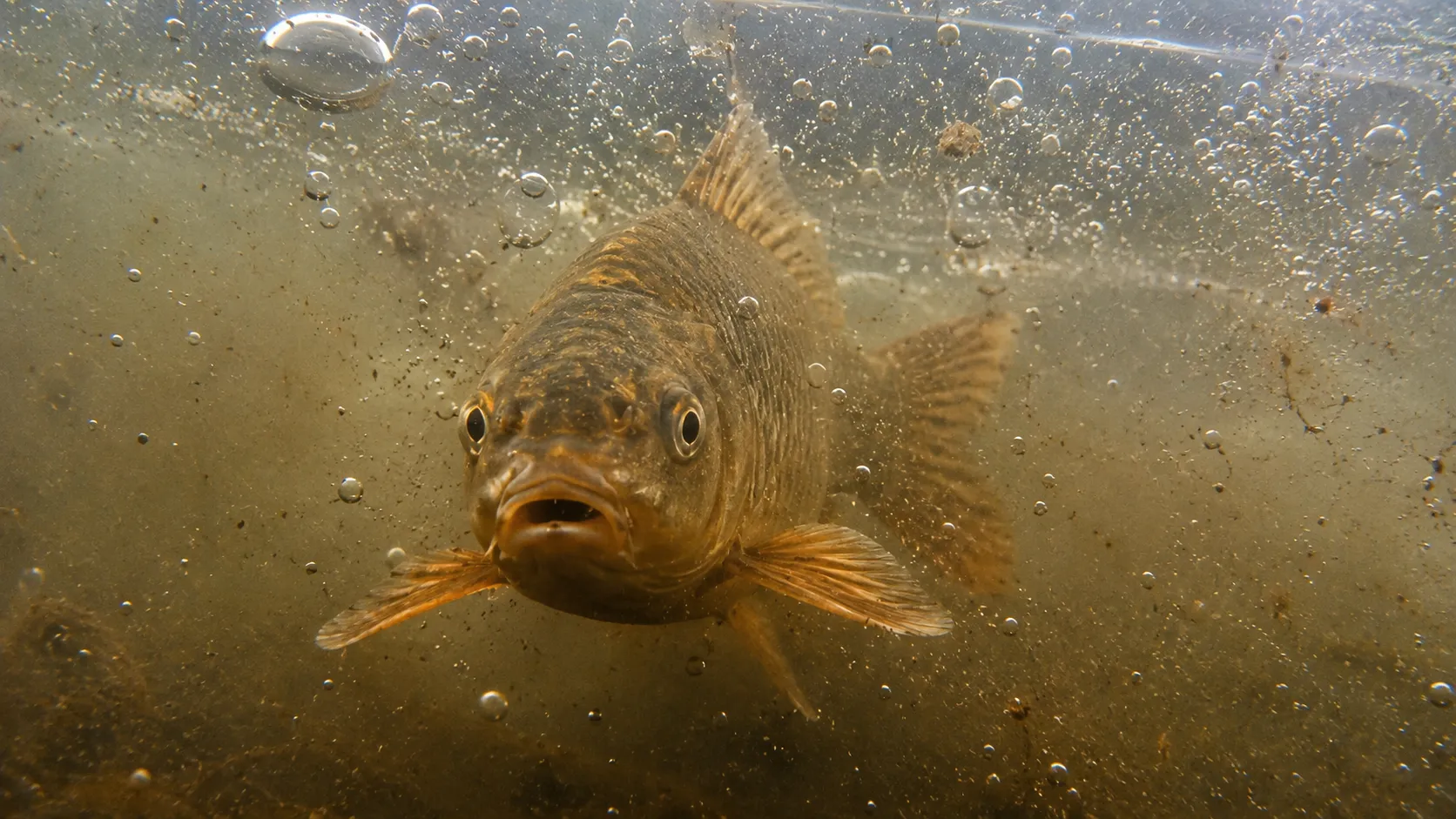
Visual answer
How fish extract oxygen from water
Gills work on the same principle as lungs, just with water instead of air.
Water enters the mouth
The fish opens its mouth and draws water in.
Water passes over gill filaments
Gills are packed with thin filaments full of tiny blood vessels.
Oxygen crosses into blood
Dissolved oxygen diffuses through the gill membrane into the bloodstream.
Water exits through gill slits
The now oxygen-depleted water exits behind the gill covers.
How gills work
Fish breathe oxygen, just dissolved in water
Water naturally contains dissolved oxygen from the atmosphere and from photosynthesis by aquatic plants and algae.
Fish extract this oxygen using gills, not lungs. Gills are densely folded membranes richly supplied with blood vessels.
As water flows over the gills, oxygen diffuses across the thin membrane into the blood, and carbon dioxide diffuses out. It is the same gas exchange that happens in your lungs, just using water as the medium.
Out of water
Do fish drown when taken out of water?
What people think
A fish out of water is drowning in air.
Since fish need water to breathe, taking them out of water seems like the equivalent of drowning for a human.
What actually happens
They suffocate in air, not drown in it.
Drowning specifically refers to suffocation caused by liquid filling the lungs. A fish out of water suffocates because gills cannot extract oxygen from air (they collapse without water to support them). It is suffocation, not drowning.
Air-breathing fish
Some fish can breathe air
Lungfish
Have functional lungs and can survive out of water for months by burrowing into mud.
Mudskippers
Absorb oxygen through their moist skin and mouth lining while on land.
Bettas (Siamese fighting fish)
Have a labyrinth organ that lets them breathe atmospheric air. Need access to the water surface.
Arapaima
Large Amazonian fish that must surface to breathe air regularly.
Dead zones
Oxygen depletion can wipe out entire waterways
Algal blooms, fueled by agricultural runoff, can use up so much dissolved oxygen as they decay that entire stretches of water become hypoxic.
These dead zones can kill thousands of fish in hours. The Gulf of Mexico has a large seasonal dead zone caused by nitrogen from Midwest farming entering the Mississippi River.
Warm water holds less dissolved oxygen than cold water, making this problem worse as temperatures rise.
Quick answers
Common questions
Can fish drown? +
Not in the technical sense. Drowning means suffocation by liquid entering the lungs. Fish use gills, not lungs. But fish can suffocate if dissolved oxygen in the water runs out.
What happens to fish in water with no oxygen? +
They suffocate. Their gills cannot extract oxygen that is not there. They may gulp at the surface briefly, but most fish cannot effectively breathe air.
Can fish breathe air? +
Most cannot. A few species, including lungfish, bettas, and mudskippers, have adapted to extract oxygen from air in various ways.
Why do fish die in polluted water? +
Often because pollution (especially agricultural runoff) fuels algal blooms that consume dissolved oxygen as they die and decay, suffocating the fish.
Do fish drown when you take them out of the water? +
They suffocate, not drown. Gills collapse without water to support them and cannot extract oxygen from air. The result is fatal suffocation.