Visual answer
The Fear Response: What Happens in Your Body
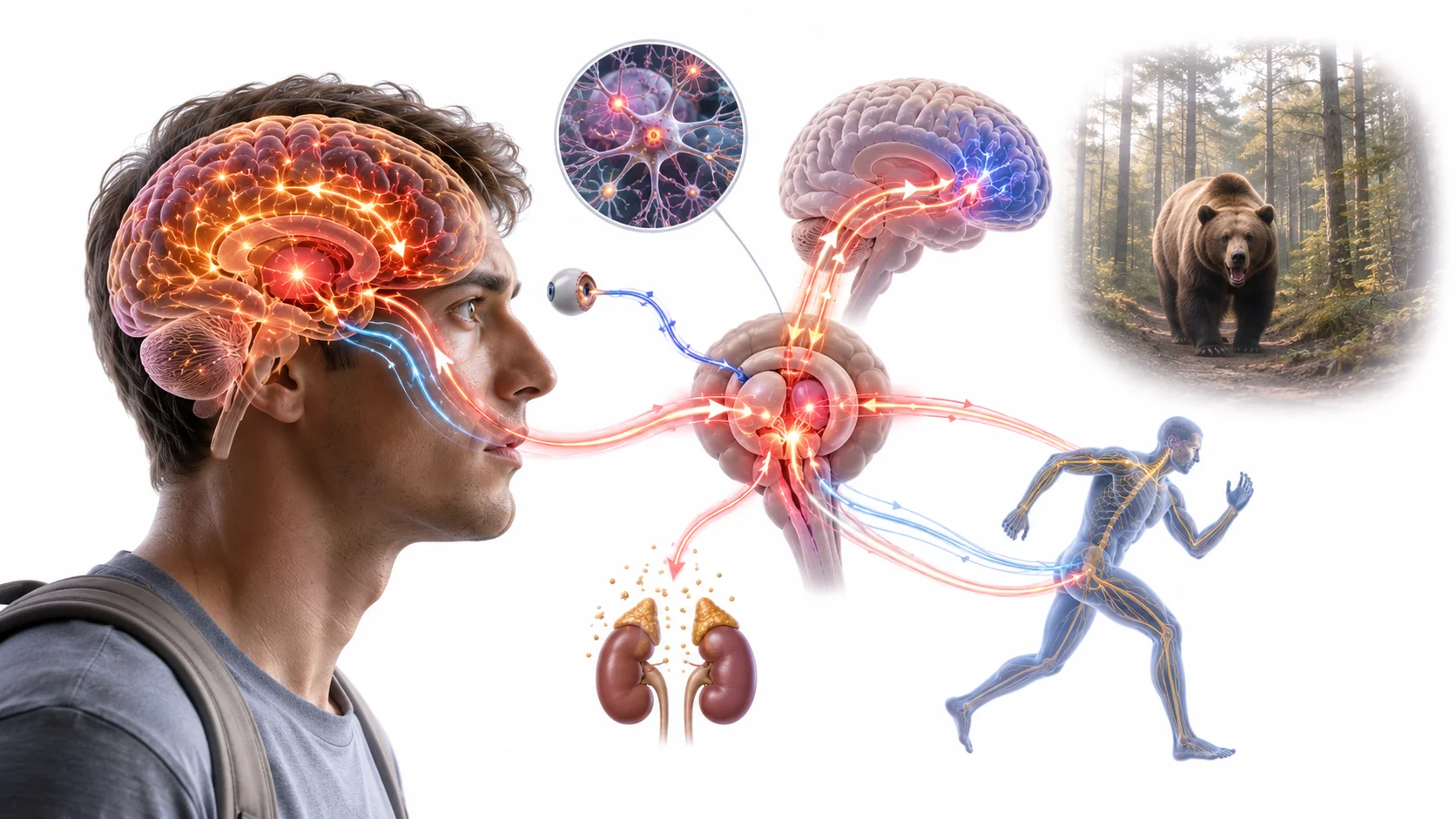
The cascade of biological events triggered by the amygdala when it detects a threat.
Threat Detection
Sensory information reaches the amygdala through a fast, crude pathway directly from the thalamus. This route bypasses the cortex entirely, allowing the amygdala to trigger a response before the brain's thinking regions have processed what was seen or heard.
Amygdala Alarm
The amygdala compares the incoming signal to stored threat memories. If a match is found, it sends an urgent signal to the hypothalamus to initiate the emergency response. This decision takes milliseconds and is made below the level of conscious thought.
Hypothalamus Activation
The hypothalamus acts as the body's emergency dispatcher. It activates the sympathetic nervous system and triggers the adrenal glands to release adrenaline into the bloodstream.
Adrenaline Release
Adrenaline causes the heart to beat faster and harder, pushing blood to muscles. Pupils dilate to take in more light. Breathing quickens to increase oxygen supply. Digestion pauses. The body redirects all available resources to immediate survival.
Cortisol Surge
Slightly after adrenaline, the adrenal glands release cortisol, which sustains the stress response and keeps the body in a state of heightened readiness. Cortisol also enhances the formation of fear memories, making the triggering situation easier to recognise and avoid in future.
Cortical Override
The prefrontal cortex, which processes the threat more slowly and rationally, can in time send inhibitory signals back to the amygdala. This is the 'thinking through it' process that allows the fear response to be calmed once the rational brain catches up with the emotional one.
Two fear pathways
Your Brain Has Two Fear Pathways and Only One Thinks
Neuroscientist Joseph LeDoux identified two pathways through which sensory information reaches the amygdala. He called them the low road and the high road. The low road runs directly from the thalamus to the amygdala. It is fast, crude, and bypasses the thinking cortex entirely. The high road passes through the cortex first, allowing for a more accurate but slower assessment.
The low road exists because speed matters more than accuracy when a threat might kill you. If you see a dark shape in the undergrowth, the low road triggers a freeze response before your visual cortex has fully processed what you saw. If it turns out to be a branch, no harm done. If it was a predator, the milliseconds gained were potentially lifesaving.
This architecture explains why fear responses are so difficult to override with reason. By the time your prefrontal cortex is forming rational thoughts, your body is already in emergency mode. You cannot think your way out of a triggered amygdala in real time. You can only let the slower cortical pathway eventually calm it down.
Fight, flight, freeze
Fight, Flight, and the Third Response Nobody Talks About
The fight-or-flight response is so well known it has become a cliche. But there are actually three primary responses to acute threat: fight, flight, and freeze. Freezing, the sudden paralysis that stops movement entirely, is often the first response when a threat is ambiguous or unavoidable, and it is the one most people find most embarrassing to admit.
Freezing likely evolved from the predator response of playing dead. Many predators use movement as the primary trigger for the attack impulse. Stopping movement reduces the probability of being spotted or pursued. The freeze response is not a failure to act. It is an ancient survival strategy.
Which response fires in a given moment is partly determined by the perceived nature of the threat. Threats from which escape seems possible trigger flight. Threats that have cornered the animal trigger fight. Threats that are overwhelming or unavoidable often trigger freeze. The amygdala makes this calculation automatically, in ways the conscious mind does not control.
Fear vs anxiety
What Is the Difference Between Fear and Anxiety?
Fear is a response to a real, present, identifiable threat. Anxiety is a response to a perceived or anticipated threat, often vague, future-oriented, or uncertain. Both involve amygdala activation and produce similar physical sensations, but they engage different cognitive processes.
Fear is generally self-limiting. When the threat passes, the amygdala calms and the body returns to baseline. Anxiety is sustained by the prefrontal cortex's capacity for future simulation. The thinking brain keeps generating threat scenarios, maintaining the amygdala in a state of activation even with no present danger.
Anxiety disorders, which affect roughly one in five people at some point in their lives, occur when this anticipatory threat system becomes dysregulated. The threshold for amygdala activation becomes too low. Neutral situations trigger responses sized for genuine emergencies. The smoke alarm goes off not for fires but for burnt toast.
How phobias form
How Do Phobias Form in the Brain?
Phobias are acquired fears that have become disproportionate to the actual threat. They form through classical conditioning, the same process Ivan Pavlov famously demonstrated with dogs. A neutral stimulus becomes associated with fear through one or more experiences in which both occurred simultaneously.
The association is stored as a fear memory in the amygdala. Because fear memories are encoded with exceptional strength and durability, even a single intensely frightening experience can create a lifelong association. The trigger does not need to be logically connected to the threat. It simply needs to have been present.
Treating phobias effectively requires not erasing the fear memory, which is largely impossible, but building a competing memory of safety. Exposure therapy systematically pairs the phobia trigger with non-threatening outcomes, gradually teaching the prefrontal cortex to send stronger inhibitory signals to the amygdala. The fear memory remains but is overridden by a stronger safety signal.
Why we enjoy being scared
Why Do Some People Enjoy Being Scared?
The fear response releases adrenaline, dopamine, and endorphins. In a context where the person knows they are safe, such as a horror film or a rollercoaster, the physiological arousal of the fear response can be experienced as exciting rather than threatening. The body is aroused. The mind knows there is no real danger. The result is a thrill.
This requires what psychologists call contextual safety signals: clear markers that the threat is not real. Cinema seats, knowing you are watching a film, being with friends who are also laughing or screaming. Remove these signals and the same content becomes genuinely distressing rather than entertaining.
Individual variation in how enjoyable this experience is comes partly from differences in amygdala sensitivity and partly from how strongly the prefrontal cortex maintains the context of safety. High sensation seekers, people who actively pursue intense stimulation, tend to show less amygdala activation in response to novel threats than low sensation seekers.
Discovery
The Patients Who Could Not Feel Fear
In the 1990s, Antonio Damasio and his colleagues at the University of Iowa began studying patients with bilateral amygdala damage, caused by a rare genetic condition called Urbach-Wiethe disease. These patients showed a striking profile of specific emotional blindness: intact intellect, normal social functioning, but complete absence of fear.
One patient, known in the literature as S.M., became the most studied individual in the neuroscience of emotion. When researchers placed her in genuinely dangerous situations, including holding live snakes she had previously said terrified her, she showed no distress whatsoever and actually leaned in with curiosity. She approached strangers in threatening situations without hesitation. She watched horror films without physiological reaction.
These cases did not just confirm the amygdala's role in fear. They also raised profound questions about the relationship between felt emotion and rational behaviour, the role of emotion in decision-making, and what it means for a survival system to be entirely absent from a fully functioning human mind.
Misconception
Common Misconception
What people think
Fear is irrational and can be overcome with logic
The cultural message around fear is often that it is a weakness to overcome, and that rational thinking is its natural antidote. Just think through it. You know there is nothing actually to be afraid of. The rational brain knows better. Trust the rational brain.
What actually happens
Reality
The fear response fires through a neural pathway that bypasses rational thought entirely. The amygdala responds to threat signals before the prefrontal cortex has even begun processing. Rational thinking arrives after the alarm has already sounded and the body is already in emergency mode. You cannot think your way out of an active fear response in real time. Effective approaches work with the amygdala's learning mechanisms, through gradual exposure and the building of safety memories, rather than trying to override the system with logic.
Quick answers
Common questions
What part of the brain controls fear? +
The amygdala is the primary structure, acting as the brain's threat-detection and alarm system. It works in conjunction with the hypothalamus, which triggers the physical response, and the prefrontal cortex, which can over time modulate and calm the amygdala's reactions.
What is the fight-or-flight response? +
Fight-or-flight is the body's automatic emergency response to perceived threat. The amygdala triggers the hypothalamus, which activates the sympathetic nervous system and releases adrenaline. Heart rate and breathing increase, blood flow is redirected to muscles, and digestion pauses. The body is primed for rapid physical action.
What is the difference between fear and anxiety? +
Fear is a response to a real, present, identifiable threat. Anxiety is future-oriented, sustained by anticipation of potential harm. Both involve amygdala activation and similar physical sensations, but anxiety is maintained by the thinking brain's capacity for simulation rather than by an actual present danger.
Why does fear cause physical symptoms? +
Physical symptoms of fear are caused by adrenaline and cortisol flooding the body. Adrenaline increases heart rate, dilates pupils, and redirects blood to muscles. The body is physically preparing for fight or flight. These symptoms are not signs of weakness. They are an ancient and effective survival mechanism.
How are phobias formed in the brain? +
Phobias form through classical conditioning: a neutral stimulus is paired with a fear response, often through a single intensely frightening experience. The association is stored as a durable fear memory in the amygdala. Effective treatment works by building a stronger competing safety memory through gradual exposure, not by erasing the original fear.
Can you unlearn a fear? +
Fear memories cannot be erased, but they can be overridden. Exposure therapy works by repeatedly pairing the feared stimulus with safety, building new inhibitory connections from the prefrontal cortex to the amygdala. The fear memory remains, but a stronger safety signal suppresses it. Relapse can occur under high stress when the safety signal weakens.