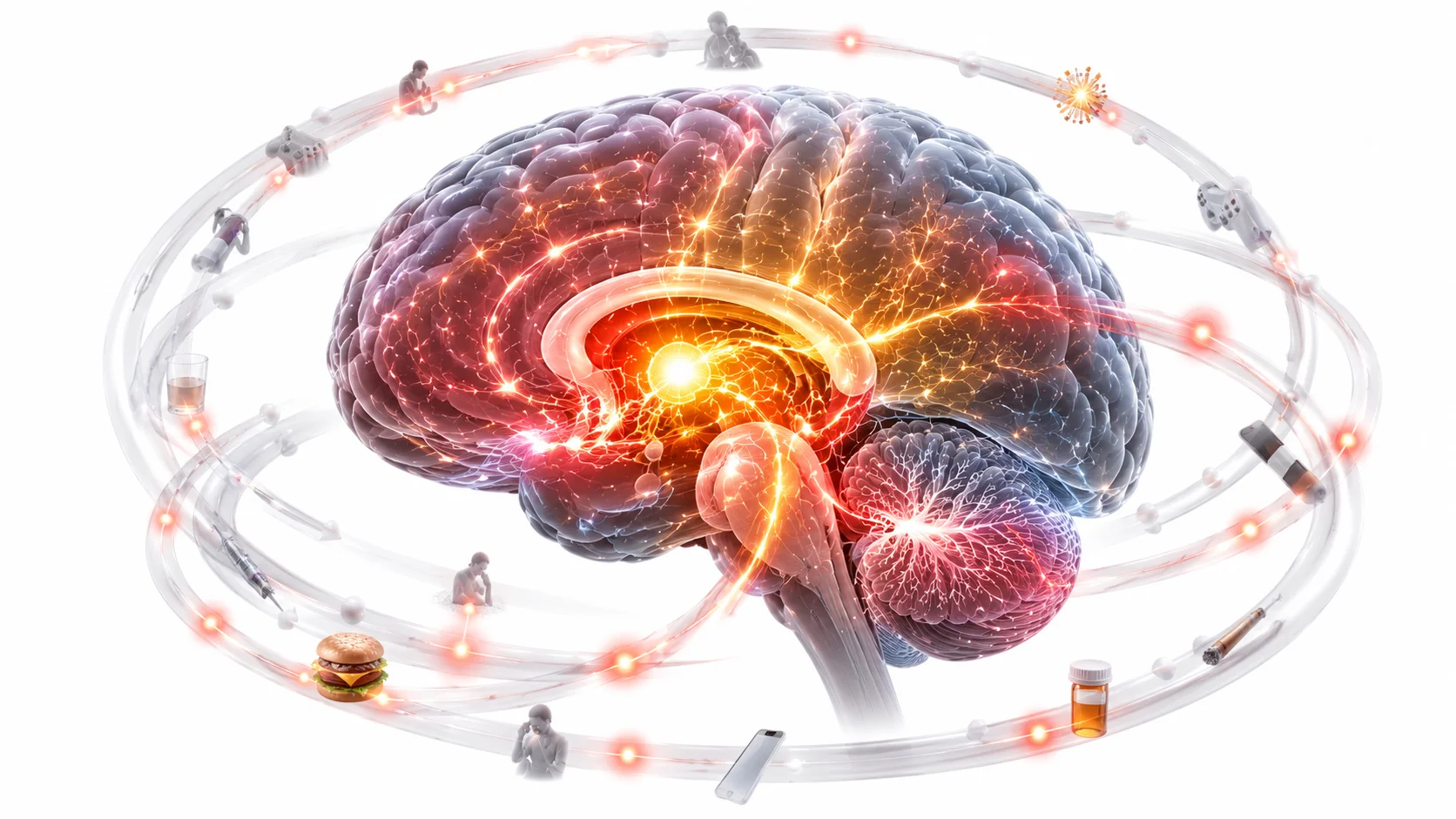
Visual answer
How Addiction Rewires the Brain's Reward System
The progression from first use to dependency, and what changes physically in the brain at each stage.
First Exposure
A substance or behaviour triggers the release of dopamine in the nucleus accumbens, the brain's reward centre. The brain experiences this as intense pleasure and flags the trigger as highly important.
Anticipation Signal
After early exposures, the dopamine response shifts. The brain begins releasing dopamine not when the reward arrives, but when the cue that predicts it appears. Wanting precedes getting.
Tolerance
With repeated exposure, the brain reduces its dopamine receptor density to protect itself from overstimulation. The same amount of substance now produces less effect, requiring more to achieve the original feeling.
Dependence
The brain recalibrates its baseline around the presence of the substance. Normal activities that once provided reward produce diminishing dopamine response. The substance becomes necessary to feel normal rather than to feel good.
Withdrawal
Without the substance, the brain's suppressed dopamine system has nothing to compensate it. The result is dysphoria, anxiety, physical discomfort, and intense craving. The brain genuinely interprets absence as a crisis.
Compulsion
The prefrontal cortex, which handles rational decision-making, loses influence over the basal ganglia's deeply ingrained habit loops. Behaviour becomes compulsive rather than chosen. The person knows they should stop. The brain will not let them.
What dopamine does
Dopamine Is Not the Pleasure Chemical. It Is the Wanting Chemical.
Dopamine is widely described as the brain's pleasure chemical, but that is not quite accurate. Dopamine is the signal for anticipation and motivation. It is the brain saying: that was important, go get it again. Pleasure itself is a separate system.
This distinction matters enormously for understanding addiction. What drives addictive behaviour is not primarily the pleasure of the substance. It is an overwhelming compulsive wanting, driven by dopamine signals that have been supercharged far beyond anything natural rewards like food or social connection can produce.
A rat with its dopamine system fully blocked will sit in front of food it loves and starve. It does not lack the ability to experience pleasure from eating. It has simply lost the motivation to reach for it. Dopamine is the engine of wanting. Addiction is that engine running at full throttle, pointed in one direction.
Tolerance and withdrawal
Why Your Brain Makes Quitting Feel Impossible
When you repeatedly flood the brain's reward system with a substance that produces far more dopamine than natural rewards, the brain adapts. It reduces the number of dopamine receptors and the amount of dopamine produced naturally. This is tolerance: you need more of the substance to feel the same effect.
More importantly, the brain recalibrates its sense of normal. Before addiction, the baseline dopamine level produced a reasonable sense of wellbeing. After dependence, that baseline has been suppressed. Without the substance, the person does not just fail to feel good. They feel genuinely terrible. Anxious, irritable, incapable of enjoying anything.
Withdrawal is not weakness. It is the physical experience of a brain trying to function without the chemical scaffolding it has been built around. The brain is not being dramatic. Its chemistry is genuinely disrupted.
Habit loops
How Addiction Becomes a Habit Loop
Addiction does not operate only through chemistry. It also operates through deeply ingrained habit circuits in the basal ganglia, a region of the brain that handles automatic, repeated behaviours. Once a behaviour is practised enough, it becomes encoded there as a habit, operating below the threshold of conscious decision.
The habit loop runs on a cue, a routine, and a reward. The cue might be stress, a particular time of day, a social setting, or an emotional state. The routine is the addictive behaviour. The reward is the dopamine signal. Once this loop is established, the cue alone triggers craving, regardless of whether the person wants it to.
This is why environments, social situations, and emotional triggers are so central to relapse. The habit loop is not stored in conscious memory. It is stored in circuits that respond automatically to the right cue, bypassing rational intention entirely.
Genetics and risk
Are Some People More Likely to Become Addicted?
Genetic factors account for roughly 40 to 60 percent of addiction vulnerability, depending on the substance. This does not mean addiction is destiny for certain people. It means some individuals have brain architectures that respond more intensely to dopamine-triggering substances, develop tolerance faster, or have less robust prefrontal regulation of impulse.
Environmental factors interact with genetics in complex ways. Childhood trauma, early exposure to substances, peer environment, and chronic stress all significantly raise addiction risk independently of genetic factors. The combination of high genetic vulnerability and high environmental stress produces the greatest risk.
This has important implications for how we treat addiction. If it is a brain-based condition with genetic components, moral judgement is as unhelpful as blaming someone for having high blood pressure. Treatment that addresses the neurological, psychological, and environmental dimensions simultaneously has the best outcomes.
Recovery science
What Actually Works for Addiction Recovery?
Effective addiction treatment combines pharmacological and psychological approaches. Medications can reduce cravings, block the reward effect of substances, or manage withdrawal symptoms. Cognitive behavioural therapy helps people identify and rewrite the cue-routine-reward loops driving their behaviour.
Long-term recovery is supported by changes to the cue environment, removal or modification of triggers that activate habit loops, social support which directly engages the brain's social reward circuits as a partial replacement for the lost substance reward, and meaningful activity that rebuilds natural dopamine regulation.
Relapse is part of recovery for most people, not evidence of failure. Brain imaging shows that craving responses to cues can persist for years after abstinence. Recovery is not an event. It is an ongoing neurological recalibration.
Misconception
Common Misconception
What people think
Addiction is a choice and a moral failure
The persistent cultural narrative around addiction frames it as weakness, selfishness, or a failure of character. People are told to just stop, as if the problem were simply a bad decision that could be reversed with sufficient willpower.
What actually happens
Reality
Addiction involves measurable, physical changes to brain structure and function. Brain imaging shows reduced prefrontal cortex activity, altered dopamine receptor density, and deeply entrenched habit circuits in addicted individuals compared to non-addicted controls. Willpower is regulated by the prefrontal cortex, which is one of the most damaged regions in severe addiction. Asking someone to use willpower to overcome addiction is like asking someone with a broken leg to run it off.
Quick answers
Common questions
What happens to the brain during addiction? +
The brain's reward system is flooded with dopamine far beyond normal levels. Over time, the brain reduces its dopamine receptor density to compensate. Natural rewards produce less pleasure. The prefrontal cortex loses regulatory influence over habit circuits. Behaviour gradually shifts from chosen to compulsive.
Is addiction a disease or a choice? +
The medical consensus treats addiction as a chronic brain disorder with genetic, psychological, and environmental components. Initial substance use often involves choice. Full addiction involves brain changes that substantially impair the ability to choose to stop. Both dimensions are real and neither cancels the other.
What is dopamine's role in addiction? +
Dopamine drives motivation and wanting. Addictive substances trigger dopamine releases far greater than any natural reward. The brain then recalibrates around these unnaturally high levels, reducing baseline dopamine and making normal activities feel unrewarding. Craving is driven by dopamine anticipation, not just the pleasure of the substance itself.
Can behavioural activities like gambling become addictive? +
Yes. Gambling, gaming, social media, and other behavioural activities can activate the same reward circuits as addictive substances with similar brain-imaging signatures. The same dopamine-driven anticipation, tolerance, withdrawal-like states, and loss of control can occur. Behavioural addictions are now formally recognised in diagnostic frameworks.
What is withdrawal and why does it happen? +
Withdrawal happens when a brain dependent on a substance suddenly loses it. The brain has suppressed its own dopamine and endorphin production around the substance's presence. Without it, those suppressed systems have nothing compensating them, causing anxiety, physical discomfort, dysphoria, and intense craving.
Are some people genetically more prone to addiction? +
Yes. Genetic factors account for roughly 40 to 60 percent of addiction vulnerability. These include differences in dopamine receptor density, the intensity of initial reward responses, and the strength of prefrontal regulatory control. Genetics interact with environment, and neither is destiny alone.