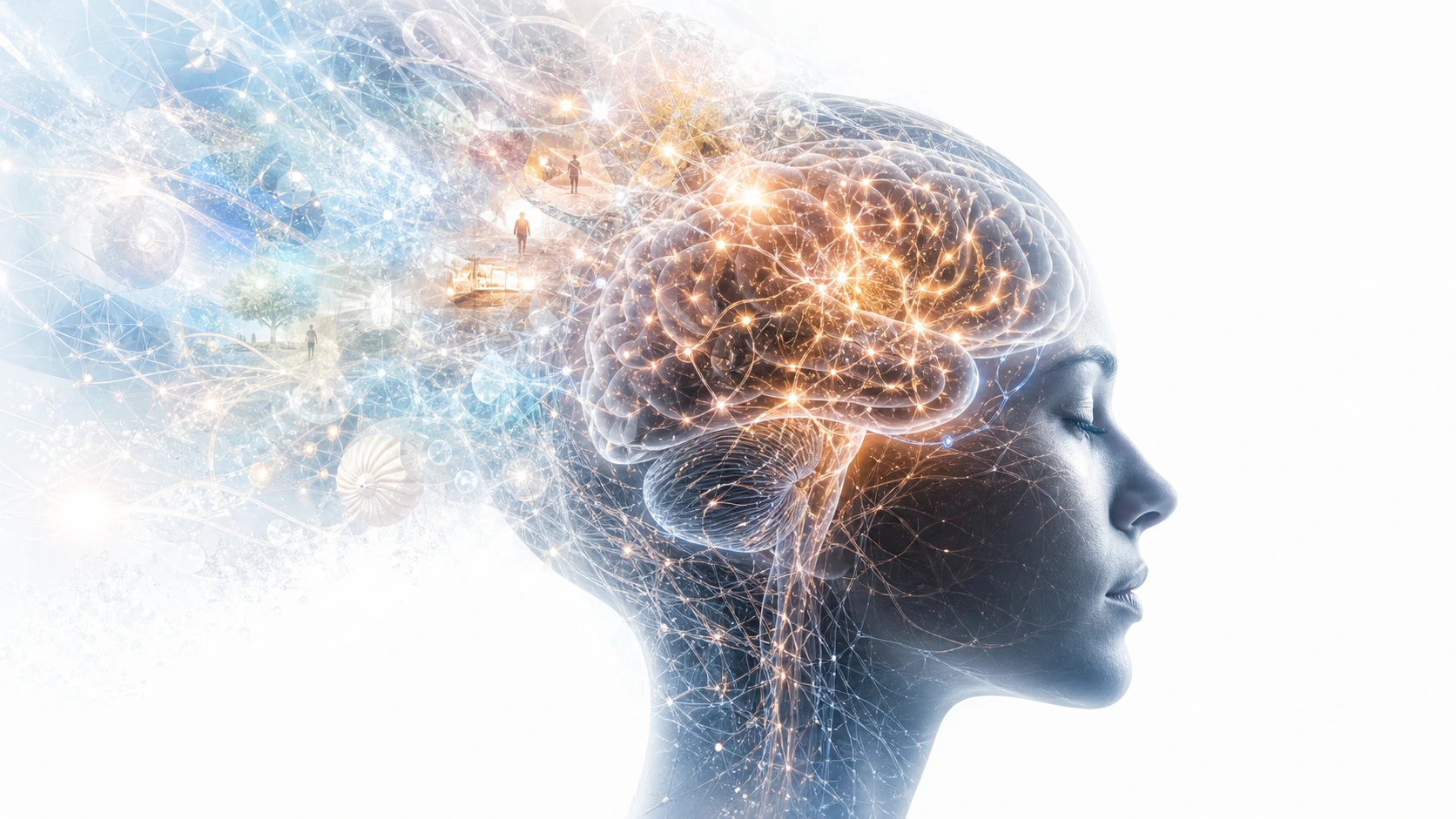
Visual answer
Neural Correlates Of Consciousness
Conscious awareness correlates with long-range coordinated activity across cortical and thalamic systems rather than one isolated brain location.
Global Workspace Theory
Information becomes conscious when it is broadcast widely across brain systems.
Integrated Information Theory
Consciousness corresponds to how much a system integrates information beyond its parts.
Predictive Processing
The brain builds a model of reality and updates it with sensory error.
Higher-Order Theories
A state becomes conscious when the brain represents that it is having that state.
Neural dynamics
Some theories focus on complex, recurrent, synchronized brain activity.
Answer
The Quick Answer
Consciousness remains an open problem. Leading theories describe it as global information broadcasting, integrated information, predictive modeling, or higher-order representation, but none has been decisively proven.
Why is there something it is like to be you? This is the question science has not answered and may not be able to.
Mechanism
The Leading Theories
No single theory of consciousness is accepted, but several frameworks dominate serious debate.
- 1
Global Workspace Theory
Information becomes conscious when it is broadcast widely across brain systems. Analogy: A newsroom story going national.
- 2
Integrated Information Theory
Consciousness corresponds to how much a system integrates information beyond its parts. Analogy: A tightly woven information network.
- 3
Predictive Processing
The brain builds a model of reality and updates it with sensory error. Analogy: A movie corrected by incoming data.
- 4
Higher-Order Theories
A state becomes conscious when the brain represents that it is having that state. Analogy: Noticing that you are watching the stage.
- 5
Neural dynamics
Some theories focus on complex, recurrent, synchronized brain activity. Analogy: A pattern in motion, not a fixed object.
Curiosities
Details That Make It Stranger
These are the facts that turn the simple explanation into a better story.
Mind-wandering is common
People spend large parts of waking life in partially automatic thought.
Binding remains unsolved
How color, shape, motion, and identity become one unified object is still debated.
Animals likely experience
Many neuroscientists accept consciousness in mammals, birds, and probably more animals.
AI is unresolved
Whether machines could be conscious depends on which theory is right.
Story
The Locked-In Man Who Wrote A Book
Jean-Dominique Bauby suffered locked-in syndrome and dictated The Diving Bell and the Butterfly by blinking one eyelid.
His case shows consciousness and the ability to express it can come apart almost completely.
Hidden mechanism
The Default Mode Network
The default mode network helps generate self-related thought, memory simulation, and the narrative sense of being a person through time.
The deeper insight
Consciousness may involve maintaining a usable story of self as much as perceiving the outside world.
Myths
Common Myths
What people think
Consciousness sits in one brain region
Consciousness sits in one brain region
What actually happens
Reality
Evidence points to coordinated networks rather than a single seat.
Another Misconception
What people think
We only use 10 percent of the brain
We only use 10 percent of the brain
What actually happens
Reality
This is false; brain regions are active across different tasks and states.
Quick answers
Common questions
Are animals conscious? +
Most scientists accept some conscious experience in mammals and birds; other animals remain debated.
Could AI be conscious? +
Unknown. It depends on what consciousness ultimately is and how it can be measured.
What happens during sleep? +
Consciousness changes form; dreams show experience can continue without waking perception.
Is free will compatible with neuroscience? +
This remains a philosophical and scientific debate, with many compatibilist positions.