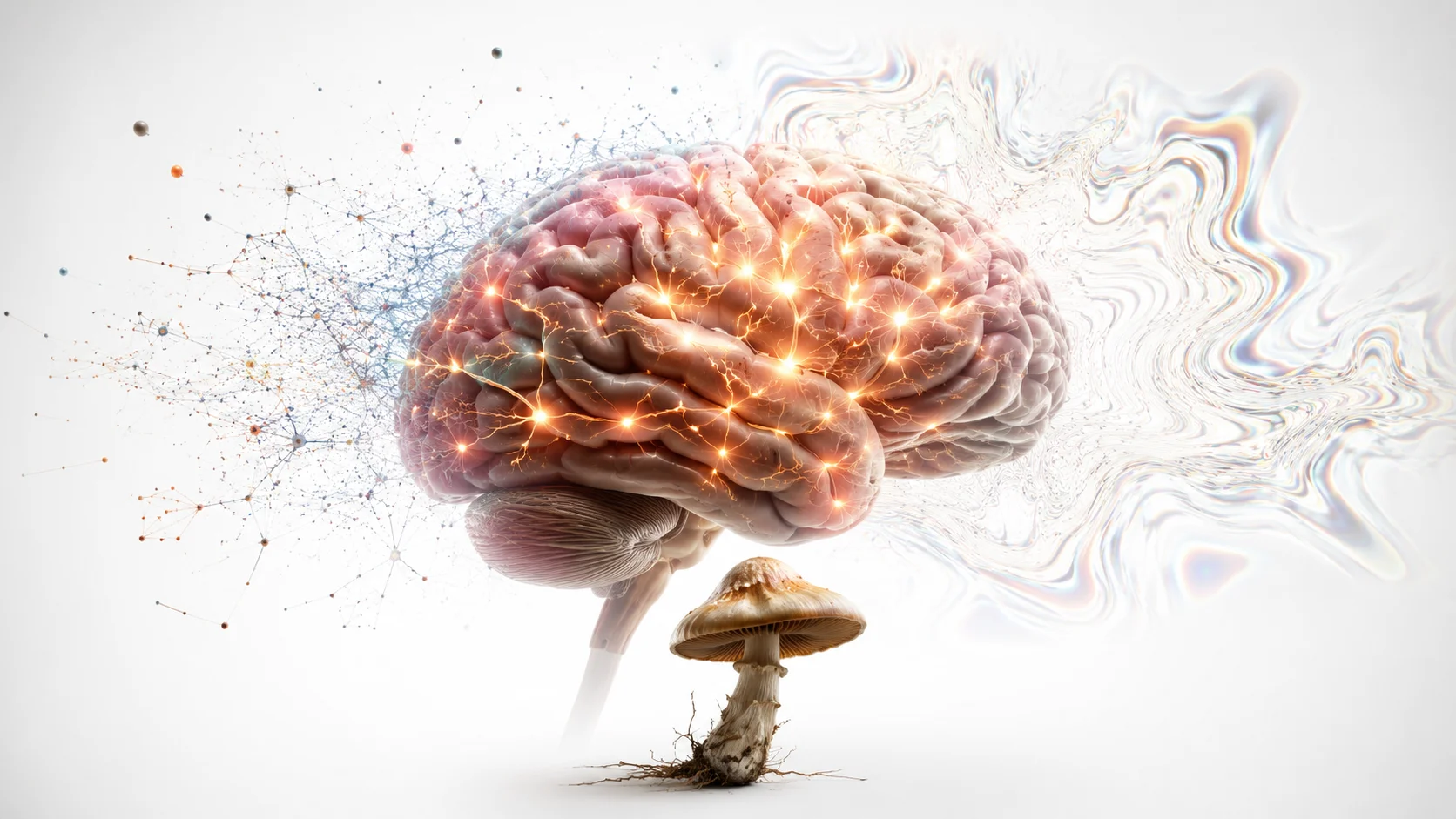
Visual answer
How Psilocin Affects the Brain
Psilocin interacts with serotonin receptors to change brain connectivity.
Conversion
Psilocybin is converted into psilocin in the liver and blood.
Binding
Psilocin binds to 5-HT2A serotonin receptors in the cortex.
Filtering
The brain's usual sensory filters loosen, letting more 'noise' into awareness.
Hyperconnectivity
Brain regions that usually stay separate begin communicating directly.
Loosening Reality
The Mushroom That Loosens Reality
Somewhere inside your skull, a construction project runs without pause. Your brain is not simply receiving reality. It is building it, filtering it, predicting it, discarding it, and assembling it into something stable enough to live inside.
Then there is a small mushroom that can temporarily dismantle the operation. Not through violence, and not through damage, but through a molecule similar enough to one your brain already uses that it slips past the checkpoints.
For several hours, the brain’s editing of reality loosens. Signals usually suppressed begin flooding through. Isolated systems begin talking. The scaffolding that holds the sense of self begins to flex.
What they are
What Are Magic Mushrooms?
Magic mushrooms are fungi that contain psilocybin, a naturally occurring psychedelic compound. More than 200 species are known to contain it, with Psilocybe being the most familiar genus.
What makes them strange is not merely that they contain a psychoactive molecule, but that this molecule evolved in a fungus and happens to fit into the signaling architecture of the human brain.
The mushroom did not evolve psilocybin for humans. The leading idea is that it may help deter insects by interfering with their nervous systems.
The molecule
The Molecule That Changes Perception
Psilocybin itself is not the molecule that mainly affects the brain. It is a prodrug. The body converts it into psilocin by removing a phosphate group.
Psilocin resembles serotonin closely enough to interact with serotonin receptors, especially the 5-HT2A receptor, which is abundant in parts of the cortex involved in perception, emotion, and abstract thought.
It behaves like a counterfeit key. It fits into locks built for serotonin, but once inside, it changes the rhythm of the whole system.
Brain effects
How Magic Mushrooms Affect the Brain
The brain is not one unified machine. It is a collection of specialized systems constantly negotiating with each other.
Psilocin disrupts this organization. One major effect involves the Default Mode Network, the system strongly associated with self-reflection, autobiographical thought, worry, planning, and the internal narrator we experience as ‘I.’
Under psilocybin, this self-focused network loses some of its authority. At the same time, regions that rarely communicate begin exchanging signals. Visual areas, emotional systems, memory networks, and sensory regions begin forming unusual conversations.
This can produce emotional amplification, sensory blending, time distortion, heightened pattern recognition, and the strange feeling that ordinary reality has become more fluid.
Hallucinations
Why Do Hallucinations Happen?
The brain does not passively receive reality. It predicts reality, then updates those predictions using sensory input.
Ordinary perception is partly a controlled hallucination that happens to match the outside world well enough to be useful.
Psilocybin weakens the brain’s confidence in its usual predictions. Filters loosen. Signals normally dismissed as noise enter awareness. The result can be geometric patterns, shifting surfaces, intensified colors, morphing shapes, and visual echoes.
Spiritual feeling
Why Do Magic Mushrooms Feel Spiritual to Some People?
The sense of being a separate self is not a fixed object. It is an active construction maintained by brain networks that separate inside from outside, me from not me.
When psilocybin disrupts self-referential processing, that boundary can soften. The narrator becomes quieter. The feeling of being a separate individual can temporarily dissolve.
This is often called ego dissolution. For some people it feels terrifying. For others, especially in controlled research settings, it can feel deeply meaningful, connected, or spiritual.
Onset & Timing
When Do Magic Mushrooms Start Working?
The timing depends heavily on digestion. Psilocybin must be converted into psilocin before the main brain effects begin.
On an empty stomach, effects may begin in roughly 20 to 40 minutes. On a full stomach, onset can take closer to 60 to 90 minutes.
Peak effects often occur between 90 minutes and 3 hours, while the full experience commonly lasts around 4 to 6 hours.
Safety & Risks
Are Magic Mushrooms Dangerous?
The danger is less about physical toxicity and more about psychological intensity.
Psilocybin can produce panic, paranoia, confusion, distress, unsafe behavior, or overwhelming emotional experiences, especially in uncontrolled environments.
People with a personal or family history of psychosis, schizophrenia, or bipolar disorder with psychotic features may face serious risks. This is not a casual caveat.
The key distinction is that low physical toxicity does not mean low psychological risk.
Quick answers
Common questions
How long do the effects of magic mushrooms last? +
The experience typically lasts between 4 and 6 hours, with peak effects occurring around 2 to 3 hours after ingestion.
What is 'ego dissolution'? +
It is the temporary loss of the sense of being a separate self or individual. It can feel like being 'one' with the universe or simply having a quieter internal narrator.
Are magic mushrooms addictive? +
Psilocybin is generally considered to have a low potential for addiction and does not cause physical withdrawal. However, it can still be misused, and its psychological intensity is not for everyone.
Do they look like normal mushrooms? +
Some do, but many species are small, brown, and easy to confuse with poisonous mushrooms. Professional identification is critical in any context.