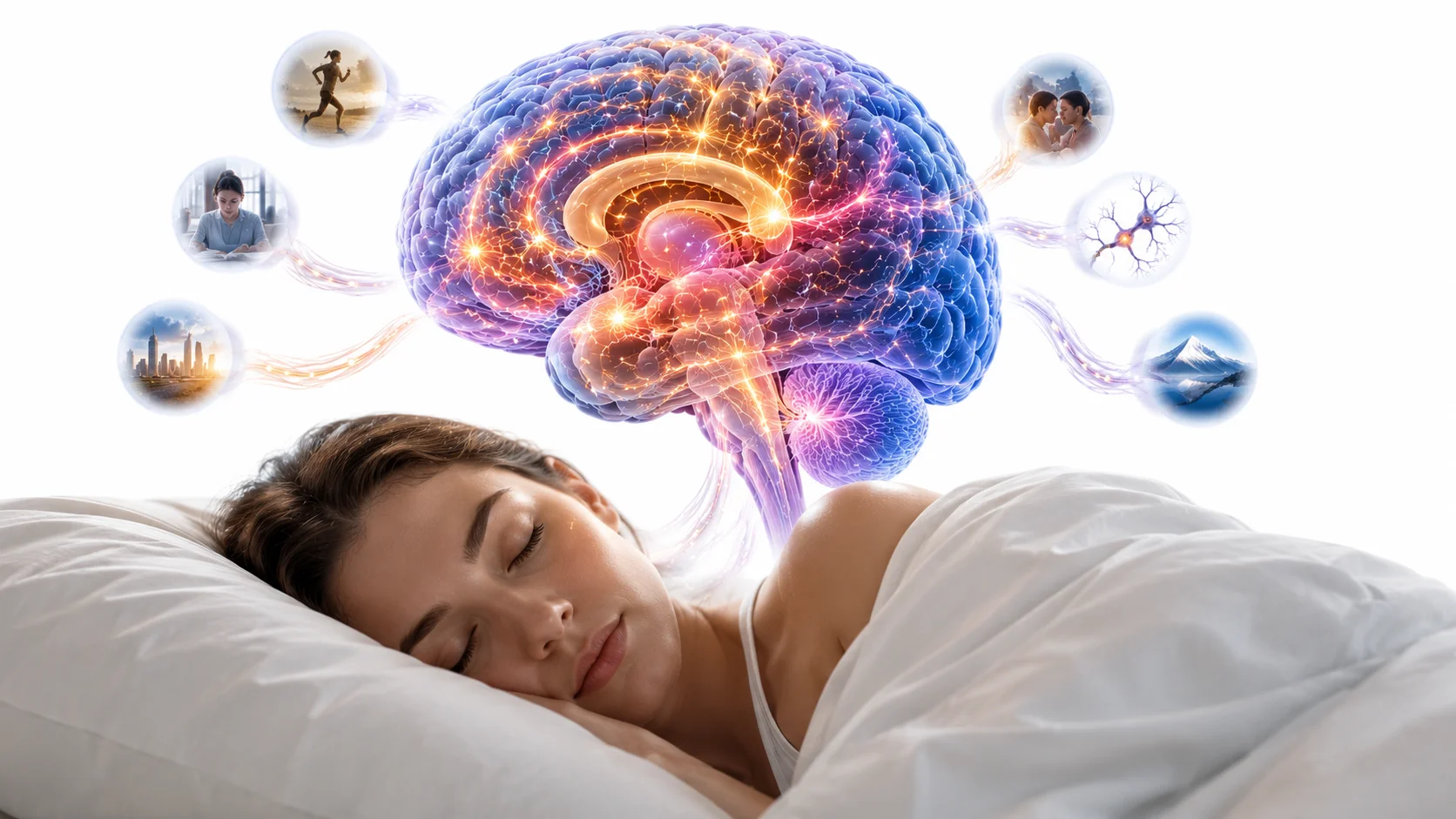
Visual answer
A Night of Sleep: The Stages and What Each One Does
What is happening in your brain at each stage of a typical sleep cycle.
Stage N1 (Light Sleep)
The transition from wakefulness. Muscle activity slows. The brain produces theta waves. You can be easily woken and may experience hypnic jerks, the sudden twitching sensation of falling. This stage lasts only a few minutes.
Stage N2 (True Sleep)
You are fully asleep. Body temperature drops. Heart rate slows. The brain produces bursts of activity called sleep spindles and K-complexes, thought to play a role in memory consolidation and protecting sleep from external sounds.
Stage N3 (Deep Sleep)
The most restorative stage. The brain produces slow delta waves. Growth hormone is released. The immune system is strengthened. Memory consolidation from the hippocampus to the cortex occurs primarily here. This stage dominates early in the night.
REM Sleep
Rapid Eye Movement sleep. Brain activity surges to near-waking levels. The body is largely paralysed to prevent acting out dreams. Emotional memories are processed and consolidated. Dreaming is most vivid here. REM periods lengthen through the night.
Glymphatic Clearance
During deep sleep, brain cells shrink by up to 60%, allowing cerebrospinal fluid to flush through the spaces between them. This clears metabolic waste including proteins associated with Alzheimer's disease. This discovery, made in 2013, transformed our understanding of why sleep is biologically necessary.
Circadian Clock
A master biological clock in the suprachiasmatic nucleus responds to light. Darkness triggers melatonin release from the pineal gland, signalling sleep time. Morning light suppresses melatonin and raises cortisol. Every cell in the body has its own clock synchronised to this central signal.
Circadian rhythm
The Internal Clock That Controls When You Sleep
Every cell in your body contains a biological clock, a set of genes that cycle on a roughly 24-hour schedule. These are all synchronised to a master clock in the brain, a tiny region called the suprachiasmatic nucleus that sits directly above the point where the optic nerves cross.
Light is the primary signal that resets this clock. When light hits the retina, signals travel directly to the suprachiasmatic nucleus and suppress the release of melatonin, the hormone that signals darkness and promotes sleepiness. As evening arrives and light fades, melatonin rises and you begin to feel sleepy.
Modern life creates powerful disruptions to this system. Artificial light, especially the blue-wavelength light from screens, mimics daylight and suppresses melatonin even late at night. Shift work, jet lag, and irregular sleep schedules all create mismatches between the internal clock and actual behaviour, and chronic circadian disruption is associated with increased risk of metabolic disease, cardiovascular disease, and certain cancers.
Memory and sleep
Why Sleep Is Non-Negotiable for Memory
During slow-wave deep sleep, the hippocampus replays the day's experiences in compressed form and gradually transfers them to the cerebral cortex for long-term storage. This process is called memory consolidation, and it cannot happen while you are awake. The two systems, hippocampus and cortex, need the quiet of sleep to communicate efficiently.
During REM sleep, the brain selectively strengthens emotional memories and may prune redundant or conflicting information. Some research suggests REM sleep also supports the creative cross-referencing of seemingly unrelated memories, which may partly explain why problems sometimes feel clearer after sleeping on them.
Staying up all night to study is one of the worst evidence-based strategies possible. Not only does fatigue impair encoding during the study session, but the absence of sleep means none of the material will consolidate. A moderate study session followed by a full night of sleep consistently outperforms marathon cramming in controlled experiments.
Why we dream
Why Do We Dream?
Dreams remain one of the least understood areas of neuroscience. The dominant current hypothesis is that dreaming, especially during REM sleep, serves a memory consolidation and emotional processing function. The sleeping brain replays and integrates experiences, testing combinations and strengthening the neural patterns that represent useful knowledge.
Another influential theory from neuroscientist Matthew Walker proposes that REM sleep essentially strips the emotional charge from memories while preserving the factual content. The memory of a painful event is retained, but the visceral emotional response to it is dampened. This may be why time, and specifically the sleep that time contains, heals emotional wounds.
The reason dreams feel so vivid and strange may be that the brain regions responsible for critical evaluation and logical consistency, primarily the prefrontal cortex, are suppressed during REM sleep. The hippocampus and emotional centres are active. The editor is asleep. The storyteller runs free.
Sleep deprivation effects
What Happens When You Do Not Get Enough Sleep
Sleep deprivation affects nearly every system in the body. After one night of insufficient sleep, the immune system's natural killer cell activity drops by 70 percent. Hunger hormones shift, with ghrelin (appetite stimulant) rising and leptin (satiety signal) falling, causing measurably increased caloric intake the following day.
The prefrontal cortex, responsible for rational decision-making and impulse control, is disproportionately impaired by sleep loss. Emotionally, the amygdala becomes hyperreactive: sleep-deprived people show up to 60 percent stronger emotional responses to negative stimuli than rested people.
Chronic sleep deprivation is associated with accelerated telomere shortening, reduced grey matter volume, increased cardiovascular disease risk, and impaired glucose metabolism. The health consequences of sleeping six hours rather than eight hours a night, sustained over years, are comparable to the effects of heavy smoking.
Discovery
The Discovery That Showed Sleep Is Not Just Rest
For most of scientific history, sleep was considered a passive state, a period of reduced activity where the brain simply switched off. That view began to collapse in 1953 when Nathaniel Kleitman and his student Eugene Aserinsky were studying infant sleep at the University of Chicago.
Aserinsky noticed that sleeping infants periodically showed rapid, darting eye movements. When he monitored brain activity during these episodes, he found it was indistinguishable from the waking state. Adults showed the same pattern. He had discovered REM sleep.
This finding transformed sleep science by demonstrating that the sleeping brain was not simply resting but passing through distinct, active stages with different physiological signatures. Every subsequent discovery in sleep research, including the role of different stages in memory consolidation and the glymphatic system, built on that 1953 observation.
Misconception
Common Misconception
What people think
You can catch up on lost sleep at the weekend
The concept of sleep debt and its resolution through weekend lie-ins is deeply embedded in how many people manage their schedules. The assumption is that lost sleep accumulates and can be repaid in a lump sum, like a financial overdraft.
What actually happens
Reality
Weekend recovery sleep does partially address some of the cognitive impairments from weekly sleep restriction. However, research shows that the metabolic, immunological, and memory consolidation deficits from chronic weekday sleep restriction are not fully reversed by weekend catch-up sleep. Worse, sleeping late on weekends shifts the circadian rhythm, creating a form of social jetlag that impairs Monday and Tuesday performance. Consistent daily sleep produces significantly better outcomes than an averaged weekly total of the same hours.
Quick answers
Common questions
What happens to your body during sleep? +
Body temperature drops, heart rate slows, growth hormone is released, the immune system strengthens, and the brain runs a waste-clearance system called the glymphatic system. Memory consolidation transfers the day's experiences from the hippocampus to long-term cortical storage. Muscles undergo repair and protein synthesis increases.
What are the stages of sleep? +
Sleep cycles through N1 (light sleep), N2 (true sleep with memory-related brain activity), N3 (deep slow-wave sleep where restoration and consolidation occur), and REM (dreaming, emotional memory processing, near-waking brain activity). Each full cycle lasts about 90 minutes. A full night contains 4 to 6 cycles.
What is REM sleep and why is it important? +
REM stands for rapid eye movement. During REM, brain activity resembles waking, the eyes move rapidly, and the body is paralysed to prevent acting out dreams. REM sleep consolidates emotional memories, may strip emotional charge from distressing experiences, and supports creative thinking. REM periods lengthen through the night, so cutting sleep short disproportionately reduces REM.
What is the circadian rhythm? +
The circadian rhythm is the internal biological clock that runs on roughly a 24-hour cycle and governs sleep-wake timing. It is synchronised primarily by light, which suppresses melatonin. Every cell in the body contains a clock, all coordinated by a master clock in the brain. Disruption of the circadian rhythm is associated with significant health consequences.
How much sleep does a person actually need? +
Most adults function optimally on 7 to 9 hours. Adolescents need 8 to 10 hours. Children need more. Fewer than 1% of people carry a gene variant that allows genuine healthy function on 6 hours or less. Most people who believe they function well on less have simply adapted to chronic impairment without a comparison point.
Why do we dream? +
The leading hypotheses are that dreaming serves memory consolidation, emotional processing, and creative integration functions. During REM sleep, the brain replays and recombines experiences. The vividness and strangeness of dreams likely reflects reduced prefrontal critical oversight. The brain's storyteller runs without the editor.