Visual answer
How the Brain Creates Déjà Vu
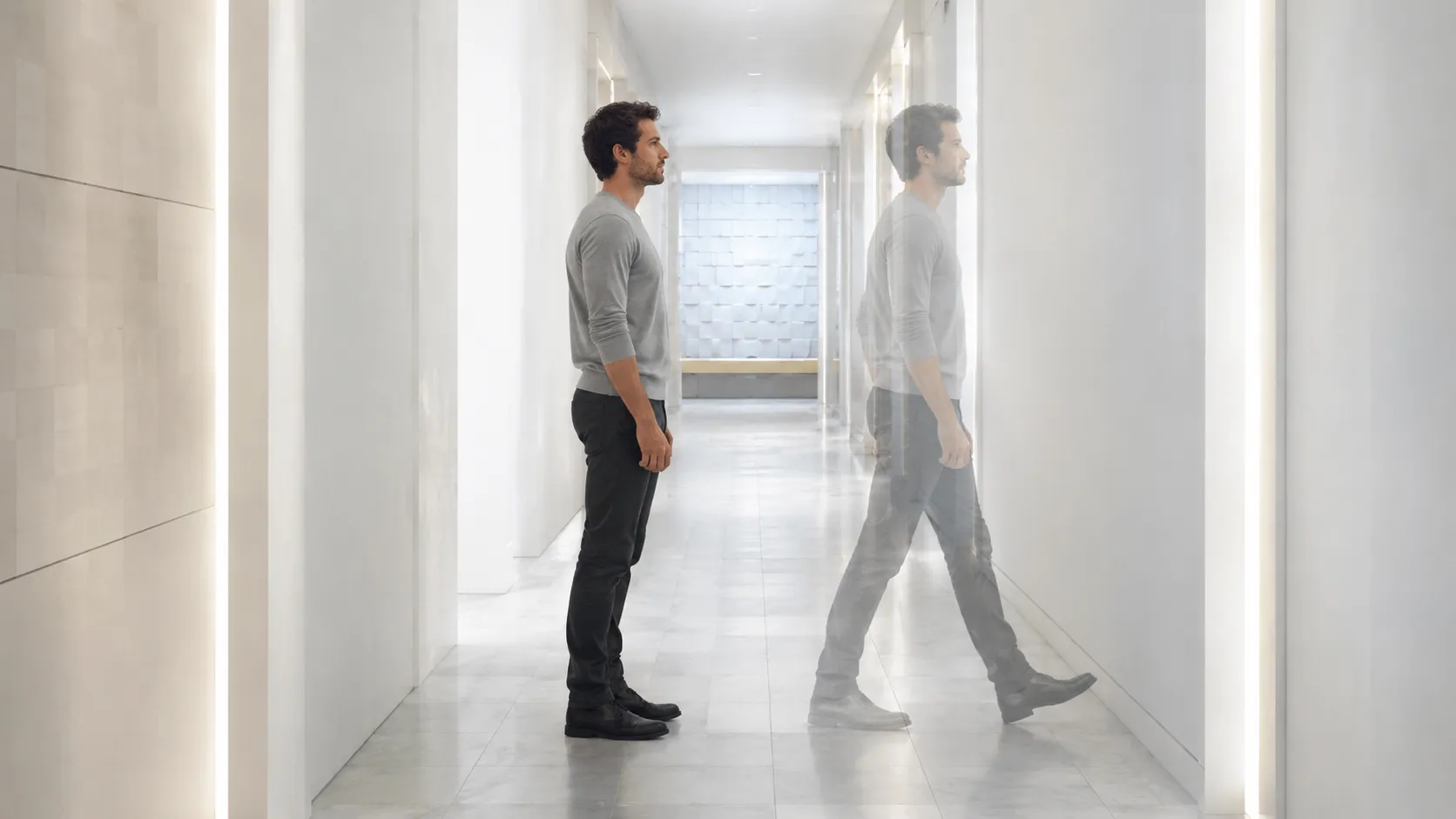
A simplified map of the memory systems involved in déjà vu, showing how a mismatch between familiarity and recollection produces the sensation.
Temporal lobe
The brain region most associated with memory processing and familiarity. Temporal lobe activity is strongly linked to déjà vu episodes, including those triggered artificially during neurosurgery.
Rhinal cortex
A structure within the temporal lobe that processes familiarity signals independently of detailed memory retrieval. When it activates without the hippocampus confirming a specific memory, the mismatch may produce déjà vu.
Hippocampus
The brain's primary memory-formation structure. It handles recollection, the detailed 'when, where, and what' of a memory. In déjà vu, familiarity fires but hippocampal recollection fails to provide a matching memory.
Frontal lobe
Recent research suggests the frontal lobe may play a role in detecting the conflict between familiarity and recollection, which is why you simultaneously feel certain something has happened before and aware that it cannot have.
What it actually is
What Exactly Is Déjà Vu?
The phrase 'déjà vu' comes from French and means simply 'already seen.' It was coined by the French philosopher and psychical researcher Émile Boirac in 1876, though people had been describing the experience long before anyone had a name for it.
What happens during déjà vu is genuinely strange. You are somewhere new, doing something ordinary, and then without warning a wave of recognition sweeps over you. This moment, this specific scene, this exact conversation: you feel certain you have experienced it before. The conviction is strong, immediate, and oddly emotional.
What makes it stranger is the awareness that runs alongside it. You simultaneously know the experience is impossible. You have never been to this place before. This conversation cannot have happened. And yet the feeling of familiarity does not waver. You are holding two contradictory certainties at once, and your brain is not sure what to do with either of them.
The sensation typically lasts only a few seconds, rarely more than a minute. It fades as quickly as it appeared, leaving behind a vague unease and the slightly unsettling memory of having felt momentarily certain about something that turned out to be wrong.
What it feels like
What Does Déjà Vu Feel Like?
People struggle to describe déjà vu accurately because the experience sits just outside ordinary language. The closest most people get is: it feels like a memory of something that never happened.
The sensation typically begins with sudden, unexpected familiarity. A room you have never entered feels known. A stranger's words feel like something you have heard before. A view you are seeing for the first time feels like a view you have always known.
Many people also report a feeling of temporal displacement, a sense that the present moment is somehow slipping into the past as it happens. Some describe it as watching a film you have seen before, where you feel on the edge of knowing what happens next. This feeling of predicting what comes next is itself part of déjà vu, and it is one of the reasons the experience feels so convincing. The sense that you know how the next few seconds will unfold amplifies the impression that you have been here before.
Then it ends. The familiarity dissolves. The moment becomes ordinary again. The only thing that remains is the memory of having briefly felt something you cannot quite explain.
The memory mismatch theory
Theory 1: Your Memory System Gets Confused
The leading scientific explanation for déjà vu involves a distinction most people have never considered: the difference between familiarity and recollection.
These are two separate processes in the brain. Recollection is explicit memory: remembering where you were, what you were doing, who was there, and when it happened. Familiarity is something different and more basic: a feeling of recognition without the supporting details. You might feel certain you have met someone before without being able to remember when or where. That is familiarity operating without recollection.
Normally these two systems work together. Familiarity provides a quick recognition signal, and recollection fills in the context. When they align, you remember something. When familiarity fires but recollection finds nothing to match it, you get the unsettling sensation that something is recognised but cannot be placed.
The theory, developed most fully by researcher Akira O'Connor and colleagues, suggests that déjà vu happens when the familiarity system activates inappropriately for a genuinely new experience. The brain sends a recognition signal for something it has never actually encountered. Recollection searches for a matching memory, finds nothing, and the conflict between those two signals is what you experience as déjà vu.
A useful analogy: imagine your brain has a 'known' stamp it applies to things it recognises. Normally it only uses the stamp on genuinely familiar things. In déjà vu, the stamp gets applied to something new by mistake, and the rest of your brain spends a few confused seconds trying to find the file that should correspond to it.
The delayed processing theory
Theory 2: Information Takes Two Paths to Your Brain
A second theory focuses on the timing of how sensory information reaches conscious awareness.
Sensory signals do not all travel to the brain at exactly the same speed or through exactly the same pathways. Under normal conditions, the tiny differences in arrival time are smoothed out, and you experience the world as a seamless continuous present.
The delayed processing theory suggests that sometimes a signal is briefly split or delayed, arriving at conscious awareness twice in rapid succession. The first arrival is processed without reaching full awareness. The second arrival, milliseconds later, reaches conscious awareness, but the brain detects that the information has already been processed once and interprets that as a prior experience.
The result would be a sensation that the current moment had already happened, even though both arrivals occurred within the same fraction of a second.
This theory has attracted less research support than the memory mismatch model, and it is harder to test directly. But it offers an intuitive explanation for why déjà vu can feel so instantaneous and why the familiar moment and the present moment seem to overlap so precisely.
The forgotten memory theory
Theory 3: A Forgotten Memory Is Being Triggered
A third explanation is more straightforward but no less interesting: you actually have encountered something similar before, and your brain is recognising the pattern without being able to retrieve the specific memory.
Memory is associative. The brain does not store experiences like files in a folder. It stores them as networks of associated details: the light in a room, the angle of a staircase, the particular quality of silence in an unfamiliar building. When you encounter a new place that shares enough of these features with somewhere you have been before, your brain can trigger a recognition response even though the two places are different and the original memory is inaccessible.
You may have walked through a hotel lobby once, briefly, years ago, without consciously registering it. The layout, the proportions, the quality of the light are stored somewhere in your memory. Years later, you walk into a completely different hotel lobby with similar architecture, and the match is close enough to trigger familiarity without providing a retrievable memory.
This theory is supported by research showing that déjà vu can be deliberately induced in laboratory settings by presenting people with scenes that share structural features with previously seen images, even when the images themselves are unrecognised. The familiarity is real. The specific memory behind it simply cannot be found.
Which part of the brain
Which Part of the Brain Creates Déjà Vu?
The brain region most consistently linked to déjà vu is the temporal lobe, a large area on each side of the brain roughly behind the temples. The temporal lobe is heavily involved in memory processing, language, and the recognition of familiar things.
Within the temporal lobe, two structures are particularly relevant. The rhinal cortex handles familiarity signals. When you encounter something recognised, the rhinal cortex generates a recognition response before the hippocampus has retrieved any specific memory. The hippocampus itself handles detailed recollection: the explicit memories of when, where, and with whom.
The connection to déjà vu became clear through an unexpected source: patients with temporal lobe epilepsy. A significant proportion of people with this condition experience déjà vu as part of their seizure activity, often in the seconds immediately before a seizure begins. Neurosurgeons operating on these patients found that electrically stimulating the rhinal cortex and temporal lobe could trigger déjà vu-like sensations in conscious patients on the operating table.
More recent research by Akira O'Connor at the University of St Andrews used functional MRI scanning to observe the brain during déjà vu in healthy subjects. The scans showed activity not just in memory regions but also in frontal areas associated with decision-making and conflict detection. This suggests that during déjà vu, the brain is not simply misfiring. It is actually checking its own work, detecting that the familiarity signal does not match any retrievable memory, and flagging the conflict. The awareness that something is wrong may be the frontal lobe doing its job.
Why it peaks in youth
Why Is Déjà Vu More Common in Young People?
Research consistently finds that déjà vu is reported most frequently by people in their teens and twenties, and that frequency decreases gradually through middle age and beyond.
Several explanations have been proposed. One focuses on the sheer volume of new experiences young people encounter. Adolescence and early adulthood are periods of rapid environmental change, new schools, new cities, new social circles, more travel, more novelty. The more new experiences the brain processes, the more opportunities there are for the familiarity and recollection systems to misfire.
Another explanation involves brain development. The neural circuits governing memory are still maturing through the teenage years. A brain whose memory systems are newer and less practised may be more prone to the kind of mismatch that produces déjà vu.
A more prosaic explanation is simply reporting bias: young people may pay more attention to unusual mental experiences and be more likely to discuss and recall them.
Interestingly, frequent déjà vu in older adults can sometimes be a symptom worth investigating. When déjà vu increases in frequency in middle age or later life, it occasionally signals temporal lobe activity worth medical review, particularly if accompanied by confusion or other unusual sensory experiences. This is not a reason to worry about occasional déjà vu at any age, but it is one reason researchers track it.
Myth: predicts the future
Myth vs Reality: Déjà Vu Predicts the Future
What people think
Déjà vu is a premonition or a glimpse of future events
Many people report that during déjà vu they feel they know exactly what will happen in the next few seconds. This feels like prediction, and some interpret it as evidence of psychic ability or foreknowledge.
What actually happens
The feeling of prediction is part of the sensation, not a genuine predictive signal
Studies have tested whether people experiencing déjà vu can actually predict what happens next at rates better than chance. They cannot. The feeling of knowing what comes next is itself generated by the same misfiring familiarity system that creates the rest of the experience. It is the brain generating a sense of recognition for a moment it has not actually seen, and that recognition can include an expectation of continuity. The prediction feels real. It is not.
Myth: evidence of past lives
Myth vs Reality: Déjà Vu Proves Past Lives
What people think
Déjà vu is a memory surfacing from a previous life
The conviction that a new place or situation has been experienced before feels too strong to be a brain error. Some people interpret this as evidence that they have lived before and are recognising something from a prior existence.
What actually happens
The conviction is generated by a misfiring familiarity signal, not a genuine prior memory
The intensity of the feeling during déjà vu comes from the same neurological mechanism that makes real recognition feel convincing. The brain has no reliable way to distinguish between a genuine memory signal and a false one while the signal is active. This is precisely what makes déjà vu feel so real. There is no scientific evidence that déjà vu represents memory from previous lives, though beliefs about past lives remain a matter of personal and spiritual conviction beyond the scope of neuroscience to address.
Myth: you are on the right path
Myth vs Reality: Déjà Vu Means You Are on the Right Path
What people think
Experiencing déjà vu is a sign from the universe that you are exactly where you are supposed to be
A popular spiritual interpretation treats déjà vu as a confirmation signal, a meaningful sign that current choices or directions are aligned with some larger purpose.
What actually happens
Déjà vu is a neurological event with no known connection to life choices or outcomes
The sensation occurs randomly and is not triggered by the significance of the moment. People experience déjà vu during completely mundane situations: standing in a supermarket, waiting for a bus, watching unremarkable television. The intensity of the feeling can make it feel meaningful. The feeling of meaningfulness is itself part of the experience, not evidence of external significance.
Myth: fully understood
Myth vs Reality: Scientists Fully Understand Déjà Vu
What people think
Déjà vu has been explained by neuroscience and is no longer mysterious
With brain scanning technology and decades of research, the assumption is that neuroscience must have resolved what déjà vu is and why it happens.
What actually happens
The exact mechanism remains actively debated among researchers
There are strong theories and genuine evidence pointing to the role of the temporal lobe, the rhinal cortex, and the mismatch between familiarity and recollection. But no single explanation has been proven beyond dispute. Déjà vu is difficult to study because it cannot be reliably induced in ordinary subjects, lasts only seconds, and is subjective. It remains one of the more genuinely open questions in memory research.
Creating it in a lab
Can Scientists Create Déjà Vu in a Laboratory?
The answer is: sometimes, partially, and in unusual circumstances.
The most direct evidence comes from neurosurgery. Wilder Penfield, a pioneering Canadian neurosurgeon working in the 1950s, discovered that electrically stimulating the temporal lobe in conscious patients during brain surgery could trigger vivid experiential responses, including sensations of familiarity and the feeling of reliving past experiences. Some patients described what sounded unmistakably like déjà vu.
More recent work by neuroscientist Fabrice Bartolomei and colleagues has refined this. Stimulating the rhinal cortex specifically, the region associated with familiarity processing, produces a recognisable déjà vu sensation in some patients. The patients are awake, aware that nothing has actually happened before, and yet report the characteristic feeling of impossible familiarity. The sensation can be switched on and off with the stimulating electrode.
Outside of neurosurgery, researchers have used hypnosis to create a version of the effect. Volunteers are hypnotised and shown specific objects. Under hypnosis, they are given a post-hypnotic suggestion that they will not consciously remember seeing the objects. When shown the objects later in a waking state, some subjects report déjà vu-like familiarity for objects they cannot consciously remember having seen.
Virtual reality research has added another angle. Subjects shown VR environments deliberately structured to share the spatial layout of previously seen environments report increased rates of déjà vu, supporting the forgotten-memory theory.
None of these methods can reliably produce déjà vu on demand in ordinary healthy people. But together they strongly suggest that the sensation is a real neurological event, not a metaphysical one, and that its mechanism is traceable to specific brain structures.
The opposite: jamais vu
The Opposite of Déjà Vu: Jamais Vu
If déjà vu is the uncanny feeling that something new is familiar, jamais vu is its mirror: the unsettling feeling that something familiar has suddenly become strange.
The term comes from French and means 'never seen.' It describes the experience of encountering something you know perfectly well and finding it has temporarily lost all sense of familiarity. A word you have used thousands of times suddenly looks wrong. A room you have lived in for years momentarily seems like a room you have never seen before. Your own face in a mirror, caught at the wrong angle, becomes the face of a stranger.
You can induce a mild form of jamais vu right now. Write your own name repeatedly, thirty or forty times, as fast as you can. At some point, the letters will begin to look wrong. The word will stop resembling a word and become an abstract pattern of shapes. That is semantic satiation, a version of jamais vu caused by overloading a recognition system until it temporarily stops responding.
Jamais vu appears in some neurological conditions, including certain types of epilepsy, and can be a symptom of depersonalisation disorder. In healthy people, it occurs occasionally and briefly, most commonly with words or very familiar environments.
Both déjà vu and jamais vu are failures of the same basic system. In déjà vu, familiarity fires when it should not. In jamais vu, familiarity fails to fire when it should. The same brain machinery, malfunctioning in opposite directions.
The three types
The Three Types of Déjà Vu
Researchers and phenomenologists have distinguished several variants of the déjà vu experience, each with its own French name and slightly different character.
Déjà vécu, meaning 'already lived,' is the most common form and what most people mean when they say déjà vu. It is the sense that an entire ongoing situation, not just a single image but an unfolding scene complete with sounds, smells, and a sense of what will happen next, has been lived through before. The experience involves the full flow of time, not just a snapshot.
Déjà senti, meaning 'already felt,' refers specifically to a feeling or emotion rather than a full scene. You suddenly feel something emotional, a specific quality of feeling, that seems deeply familiar, as though you have felt exactly this before. The experience is internal and affective rather than environmental. It is often associated with temporal lobe epilepsy and may pass without any associated visual or situational familiarity.
Déjà visité, meaning 'already visited,' involves spatial familiarity with an unfamiliar place. You arrive somewhere you have never been and feel with conviction that you know the layout, that you know what is around the corner or through the door. Unlike déjà vécu, it is specifically geographical. The writer Nathaniel Hawthorne described this experience in the 19th century, wondering how he could feel so familiar with English landscapes he had never seen.
Is frequent déjà vu normal?
Is It Normal to Get Déjà Vu a Lot?
Occasional déjà vu is normal and common. Surveys suggest between 60 and 70 percent of people report experiencing it at some point, and for most people it is an infrequent, brief, and harmless phenomenon.
Frequent déjà vu in young people is also well within the normal range. Teenagers and people in their twenties report the highest rates, and several episodes a month is not considered clinically remarkable in this age group.
What is worth noting is when déjà vu becomes significantly more frequent, more prolonged, or more distressing than usual. In rare cases, persistent déjà vu can be associated with temporal lobe epilepsy, certain anxiety disorders, or the early stages of some neurological conditions. People with temporal lobe epilepsy often experience déjà vu as an aura in the seconds before a seizure.
The practical guidance is this: occasional, brief déjà vu that leaves you feeling momentarily strange and then passes is almost certainly normal. If you find yourself experiencing prolonged episodes, very frequent recurrences, or déjà vu accompanied by confusion, blackouts, or other unusual sensory experiences, it is worth mentioning to a doctor. Not as cause for alarm, but as useful information about how your brain is functioning.
Déjà vu vs jamais vu
Déjà Vu vs Jamais Vu: The Same System, Opposite Failures
Meaning
Déjà vu: 'already seen.' Jamais vu: 'never seen.'
What happens
Déjà vu: a new experience feels familiar. Jamais vu: a familiar thing temporarily feels unknown.
Brain mechanism
Déjà vu: familiarity fires without a matching memory. Jamais vu: familiarity fails to fire for something genuinely known.
Common triggers
Déjà vu: new places, conversations, situations. Jamais vu: repeated words, familiar rooms seen from unusual angles, certain neurological states.
How to experience jamais vu
Write your own name 30 to 40 times as fast as possible. The word will begin to look strange and unfamiliar. That is semantic satiation, a mild form of jamais vu.
Clinical connection
Both are associated with temporal lobe epilepsy. Both can occur in healthy people as brief, harmless experiences.
Final verdict
The Final Verdict
Why do we get déjà vu? The best current answer is a mismatch: the brain's familiarity system briefly fires for a new experience, generating a recognition signal that the recollection system cannot match with any actual memory. The conflict between those two signals, detected and flagged by the frontal lobe, is what you experience as the sensation.
The temporal lobe is the key structure. The rhinal cortex generates the false familiarity. The hippocampus fails to find a supporting memory. The frontal lobe detects the error, which is why you feel simultaneously certain this has happened before and aware that it cannot have. You are experiencing both the glitch and the brain's attempt to correct it at the same time.
What remains genuinely uncertain is why the mismatch happens in the first place. Is it random neural noise? Pattern-matching that overreaches? Delayed signal processing? The theories are plausible, the evidence is suggestive, but the exact trigger mechanism is still debated.
Déjà vu may be one of the closest things we have to watching the brain briefly confuse the present with the past. For a few seconds, a brand-new moment feels like a memory, revealing just how mysterious the human mind still is. The brain built the most complex object in the known universe and it still occasionally stamps 'already seen' on something it has never encountered before.
Quick answers
Common questions
Why do we get déjà vu? +
The leading explanation is a temporary mismatch between two memory systems. The familiarity system fires a recognition signal for a new experience, but the recollection system cannot find any matching memory. The conflict between those signals, detected by the frontal lobe, is experienced as déjà vu.
What is déjà vu trying to tell you? +
From a neuroscience perspective, nothing specific. Déjà vu is a neurological event caused by a brief mismatch in memory processing, not a meaningful signal or message. The feeling of significance that accompanies it is itself part of the experience, not evidence of external meaning.
What is the real reason for déjà vu? +
The most supported explanation involves the rhinal cortex generating a familiarity signal for a new experience while the hippocampus fails to retrieve any matching memory. The frontal lobe detects the mismatch and generates the awareness that something is both recognised and impossible to remember.
Is it normal to get déjà vu a lot? +
Occasional and even frequent déjà vu in young people is within the normal range. If frequency increases significantly in middle age or later, or if episodes are prolonged and accompanied by confusion or unusual sensations, it is worth discussing with a doctor.
What does déjà vu feel like? +
A sudden, strong sense that a new situation has been experienced before, combined with the awareness that it cannot have been. Many people also feel they know what will happen in the next few seconds. The sensation typically lasts only a few seconds and is difficult to describe precisely.
Is déjà vu good or bad? +
For most people, déjà vu is a harmless and occasionally interesting neurological event. Occasional experiences are normal. Significantly increased frequency, prolonged episodes, or déjà vu accompanied by confusion or blackouts may warrant medical attention.
Can déjà vu predict the future? +
No. The feeling of knowing what will happen next is generated by the same misfiring familiarity system. Studies show that people experiencing déjà vu cannot predict future events at rates better than chance. The predictive feeling is part of the sensation, not a genuine ability.
What is the opposite of déjà vu? +
Jamais vu, meaning 'never seen.' It is the experience of something deeply familiar suddenly feeling unknown or strange. Writing your own name repeatedly until the word starts to look wrong is a mild, self-induced form of jamais vu.
What are the three types of déjà vu? +
Déjà vécu (already lived): the full sense of reliving an ongoing situation. Déjà senti (already felt): a specific emotion or feeling that seems familiar without a situational context. Déjà visité (already visited): the feeling of knowing an unfamiliar place's layout.
Is déjà vu spiritual? +
Many people interpret déjà vu through spiritual frameworks including past lives, parallel universes, or meaningful signs. Neuroscience points to a memory-system mismatch in the temporal lobe as the mechanism. Whether the experience carries spiritual meaning beyond its neurological basis is a matter of personal belief rather than scientific evidence.