Quick Facts
Quick Facts
The 'buboes' were swollen lymph nodes, usually in the groin or armpit, that could grow to the size of an apple.
There were three forms: Bubonic (lymph nodes), Pneumonic (lungs, highly contagious), and Septicemic (blood, almost 100% fatal).
The plague is still around today. A few dozen people catch it in the American Southwest every year from prairie dogs.
The iconic 'plague doctor' masks with beaks were stuffed with herbs, based on the flawed idea that bad air caused the disease.
The Biology
How the Bacteria Won
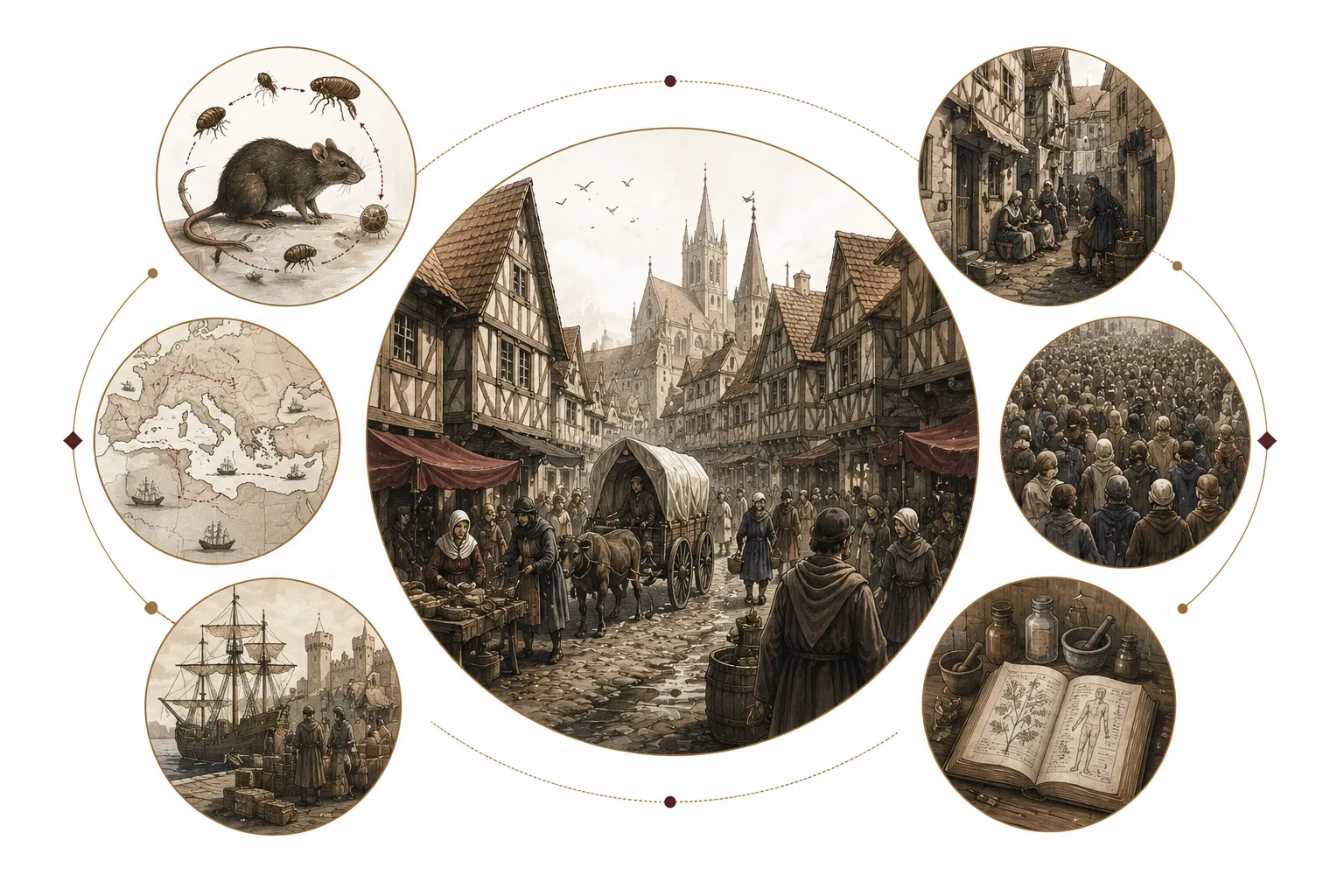
The plague bacteria, *Yersinia pestis*, is a masterclass in sabotage. When it gets into a flea's stomach, it multiplies and forms a sticky clump. This clump blocks the flea's throat. The flea is starving. It desperately bites a rat, or a human, trying to get a meal. Because it can't swallow, the flea's blood mixes with the bacteria in its throat and is vomited back into the bite wound.
It’s essentially a biological syringe. Once inside a human, the bacteria travel to the nearest lymph node. The body's immune system rushes to fight it, but the bacteria are coated in proteins that prevent them from being eaten. Instead, the immune cells just swell up and die, creating the horrific buboes.
Timeline
The Spread
The bacteria spreads along Mongol trade routes in Asia.
1340sIt hitched a ride on the new globalized economy.
Infected rats board Genoese trading ships in Crimea.
1347The ships become floating coffins, arriving in Sicily.
The plague hits France, England, and North Africa.
1348It moves faster than any disease before it.
The worst of the first wave subsides. Europe's population is halved.
1351It fundamentally altered the labor economy and feudal system.
Curiosity Notes
Details Most People Miss
Why this still matters
Why This Still Matters
The plague is a reminder that pandemics are not just medical events; they are civilizational events. A microscopic bacteria can rewrite economies, religions, and borders. It also reminds us that animals, rats and fleas in this case, are the invisible drivers of human history.
Key Findings
- ✓Core findingIt was caused by the *Yersinia pestis* bacteria.
- ✓Strong evidenceFleas acted as biological syringes, vomiting the bacteria into bite wounds.
- ⚠Main consequenceIt caused massive, painful swelling in the lymph nodes called buboes.
- ✓Wider legacyMedieval cities had terrible sanitation, creating a utopia for rats.
- ★Bottom lineIt is still around today, but easily cured by modern antibiotics.
Final insight
A Last Thought
The plague was deadly because it was a perfect biological machine meeting a perfectly vulnerable world. It took a bacterium that turned fleas into vomiting syringes, dropped it into cities piled high with garbage, and watched the fireworks. It was horrible. And it changed everything.
Quick answers
Common questions
Is the plague still around? +
Yes, mostly in parts of Africa, Asia, and the rural US. It is treatable with antibiotics if caught early.
Did the plague doctors actually help? +
No. Their herbs did nothing to stop a bacteria. But the heavy leather coats probably protected them from flea bites.