Quick Facts
Quick Facts
Mercury is the only metal that is naturally liquid at room temperature.
It expands almost perfectly as temperature rises.
It doesn't wet the glass, making readings easy to see.
Many countries now restrict mercury thermometers because of environmental and health concerns.
Visual answer
How mercury shows temperature
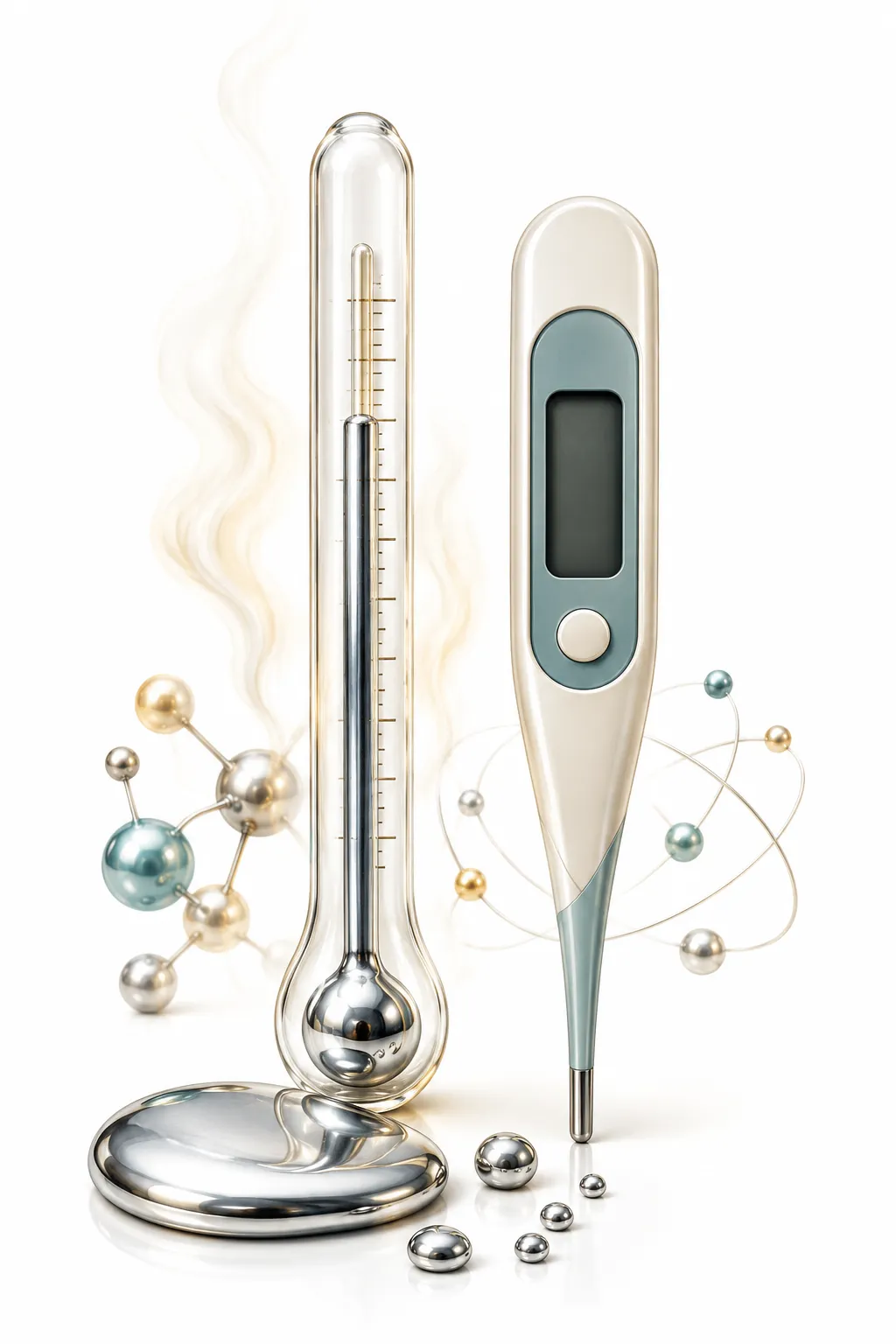
The diagram shows mercury expanding up a narrow glass tube as it warms and contracting as it cools.
Heat enters
Thermal energy moves from the surroundings into the mercury bulb.
Mercury expands
The liquid metal expands predictably when it gets warmer.
Column rises
The narrow tube turns that expansion into an easy-to-read temperature scale.
Why Mercury?
Mercury Behaves Exceptionally Well
A thermometer works only if the liquid inside expands by a predictable amount every time the temperature changes. Mercury does exactly that.
Unlike many liquids, mercury hardly sticks to glass. Instead, it forms a clean, shiny column that rises and falls smoothly.
It also remains liquid through an enormous range of temperatures, making it useful everywhere from freezing winters to boiling laboratories.
The Downside
Excellent Thermometer. Terrible Escape Artist.
Mercury's only serious flaw turned out to be a very serious flaw indeed.
If a thermometer breaks, mercury can evaporate into invisible vapor that is harmful to people and wildlife.
As digital sensors became cheaper and alcohol thermometers improved, there was much less reason to keep using a toxic metal in homes and hospitals.
Analogy
The Brilliant Employee Nobody Can Hire Anymore
The familiar part
Imagine your company has an employee who is unbelievably accurate, never makes mistakes, and works every single daybut accidentally releases poison if the coffee mug falls over.
How it applies
That was mercury. It did its job beautifully, but the risks eventually outweighed the benefits.
Where the analogy breaks
Fortunately, replacement thermometers don't require human resources.
Curiosity Notes
Details Most People Miss
Why this still matters
Why This Still Matters
Although digital thermometers have largely replaced mercury ones, understanding why mercury was once the gold standard explains how science constantly balances accuracy, practicality, and safety.
Key Findings
- ✓Core findingMercury expands very predictably with temperature.
- ✓Strong evidenceIt forms a clear, easy-to-read column inside glass.
- ⚠Main consequenceIt stays liquid across a very wide temperature range.
- ✓Wider legacyIts toxicity is why most mercury thermometers have been replaced.
Final insight
A Last Thought
Mercury spent centuries quietly helping humanity measure one of nature's most important quantities. It was wonderfully reliable, impressively elegant, and just dangerous enough that we eventually decided we'd rather trust tiny electronic chips instead.
Quick answers
Common questions
Do thermometers still use mercury? +
Some specialized laboratory thermometers do, but most medical and household thermometers now use alcohol or electronic sensors.
Why is mercury silver? +
Because it is a metal. Unlike most metals, however, it remains liquid at room temperature.