Visual answer
The Pressure Transformer
How one shape spreads force and the other concentrates it.
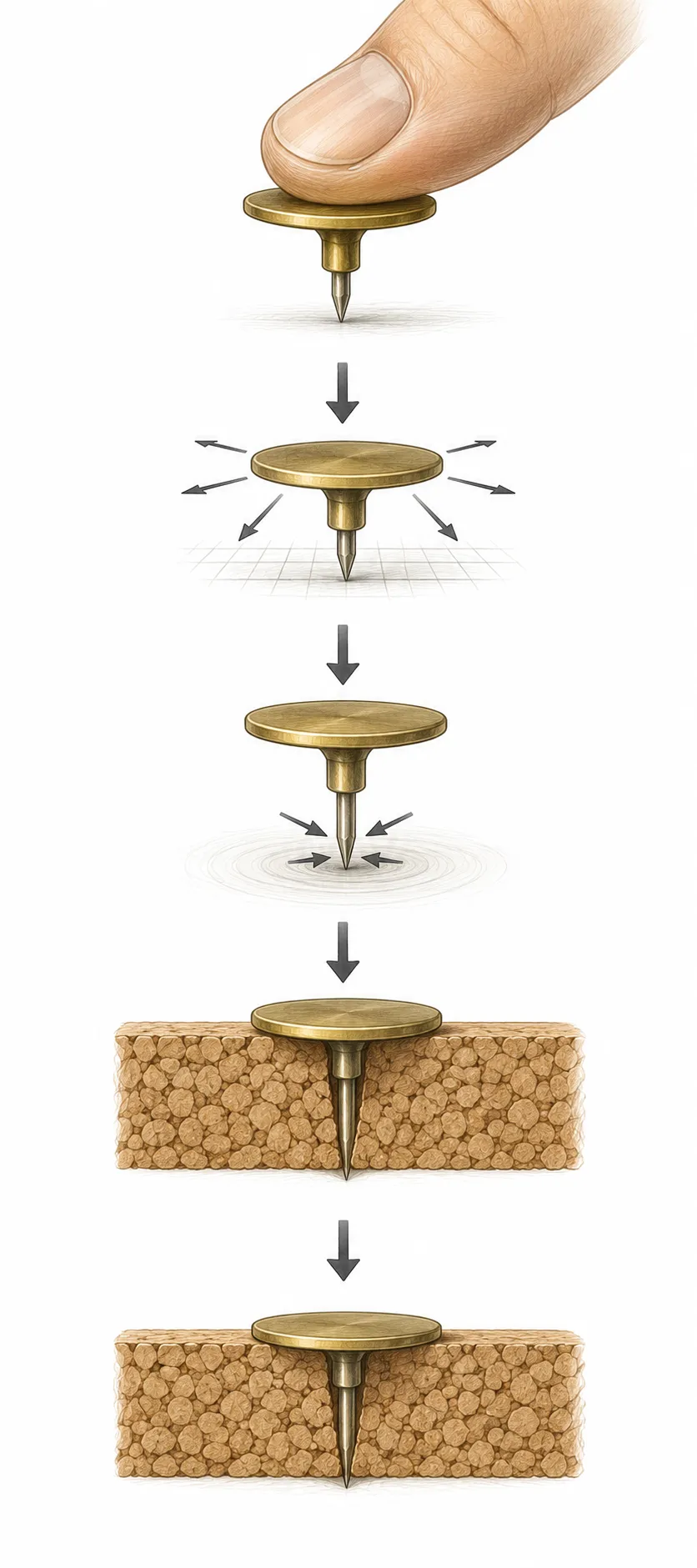
The Force (Input)
Your thumb applies a specific amount of force (e.g., 5 lbs) to the top of the tack.
The Flat Head (Spreader)
The large surface area spreads the force out. Pressure on thumb = Force / Large Area = Low Pain.
The Shaft (Transmitter)
The solid steel shaft transmits the force with minimal loss to the tip.
The Point (Concentrator)
The microscopic tip focuses the force. Pressure on wall = Force / Tiny Area = High Piercing Power.
Where We Stand
An Interface Between Flesh and World
Current state
The thumbtack is a perfect example of a tool that exists purely to bridge a biological limitation. Humans have immense pushing power in our arms and shoulders, but our fingertips are soft, squishy, and packed with pain receptors. The flat head translates mechanical power into puncturing force without triggering biological failure.
What supports this
Before the thumbtack (or push-pin), people used 'drawing pins' or map pins. These often had small, domed heads made of brass. They were sharp, but to push them into hardwood or dense cork, you often needed a small hammer or a thimble to protect your thumb. Edwin Moore's innovation was making the head broad enough to be used with an unprotected thumb.
What could change this
As long as humans have soft thumbs and need to stick things to hard surfaces, the flat-headed tack will remain optimal. Even electric staple guns require you to press a broad button to trigger the mechanism.
The Core Idea
Think of It Like Snowshoes
The familiar part
If you step on deep snow with a regular boot, all your weight concentrates on the sole, and you sink. Put on snowshoes, vastly increasing the surface area, and your weight is spread out. You float on top of the snow.
How it applies
Your thumb pressing against a tiny pinhead is the boot in the snow. The force concentrates, exceeds the pain threshold of your skin, and you 'sink' into agony. The flat head of the thumbtack is the snowshoe. By spreading the exact same pushing force over a larger area, the pressure on your thumb drops below the pain threshold. You 'float' safely above the pain, while the sharp end does the dirty work.
Where the analogy breaks
Snowshoes don't pierce the snow; they float. The thumbtack does both simultaneously. It acts as a snowshoe for your thumb and an anti-snowshoe (a concentrator) for the wall. It's a one-way pressure transformer.
The Physics
The Pressure Equation
In physics, Pressure is defined as Force divided by Area ($P = F/A$). This is perhaps the most practical equation in all of mechanics.
Let's say you push with 5 pounds of force. If the head of the pin is the size of a pinhole (say, 1 square millimeter), the pressure is 5 pounds per square millimeter. That will easily break your skin. But if the head is a flat disc 10 millimeters wide (roughly 80 square millimeters), the pressure drops to 0.06 pounds per square millimeter. Your thumb easily handles that.
Meanwhile, at the other end of the tack, the point might be 0.01 square millimeters. That same 5 pounds of force is now concentrated into 500 pounds of pressure per square millimeter. That is enough to forcibly separate the fibers of cork, wood, or drywall, pushing them aside.
The Evidence
The Math of the Push
Increasing the head's surface area decreases pressure on the thumb.
StrongDecreasing the point's surface area increases pressure on the board.
StrongThe flat head makes the tack easier to grip and pull out.
ModerateThe flat head is just to make it look bigger so you don't lose it.
WeakThe Big Myth
The Most Common Misconception
What people think
"You need a flat head so you can pull it out with your fingers."
While true that it helps with removal, people often think that's its primary purpose.
What actually happens
Removal is a bonus; pushing is the necessity
If pushing weren't an issue, we could use a tiny hook or loop to pull it out. But if the head were too small to push safely, you'd never get it into the wall in the first place. The flat head's primary evolutionary reason for existing is to protect your flesh during the insertion phase. The ease of removal is a happy byproduct of that geometry.
What If It's True?
What If We Didn't Have Flat Heads?
Imagine this
Imagine a world where every time you wanted to hang a flyer, you had to find a thimble or a small hammer to drive a tiny, headless pin into the corkboard.
What would happen
The casual, spontaneous act of pinning a note to a board would vanish. It would become a minor construction project. The flat-headed thumbtack democratized fastening. It removed the need for a tool, putting the power to modify your environment directly into your thumb.
Why this matters
It is a rare piece of hardware that puts the comfort of the user above the requirements of the job. The wall doesn't care what shape the head is. The thumbtack's flat top is a pure concession to human fragility.
Final insight
A Concession to Softness
The universe is full of hard surfaces that resist us. The thumbtack is a tiny truce between our soft, biological bodies and the unyielding walls of our environment. It absorbs our violence and translates it into order, asking only for a flat piece of metal to protect your skin in the process.
Quick answers
Common questions
Is a thumbtack the same as a push pin? +
The terms are often used interchangeably today. Historically, 'push pins' (like Moore's) often had a distinct handle or larger head, while 'thumbtacks' referred to the flat, disc-headed metal variety. Functionally, they rely on the same physics.
Why do some thumbtacks have colorful plastic heads? +
Plastic is even softer than metal against the skin, further reducing perceived pressure and discomfort during pushing. The colors also make them highly visible on a crowded corkboard.
Why do thumbtacks sometimes bend when you push them? +
If the material you are pushing into is denser than the tack's steel shaft (like some hardwoods or metals), the force has nowhere to go but sideways, causing the shaft to buckle (compressive failure) rather than pierce the material.