Visual answer
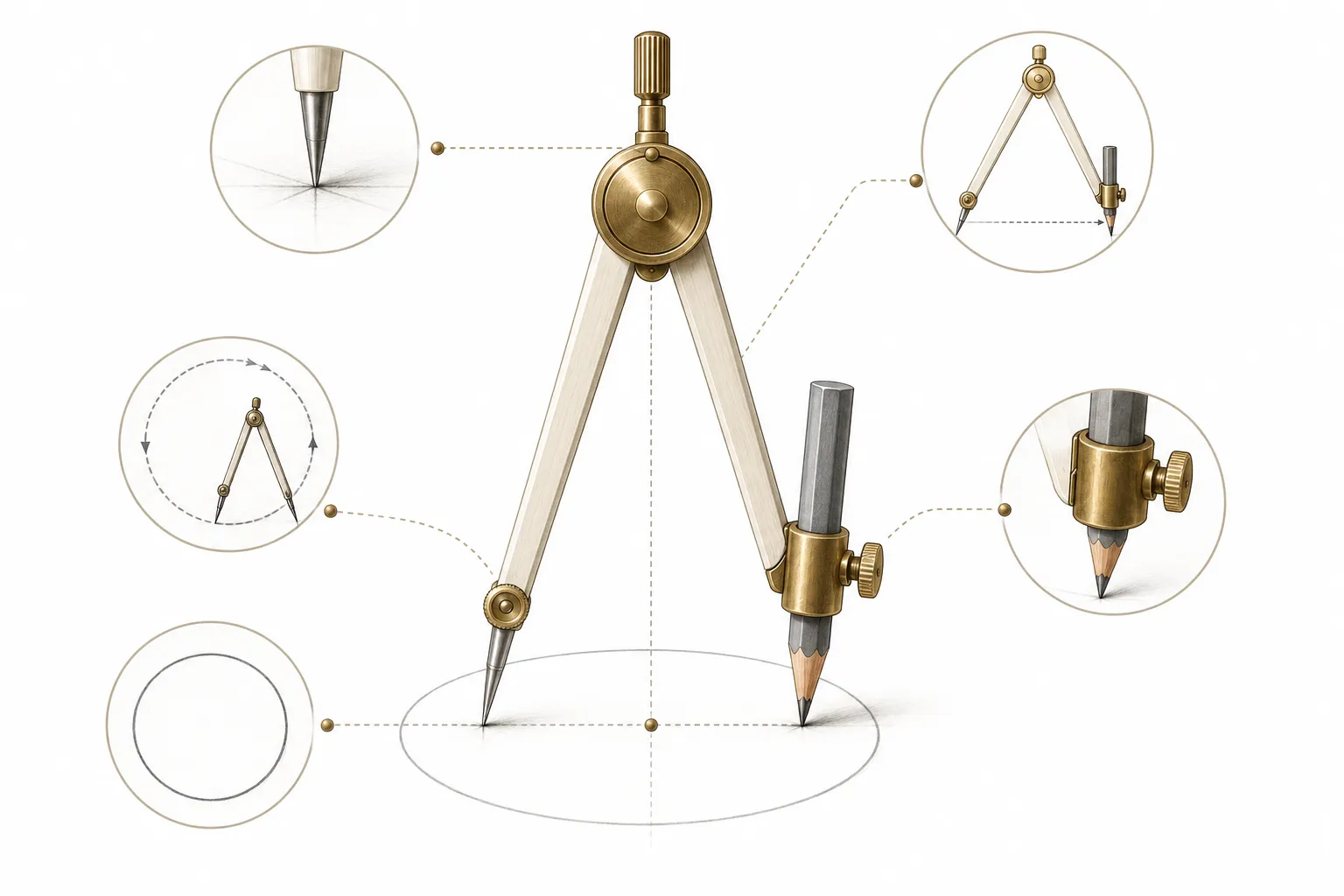
Anatomy of the Radius Lock
How the pencil holder maintains geometric integrity.
The Pivot (Needle)
The fixed center point. Must not move laterally.
The Rigid Arm
Inelastic metal ensures the distance (radius) cannot stretch or shrink.
The Pencil Clamp
Crushes the pencil, preventing it from wobbling, tilting, or slipping independently of the arm.
Constant Radius
The result: a perfect circle where every point is exactly equidistant from the center.
Where We Stand
From Scribing to Drawing
Current state
The pencil-holding compass is the standard for geometry because it bridges the gap between measurement and creation. It allows you to physically manifest an abstract mathematical concept, a set of points equidistant from a center, onto paper.
What supports this
Dividers are still used in metalworking and navigation where the material is too hard for pencil lead, or where a scratch is the desired outcome. But for paper, the pencil compass became dominant during the Renaissance as drafting and engineering required highly visible, reproducible plans.
What could change this
Beam compasses (which use a wooden or metal bar to hold the pencil) are used for massive circles, but for everyday geometry, the hinged metal compass with a pencil holder remains the most portable and accurate tool.
The Core Idea
Think of It Like a Radial Arm Saw
The familiar part
In a radial arm saw, the motor and blade are mounted on an arm that swings in a perfect arc. The pivot point is locked, and the distance from the pivot to the blade dictates the size of the cut.
How it applies
A compass is a miniature radial arm saw for paper. The needle is the locked pivot. The pencil holder is the motor/blade mount. If the pencil were just loosely taped to a stick, as you rotated it, the pencil would wobble, tilt, and change its distance from the center. The rigid metal sleeve of the pencil holder locks the pencil perfectly parallel to the paper, ensuring the radius never changes during the 360-degree rotation.
Where the analogy breaks
A saw cuts through material; a compass just drags graphite. But the mechanical requirement, maintaining a deadly strict tolerance on the distance between the pivot and the cutting/drawing point, is identical.
The Mechanics
The Battle Against Wobble
Drawing a perfect circle is an act of violence against the natural tendency of things to wobble. The hinge at the top of the compass is its weakest point. If there is any slack in that hinge, the pencil arm will shift laterally as you push it around the paper, turning your circle into an ugly, spiraling ellipse.
The pencil holder combats this in two ways. First, it adds mass to the end of the arm, helping to maintain a consistent downward pressure that keeps the needle firmly planted in the paper. Second, the clamp mechanism (usually a tiny screw) crushes the pencil slightly, locking it tightly inside the metal tube so it cannot slip or rotate independently.
By standardizing the pencil holder, manufacturers could also ensure that the pencil tip sat at the exact same vertical height as the needle tip. If the pencil was higher or lower than the pivot, the geometry of the circle would be skewed depending on how hard you pressed.
The Evidence
Why Not Just Tape a Pencil?
The metal sleeve prevents lateral wobble by keeping the pencil rigid.
StrongA pencil leaves a visible, erasable mark, unlike a metal scratch.
StrongThe clamp allows for micro-adjustments to the radius length.
ModerateThe holder is just there so you don't lose the pencil.
WeakThe Big Myth
The Most Common Misconception
What people think
"You could just use a string tied to a pin to draw a circle."
People often point out that a string works just as well, making the compass seem overly complex.
What actually happens
Strings stretch, compasses don't
A string is a terrible way to draw a precise circle. As you pull it around, it stretches elastically. If you pull harder, the circle gets bigger; if you pull softer, it shrinks. And if your hand wobbles, the string absorbs it. A metal compass arm is inelastic. Once set, the radius is physically locked by rigid steel. The compass is a machine; the string is a suggestion.
What If It's True?
What If We Couldn't Draw Perfect Circles?
Imagine this
Imagine a world where we could conceive of a circle mathematically, but had no way to physically draw one accurately.
What would happen
Engineering would stall. Gears, wheels, pipes, and arches all rely on perfect circles. The compass wasn't just a tool for geometry class; it was the fundamental enabling technology of the Industrial Revolution. It allowed an idea in an engineer's head to be perfectly translated into a physical template that a machinist could follow.
Why this matters
The pencil holder turns the compass from an observer of reality into a creator of it. It takes the pure, invisible concept of 'pi' and drags it, kicking and squeaking, onto a piece of paper.
Final insight
The Squeak of Perfection
There is a specific, slightly grating squeak a metal compass makes when it turns. It is the sound of friction, yes, but it is also the sound of imperfection being held at bay. The pencil holder is the unsung hero in that sound, gripping the graphite tight, refusing to let the circle be anything less than perfect.
Quick answers
Common questions
What is the difference between a compass and a divider? +
A divider has two sharp metal points. It is used for measuring distances or scribing lines on materials tougher than paper. A compass has one sharp point (the pivot) and a pencil/lead holder (the scribe).
Why do you sometimes put a separate piece of lead in a compass instead of a pencil? +
Wooden pencils are slightly flexible and vary in diameter. A solid piece of graphite (lead) is rigid and perfectly uniform. For high-precision technical drafting, a lead holder ensures maximum accuracy and a thinner, more consistent line.
Why does the compass needle sometimes slip on the paper? +
If the paper is too glossy, or the needle is dull, the pivot point moves. Drafters often put a tiny piece of sticky tape or a small piece of cardboard under the pivot point to give the needle something firm to bite into.