Visual answer
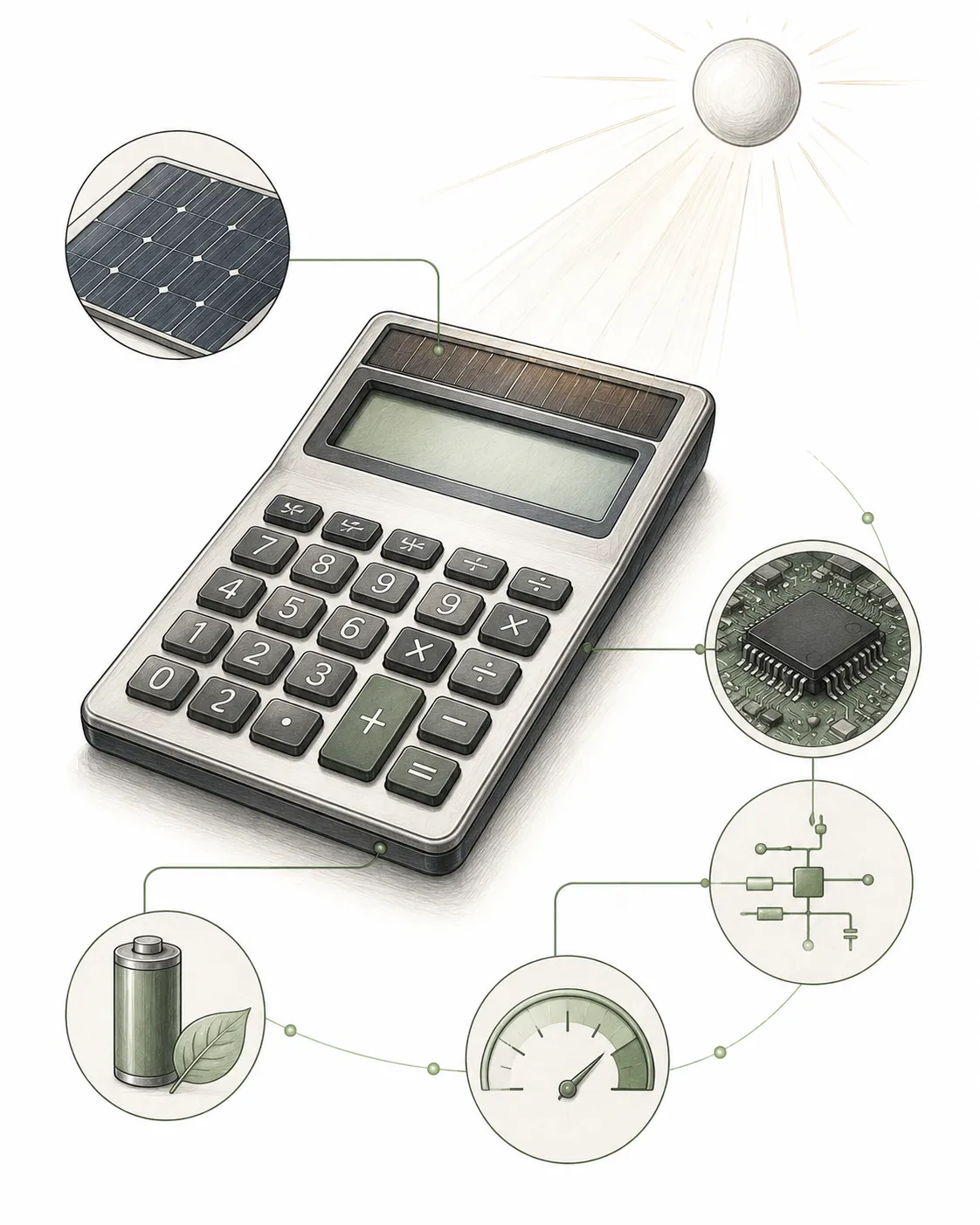
The Direct-Drive Power Loop
How photons become math with no battery in between.
Ambient Photons
Room light (fluorescent or sun) hits the amorphous silicon strip.
Photovoltaic Effect
The solar cells generate a tiny, direct current (DC) trickle of electricity.
Micro-Power CPU
The calculator's chip operates on microamps, running entirely on this real-time trickle.
Zero-Power Display
The LCD twists crystals to show the number, using almost none of the incoming power.
Where We Stand
An Unlikely Marriage of Tech
Current state
The solar-powered calculator is one of the most successful consumer technology integrations in history. It took a power source originally developed for satellites and made it cheap and reliable enough to be given away in cereal boxes.
What supports this
Early solar calculators were expensive novelties. But as manufacturing processes for amorphous silicon improved, the cost of the solar strip plummeted. It eventually became cheaper for companies to print a solar strip on the calculator than to include a battery compartment, a spring, and a battery itself.
What could change this
Only a move away from physical calculators entirely (smartphones, tablets) threatens it. But for standardized testing environments where smart devices are banned, the cheap solar calculator remains an unkillable staple.
The Core Idea
Think of It Like a Hybrid Car Engine
The familiar part
A hybrid car uses a tiny gasoline engine to keep a battery charged, because the electric motor is so efficient it barely needs any fuel to keep the car running.
How it applies
A calculator's brain (the CPU chip) and its face (the LCD screen) are so incredibly energy-efficient that they run on a microscopic trickle of electricity, measured in microamps. A standard LED flashlight might draw 500 milliamps. A calculator draws 0.001 milliamps. Because its 'engine' is so tiny, it can be entirely powered by the faint electrical trickle generated by room light hitting a cheap solar strip. It's the ultimate hyper-miler of electronics.
Where the analogy breaks
Unlike a hybrid car, the calculator has no battery buffer to speak of (in pure solar models). If you cover the panel with your thumb, the calculator dies instantly. It doesn't store the light; it uses it in real-time, directly from photons to math.
The Technology
Amorphous Silicon and the LCD Miracle
You might wonder why your calculator's solar panel is a dark, purplish-brown strip, while rooftop solar panels are shiny blue or black. Calculators use amorphous silicon. It is much less efficient at converting light to electricity than crystalline silicon, but it is incredibly cheap to manufacture. You can literally print it onto glass or plastic in long strips.
Because the calculator needs so little power, 'inefficient' is more than enough. A cloudy day, a fluorescent bulb overhead, or even a bright desk lamp provides sufficient photons to push electrons through the amorphous silicon and power the chip.
The other half of the miracle is the LCD (Liquid Crystal Display). Unlike old LED displays (which glowed red and ate batteries for breakfast), LCDs don't emit light. They just twist tiny crystals to block or allow ambient light to pass through. They use essentially zero power to hold an image. Solar panels and LCD screens were a match made in engineering heaven.
The Evidence
The Power Equation
LCD calculators require so little power that ambient room light is sufficient.
StrongAmorphous silicon solar strips became cheaper than battery compartments.
StrongSolar calculators still need to be in direct sunlight to work.
WeakThe solar panel charges a rechargeable battery inside.
ModerateThe Big Myth
The Most Common Misconception
What people think
"The solar panel charges a battery inside the calculator."
People assume it works like a solar-powered phone charger, storing up energy for later use.
What actually happens
Most run *directly* off the light, with no storage
In a pure solar calculator, there is no battery. The solar cells generate electricity, the chip uses it instantly to do math, and the screen displays it. If you take it into a dark room, it dies immediately. 'Dual-power' calculators *do* have a battery, but the solar panel isn't charging it; it's just powering the calculator when light is available to save the battery from draining.
What If It's True?
What If Everything Used This Little Power?
Imagine this
Imagine if phones, laptops, and televisions were so efficient they could run on the ambient light in your living room.
What would happen
The entire global energy grid would collapse, but in a good way. We wouldn't need power lines, batteries, or charging cables. While we are nowhere near that for complex devices, the solar calculator remains a proof-of-concept that with extreme efficiency, the environment provides all the power you need.
Why this matters
The solar calculator is a quiet reminder that the best way to solve an energy crisis isn't always to generate *more* power, but to demand *less*. It is a tiny, plastic monument to electrical minimalism.
Final insight
Drinking from the Air
There is something profoundly elegant about a machine that does its complex work by sipping the faintest scraps of light bouncing around a room. It doesn't demand a power plant, a wall outlet, or a lithium mine. It just asks for a window, or a lamp, and in return, it gives you the square root of 144.
Quick answers
Common questions
Why do calculators have that weird 'on' button you have to press twice? +
Because LCDs use almost no power to *hold* an image, but use a tiny surge to *change* the image. Pressing 'ON' twice clears the memory and resets the chip, ensuring it starts from a known, low-power state rather than trying to hold onto ghost data in the volatile memory.
What happens if my solar calculator is in the dark? +
If it's a pure solar model, the screen fades instantly and it turns off, losing any unsaved memory (though most just hold the display as long as light hits them). If it's a 'dual-power' model, it seamlessly switches to the backup button cell battery.
Do solar calculators wear out? +
The solar strip itself is solid-state and essentially lasts forever unless physically scratched or cracked. The liquid crystals in the LCD can eventually degrade or leak, and the rubber keypad contacts can oxidize, but the solar panel is usually the most durable part.