Visual answer
Anchoring the Vertex
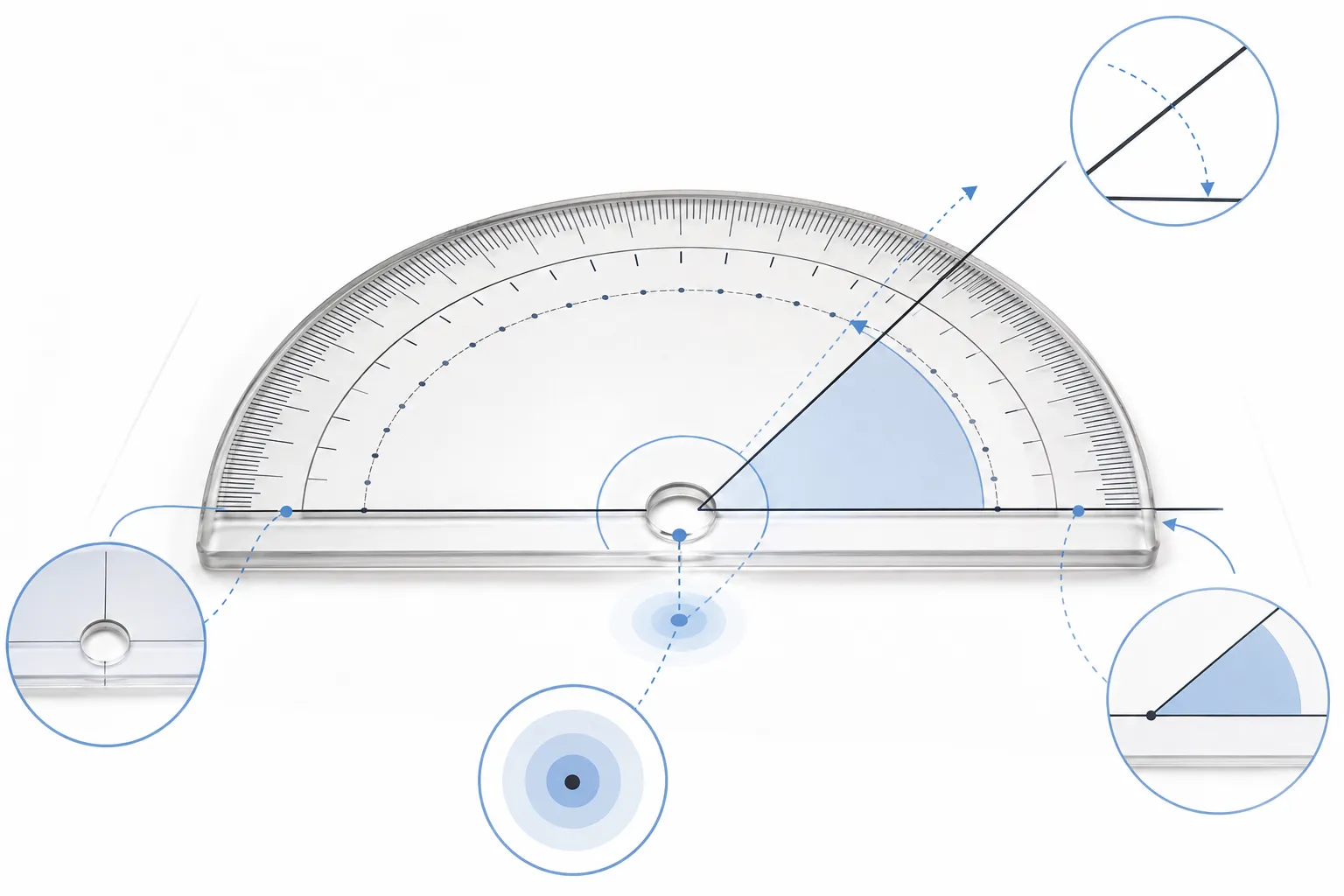
How the hole locks the abstract origin point to the physical paper.
The Vertex
The exact point where the two rays of the angle meet.
The Pin Lock
A pin through the hole eliminates parallax error, locking the origin to the vertex.
The Baseline Alignment
The bottom edge of the protractor aligns with one ray, ensuring zero degrees is the starting point.
Reading the Arc
Because the center is locked, the scale accurately reads the spread of the second ray.
Where We Stand
The Physical Anchor of Abstract Math
Current state
The holed protractor is the universal standard for geometry students. While high-end drafting machines use mechanical arms, the simple plastic protractor relies on this single hole to translate a physical corner into a mathematical degree.
What supports this
Early protractors used for navigation and artillery didn't have a hole; they had a central line or notch, and the user had to carefully align it by eye. The addition of a physical puncture for a pin or pencil tip was a practical improvement that drastically reduced user error in classroom settings.
What could change this
Digital protractors and CAD software have entirely removed the need for physical alignment. However, the tactile act of pinning a center point remains one of the best ways for students to intuitively understand what an angle actually is.
The Core Idea
Think of It Like the Bullseye on a Dartboard
The familiar part
If you throw a dart at a blank circle, you don't know where the center is, so you can't calculate your score accurately. The bullseye gives you a fixed, undeniable target to measure from.
How it applies
An angle is just two rays meeting at a point. To measure how wide those rays have spread, you *must* know exactly where that meeting point is. The hole in the protractor is the bullseye. It physically locks the tool to the vertex. If the protractor slips a fraction of an inch along the paper while you're reading the scale, a 45-degree angle might suddenly read as a 48-degree angle. The hole eliminates the slip.
Where the analogy breaks
A dartboard bullseye is just a visual target. The protractor hole is a mechanical lock. It turns the abstract concept of an 'origin point' into a physical reality you can pin to a desk.
The Geometry
The Terror of Parallax Error
In measurement, there is a demon called 'parallax error.' This happens when the reference point shifts relative to the measuring scale because the tool moved. When measuring an angle, the baseline of the protractor must align perfectly with one ray, and the dead center of the baseline must sit exactly on the vertex.
If you just eyeball it, your pencil lead or your line of sight might be off by a fraction of a millimeter. Over the length of a protractor's arc, that tiny error at the center magnifies into a massive error at the edges. By putting a pin through the hole, you reduce the error at the origin to zero. Whatever the scale reads at the edge is now the true measurement.
Of course, it also doubles as a handy way to hang the protractor on a hook, or snap it into a three-ring binder. But make no mistake: its primary reason for existing is geometric precision.
The Evidence
Centering the Argument
The hole physically locks the protractor's origin to the angle's vertex.
StrongIt drastically reduces parallax error caused by tool slippage.
StrongIt is primarily a cost-saving manufacturing byproduct.
WeakIt's used to draw perfect circles like a compass.
WeakThe Big Myth
The Most Common Misconception
What people think
"The hole is just there so you can hang it up or put it in a binder."
Because it's so convenient for storage, many people assume that's its entire purpose.
What actually happens
Storage is a bonus; precision is the point
If storage were the only goal, the hole could be anywhere, like near the top. But it is placed with microscopic precision at the exact mathematical intersection of the baseline and the perpendicular line rising to the 90-degree mark. It is an engineering feature placed at the most critical coordinate on the tool.
What If It's True?
What If We Removed the Origin Point?
Imagine this
Imagine trying to understand angles without a fixed center. Just two lines floating in space.
What would happen
Geometry would become impossibly abstract, much earlier. The physical act of pinning a tool to a point and watching the degrees spread out is how human brains grasp the concept of rotation. The hole grounds the math in physical reality.
Why this matters
Mathematics can feel like it exists purely in the ether. The hole in the protractor is a reminder that even the most abstract concepts often require a physical anchor to be useful to flawed, fumbling humans.
Final insight
The Pinhole of Reality
A protractor without a hole is just a piece of plastic with numbers on it. The hole is what makes it a machine. It is the exact spot where the perfect, immutable laws of mathematics are forced to intersect with the messy, sliding reality of a wooden desk.
Quick answers
Common questions
Who invented the protractor? +
The concept of measuring angles dates back to ancient astronomers (like Hipparchus) using graduated arcs. The familiar, portable semi-circular protractor for flat geometry was developed and refined in the 17th and 18th centuries for navigation, artillery, and drafting.
What is the little horizontal line at the bottom of a protractor for? +
That is the baseline. You align it perfectly with one of the rays (sides) of your angle. The hole is at the exact center of this baseline, ensuring the rotation is measured from the correct starting position.
Why are protractors usually semi-circles (180 degrees)? +
A straight line is 180 degrees. A semi-circle perfectly captures every possible angle formed by two rays meeting at a point on a flat plane. You can measure angles less than 90, exactly 90, or greater than 90 up to 180 without needing a full circle.