Quick Facts
Quick Facts
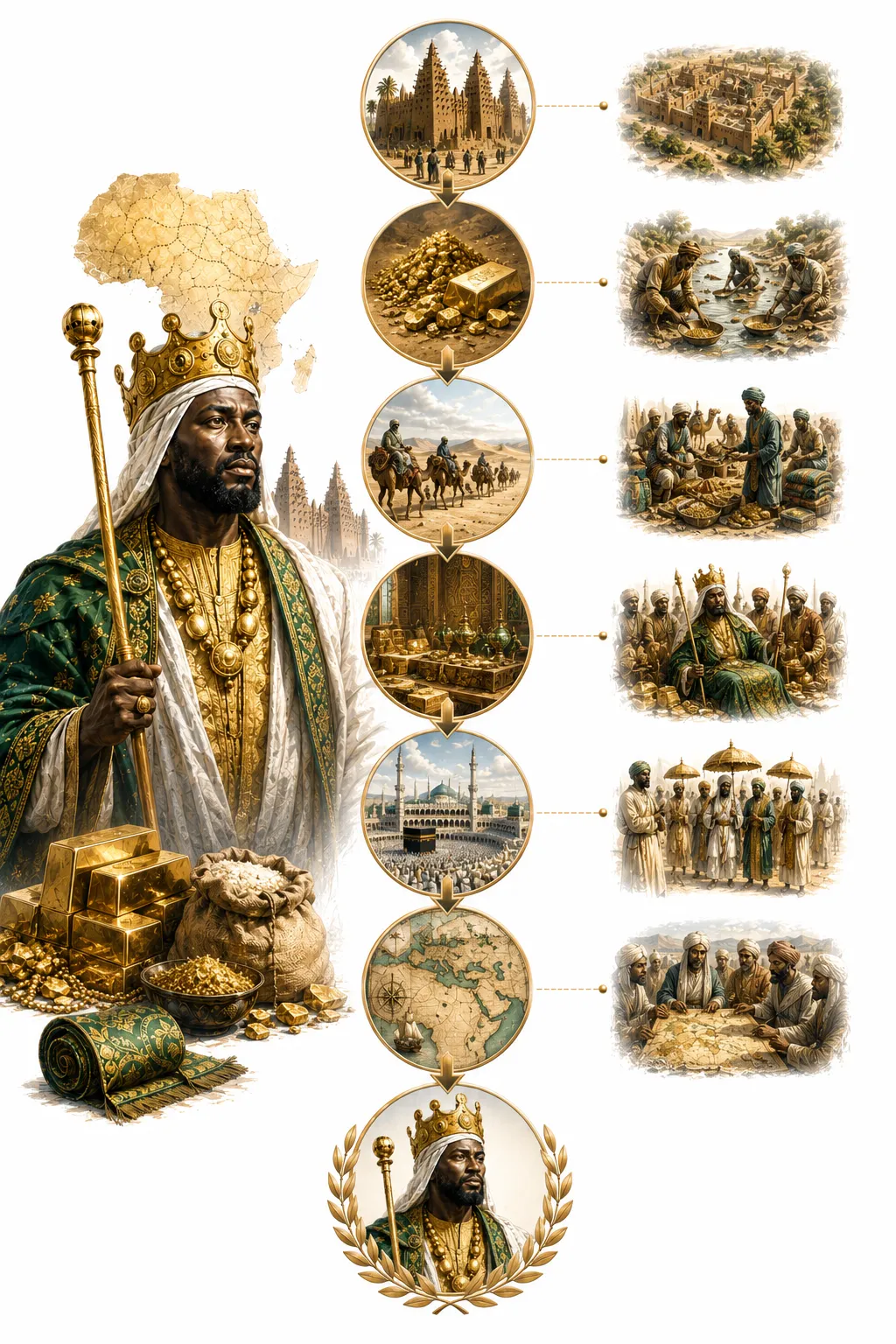
Mali controlled nearly half of the world's gold supply during Musa's reign.
His pilgrimage to Mecca included 60,000 men and 80 camels, each carrying 300 pounds of gold.
He gave away so much gold in Cairo that the value of gold fell by 25% and took a decade to recover.
He built mosques and universities throughout his empire, including the famous University of Timbuktu.
He is depicted on a 14th century European map, the Catalan Atlas, holding a golden nugget.
Visual answer
The Richest Man in History
How Mansa Musa's wealth compared to others.
Mansa Musa's Wealth
Estimated at over $400 billion in modern terms. Some historians argue it is incalculable.
Jeff Bezos (peak)
About $200 billion.
Elon Musk (peak)
About $300 billion.
John D. Rockefeller (adjusted)
About $400 billion.
Mansa Musa's Gold
He controlled nearly half the world's gold supply. His wealth was the global economy.
Story in brief
Story in Brief
c. 1312
Mansa Musa becomes emperor of Mali. The empire already controls vast gold mines.
1324
Musa begins his pilgrimage to Mecca. He travels with 60,000 men and 80 camels carrying gold.
The pilgrimage becomes legendary. Stories of Musa's wealth spread throughout Europe and the Middle East.
1324-1325
Musa visits Cairo. He gives away so much gold that the value of gold crashes. The Egyptian economy suffers for a decade.
1325
Musa returns to Mali. He brings back architects and scholars. He builds mosques and universities.
Timbuktu becomes a center of learning. The University of Timbuktu is one of the oldest in the world.
1375
The Catalan Atlas is published in Spain. It depicts Mansa Musa holding a golden nugget.
Musa is forever remembered as the richest man in history.
The Story
How One Man Broke the Economy with Generosity
In the 14th century, the Mali Empire controlled the world's largest gold mines. Mansa Musa inherited this wealth. He added to it. He built a kingdom that stretched across West Africa. Gold was so common in Mali that it was used for everyday trade. Salt, which was rare, was more valuable than gold.
In 1324, Musa decided to make the hajj, the pilgrimage to Mecca. He traveled in style. He brought 60,000 men, 80 camels, and thousands of pounds of gold. He gave gold to everyone he met. He spent gold like water.
When he reached Cairo, he gave away so much gold that the market collapsed. Gold that had been worth a fortune became almost worthless. The Egyptian economy took a decade to recover. Musa did not seem to notice. He kept giving. He was too rich to care.
From the Catalan Atlas
"This lord is named Musa Mali. He is the richest and most noble king in all the land."
, Catalan Atlas, 1375
The atlas was a world map. Mansa Musa was the only African ruler depicted. He holds a golden nugget. The message was clear: he had more gold than anyone else.
Evidence
Why Musa Is Considered the Richest
He controlled nearly half the world's gold supply.
StrongHis pilgrimage caused a decade-long inflation crisis in Cairo.
StrongHe is depicted on the Catalan Atlas holding a golden nugget.
StrongHis wealth is estimated to exceed $400 billion in modern terms.
ModerateKey Points
Key Points So Far
Mansa Musa controlled the world's largest gold mines.
His pilgrimage to Mecca included 60,000 men and 80 camels carrying gold.
He gave away so much gold in Cairo that the economy collapsed for a decade.
He built mosques and universities, including the University of Timbuktu.
He is depicted on the Catalan Atlas as the richest king in the world.
Analogy
Like a Billionaire Who Breaks the Economy
The familiar part
Imagine a billionaire who walks into a small country and gives everyone a million dollars. The country's currency becomes worthless. The economy collapses.
How it applies
That was Mansa Musa in Cairo. He gave away so much gold that gold became worthless. He did not mean to break the economy. He was just being generous. His generosity was a weapon.
Where the analogy breaks
Billionaires usually do not cause decade-long depressions. Musa did.
Curiosity Notes
Details Most People Miss
Why this still matters
Why This Still Matters
Mansa Musa is still remembered because he represents the pinnacle of wealth. He had more gold than anyone in history. He used it to build an empire, to patronize learning, and to show off. He also crashed an economy by accident. His story is a warning about the power of wealth. Too much money in one place can destabilize everything around it. Even generosity can be destructive.
Key Findings
- ✓Core findingMansa Musa controlled the world's largest gold mines in the 14th century.
- ✓Strong evidenceHis pilgrimage to Mecca included 60,000 men and 80 camels carrying gold.
- ⚠Main consequenceHe gave away so much gold in Cairo that the value of gold crashed for a decade.
- ✓Wider legacyHe built mosques and universities, including the University of Timbuktu.
- ★Bottom lineHe is considered the richest person in history.
Final insight
A Last Thought
Mansa Musa is called the richest man ever because he had more gold than anyone. He also had more generosity than anyone. He gave it away. He crashed economies. He built universities. He is remembered not just for his wealth, but for what he did with it. He was not a miser. He was a spender. And his spending changed the world. That is the difference between rich people and legends. Legends spend. Mansa Musa spent.
Quick answers
Common questions
How much was Mansa Musa worth? +
Estimates vary. Some historians say his wealth was equivalent to over $400 billion in modern terms. Others argue that his wealth is incalculable because he controlled the global supply of gold.
What happened to the Mali Empire after Mansa Musa died? +
It declined. Successors could not maintain the empire. The gold mines were eventually taken over by other powers. The empire collapsed in the 16th century.