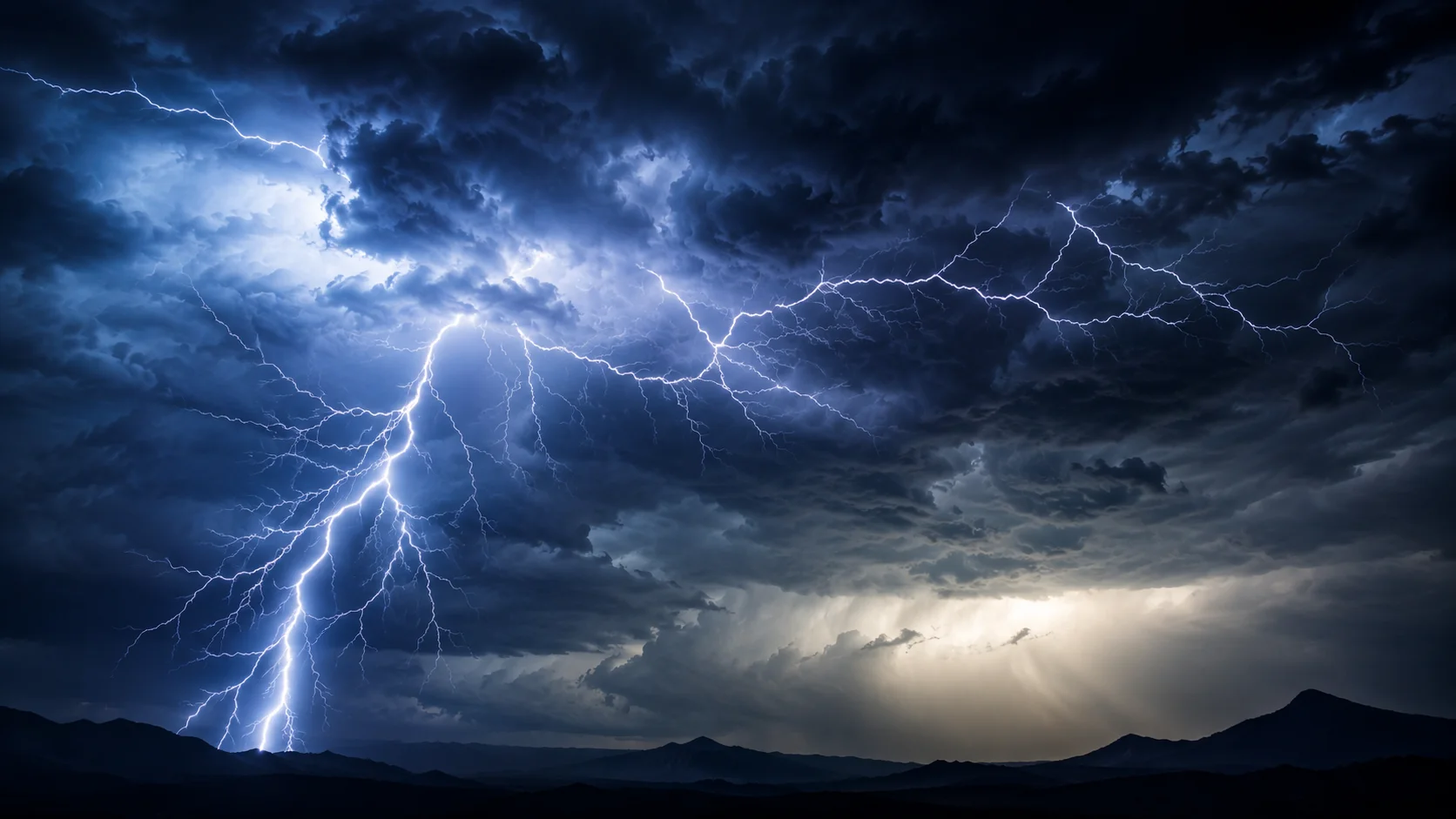
Visual answer
How a Lightning Bolt Forms and Discharges
Lightning involves charge separation, channel formation, and rapid discharge.
Charge separates inside the storm cloud
Collisions between ice crystals and graupel transfer charge in strong updrafts.
Step leaders branch downward invisibly
Ionized air channels propagate downward from the cloud in branching steps.
Upward streamers rise from the ground
Positive charge concentrates at tall objects and sends streamers upward.
The return stroke creates the visible flash
When the channel connects, current surges through it and produces the bright flash.
Charge separation
The Mechanics Inside a Thunderstorm Are Violent
A mature thunderstorm has powerful updrafts. Water droplets, ice crystals, and graupel collide constantly, moving charge around the cloud.
Over time, charge imbalances build up. The negative cloud base also induces positive charge on the ground below, setting up a huge voltage difference.
Not all lightning hits the ground. Intracloud and cloud-to-cloud lightning are common and create much of the diffuse flashing seen inside storms.
Myth vs reality
Myth vs Reality
What people think
Lightning comes from the clouds down to the ground
The invisible step leader moves downward, but the brightest visible stroke travels upward through the completed channel.
What actually happens
The visible flash is largely an upward return stroke
High-speed cameras show the bright return stroke racing from ground to cloud after the channel connects.
Types of lightning
Different Types of Lightning
Cloud-to-ground
Discharge between cloud base and Earth's surface. The most dangerous type for people.
Intracloud
Discharge within a single cloud. Often seen as sheet lightning.
Cloud-to-cloud
Discharge between separate clouds, often visible as horizontal bolts.
Positive lightning
Rarer, more powerful strikes that can originate from the upper storm cloud.
Quick answers
Common questions
Why does lightning strike tall objects more often? +
Tall objects are closer to cloud base and concentrate charge at their tips, making streamer connection more likely.
Is it safe to be under a tree during lightning? +
No. Trees are dangerous shelters because current can jump to people nearby or travel through the ground.
Why does lightning come before thunder? +
Light reaches you almost instantly, while sound travels much more slowly through air.
Can lightning strike from a clear sky? +
Yes. Positive lightning can travel far from a storm before striking, sometimes under apparently clear sky.