Visual answer
The Over-Center Snap
How a slow finger movement becomes a high-speed electrical break.
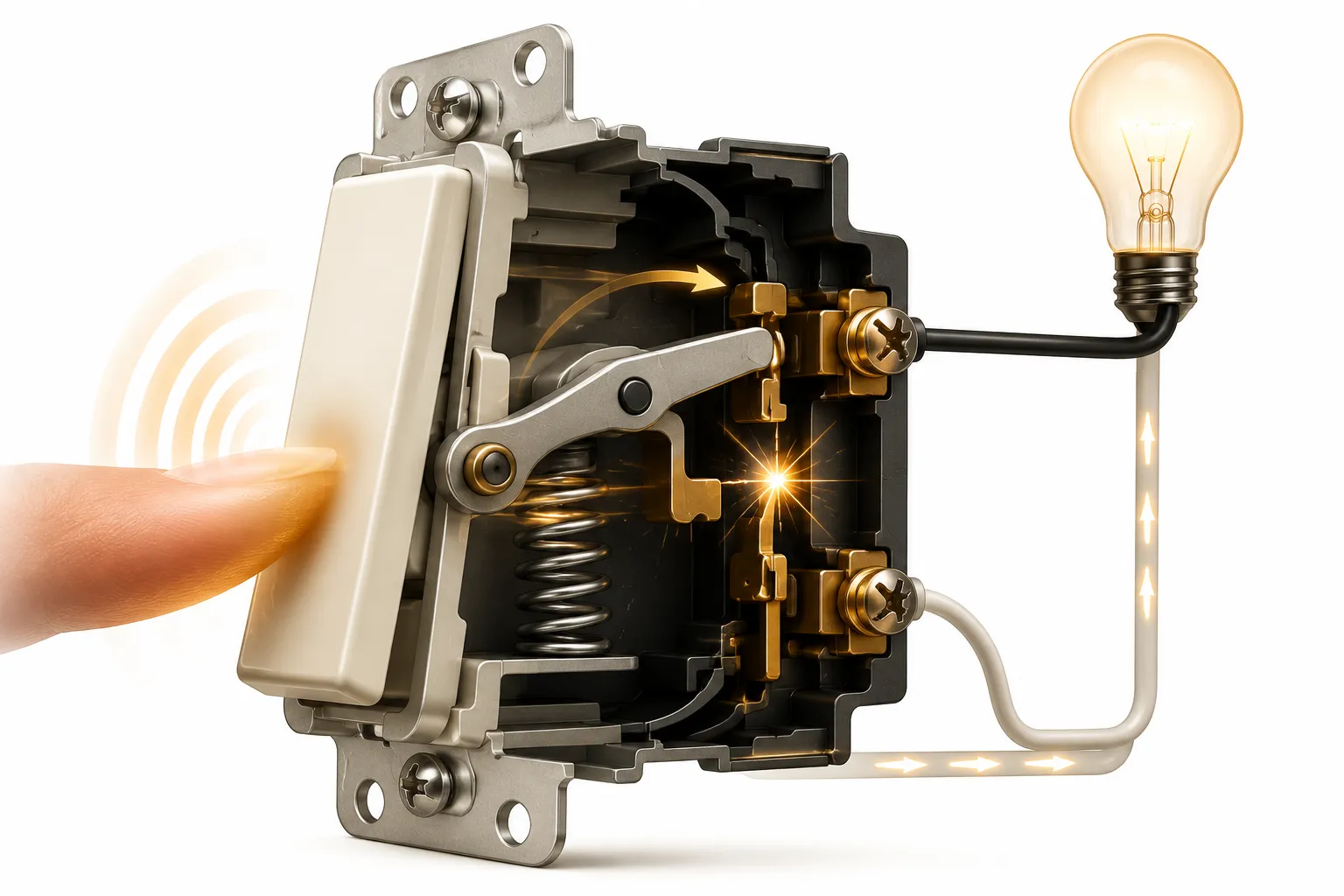
Slow Input
Your finger moves the lever slowly, forcing the spring to flex past its center pivot.
The Tipping Point
The spring passes the 'over-center' point. The physics of the bent metal take over.
The Snap
The spring violently releases, slamming the electrical contacts together (or apart) at high speed.
Arc Extinguished
Because the connection is made so fast, any electrical spark is instantly snuffed out, preventing heat damage.
Where We Stand
A Built-In Safety Valve
Current state
The snap-action switch is a foundational piece of electrical safety. Whether it's a wall toggle, a keyboard key, or a joystick button, the internal mechanism is designed to decouple the speed of your input from the speed of the electrical connection.
What supports this
Early switches were just simple levers that pushed two metal plates together. Because the lever moved slowly, the electricity would jump the gap before the plates fully touched, creating a sustained, hot arc that pitted and destroyed the metal. The snap-action mechanism solved this entirely.
What could change this
Solid-state switches (like transistors or touch sensors) have no moving parts and therefore no click. They are used in smartphones and dimmer switches. But for high-power applications like wall outlets and lights, the mechanical snap-action remains the safest, most reliable method.
The Core Idea
Think of It Like Ripping Off a Band-Aid
The familiar part
If you peel a band-aid off slowly, it hurts the entire time because the adhesive bonds break one by one. If you rip it off fast, the pain is sharp but over in a millisecond, and less total damage is done to the skin.
How it applies
Electricity jumping a gap is like a band-aid being peeled. If the switch contacts come together slowly, the electricity arcs continuously as the gap shrinks, generating sustained heat that melts the metal. The snap-action mechanism rips the band-aid off. It holds the contacts back, building up mechanical tension, and then violently releases them so they smash together (or pull apart) in milliseconds. The arc happens, but it's extinguished almost instantly before it can cause damage.
Where the analogy breaks
Unlike a band-aid, the 'pain' of an electrical arc isn't felt by the switch; it manifests as pitting, oxidation, and eventual failure of the metal contacts. The click is the switch saving its own life.
The Physics
The Over-Center Spring
Inside a standard toggle switch is a piece of spring steel, often shaped like an inverted 'U' or a dome. This spring sits on a pivot point. As you push the lever, you are forcing the spring to flex past its stable center point.
For a brief moment, your finger is fighting the tension of the spring. Then, the spring passes the 'over-center' point. The physics of the bent metal takes over. The spring violently snaps to its new resting position. *Clack.*
This snap happens independently of your finger's speed. You can move the lever as slowly as a snail, but the moment the spring hits the tipping point, the internal contacts will slam together at a fixed, high velocity. This guarantees that every time you use the switch, the connection is made fast enough to prevent a destructive, sustained arc.
The Evidence
The Mechanics of the Clack
Snap-action mechanisms move contacts faster than human input speed.
StrongRapid switching prevents sustained electrical arcing and heat damage.
StrongThe click is purely to give the user auditory feedback.
WeakAll switches click (e.g., dimmer switches, touch screens).
WeakThe Big Myth
The Most Common Misconception
What people think
"The click is just there so you know the light turned on."
Because we rely on the sound to confirm the switch worked, we assume that's why manufacturers built it in.
What actually happens
Feedback is a byproduct; survival is the goal
If audio feedback were the goal, a tiny speaker or buzzer would be much cheaper and more reliable than a heavy-duty spring mechanism. The click is the sound of metal violently snapping under tension. We just learned to use that sound as a convenient mental cue. The switch doesn't click for you; it clicks to stay alive.
What If It's True?
What If Switches Didn't Snap?
Imagine this
Imagine if wall switches operated like a volume slider, slowly bringing the metal contacts together.
What would happen
Every time you turned on a light, a tiny, sustained lightning bolt would dance inside your wall for a fraction of a second. Over months, this would char the contacts. Eventually, the switch would fail, potentially arcing permanently, overheating, and becoming a significant fire hazard. The snap-action click is a fire prevention device disguised as a piece of plastic.
Why this matters
We interact with switches thousands of times in our lives, taking for granted that they don't spark, smoke, or burn us. That reliability is entirely paid for by that tiny, violent, over-center snap.
Final insight
The Sound of Safety
Next time you flip a switch, don't just listen for the light. Listen for the click. It is the sound of a tiny, bent piece of steel throwing itself violently across a gap, sacrificing its own structural integrity for a millisecond to save your house from burning down. It is, perhaps, the most heroic sound in your home.
Quick answers
Common questions
What is electrical arcing? +
When electricity has to jump across a gap (like two metal contacts separating), it ionizes the air, turning it into a glowing plasma. This plasma is extremely hot (thousands of degrees) and can melt metal. It's the same phenomenon as a lightning bolt, just on a much smaller scale.
Why do some switches feel 'mushy' and not click? +
Cheaply made switches, or switches designed for low-voltage DC (like some electronics), might not use a snap-action spring if the current is too low to cause a damaging arc. This results in a 'mushy' feel where you can feel the contacts sliding together.
Do dimmer switches click? +
Standard dimmer switches usually *do* click when turned fully on or off, because they still use a snap-action mechanic to engage the main circuit. But as you rotate the dial to dim, there is no click, because they use a different electronic component (a TRIAC) to slowly chop the electrical wave, which doesn't create the same arcing danger.