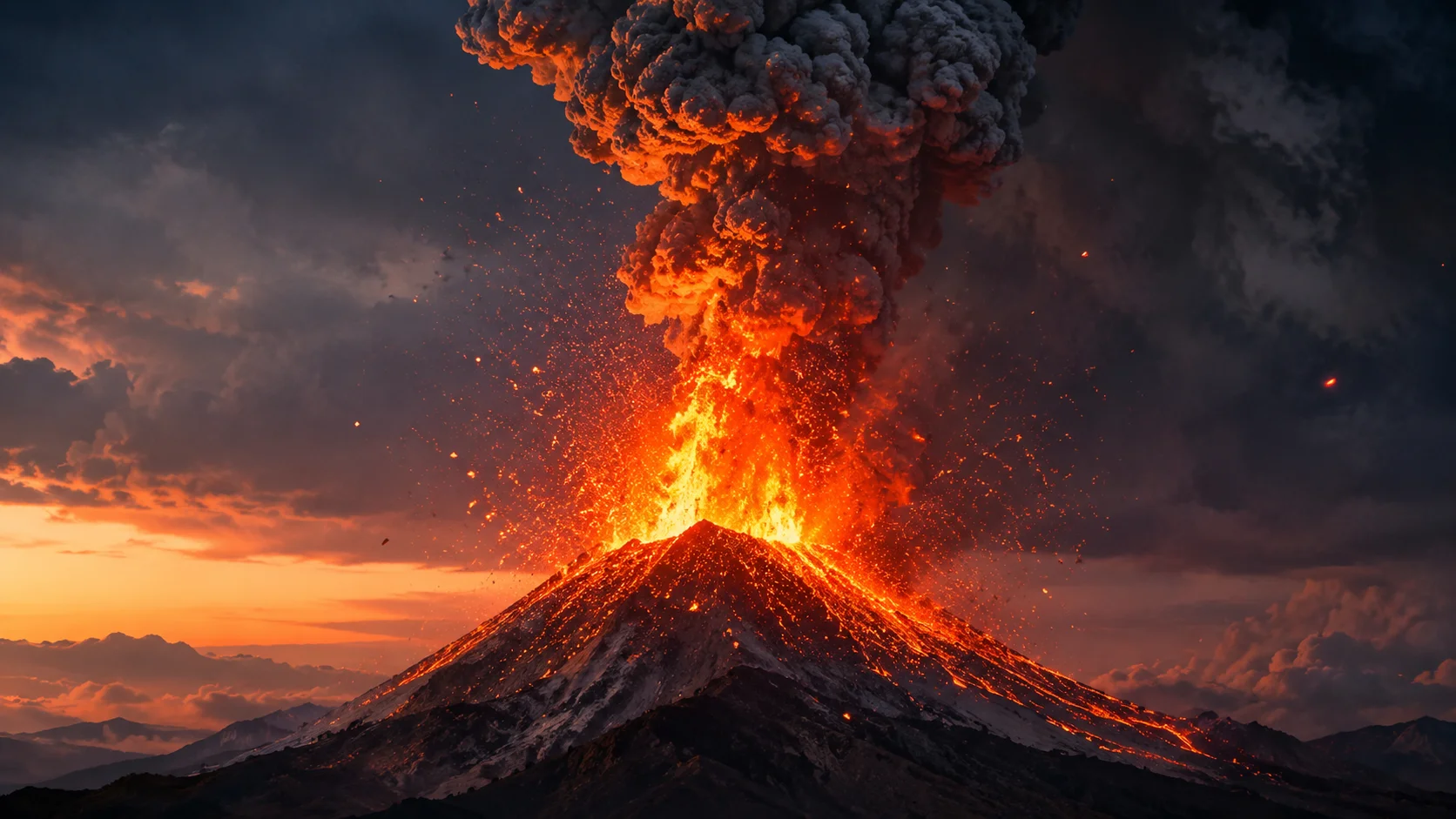
Visual answer
How Magma Forms, Rises, and Erupts at a Volcano
The eruption path is driven by heat, buoyancy, pressure, and gas expansion.
Rock melts in the mantle or lower crust
Melting can happen when pressure drops, water lowers melting point, or unusually hot mantle rises.
Magma collects in a magma chamber
Less dense magma rises and accumulates beneath the volcano.
Pressure opens a path to the surface
Magma breaks through fractures and conduits as chamber pressure builds.
Gas expansion drives the eruption
As pressure drops near the surface, dissolved gases expand and accelerate the magma.
Three causes
Volcanoes Form in Three Geological Situations
At divergent boundaries, plates pull apart and pressure drops on hot mantle rock. That decompression allows partial melting.
At subduction zones, a plate dives into the mantle and releases water, lowering the melting point of nearby rock.
Hotspot volcanoes form over unusually hot mantle plumes, even in the middle of tectonic plates, as in Hawaii.
Myth vs reality
Myth vs Reality
What people think
Volcanoes erupt because Earth's core is melting
The core is not the source of volcanic magma. Magma forms mostly in the mantle and lower crust.
What actually happens
Magma forms when pressure drops or water lowers melting point
The mantle is mostly solid. Specific pressure, temperature, and water conditions allow partial melting.
Eruption types
Explosive Eruptions vs Effusive Eruptions
Magma type
Explosive: high-silica and viscous. Effusive: low-silica and fluid.
Gas behavior
Explosive: gases are trapped. Effusive: gases escape steadily.
Eruption character
Explosive: ash columns and pyroclastic flows. Effusive: lava fountains and flows.
Examples
Explosive: Mount St. Helens and Pinatubo. Effusive: Kilauea and Mauna Loa.
Quick answers
Common questions
What is the difference between magma and lava? +
Magma is molten rock underground. Once it reaches the surface, it is called lava.
Why are some eruptions bigger than others? +
Silica content, trapped gas, magma volume, and storage time all affect eruption size and violence.
Can we predict volcanic eruptions? +
Volcanologists can detect warning signs such as earthquakes, ground swelling, and gas changes, but exact timing remains difficult.
Why does Hawaii have volcanoes in the middle of the ocean? +
Hawaii sits over a mantle hotspot while the Pacific Plate moves over it.