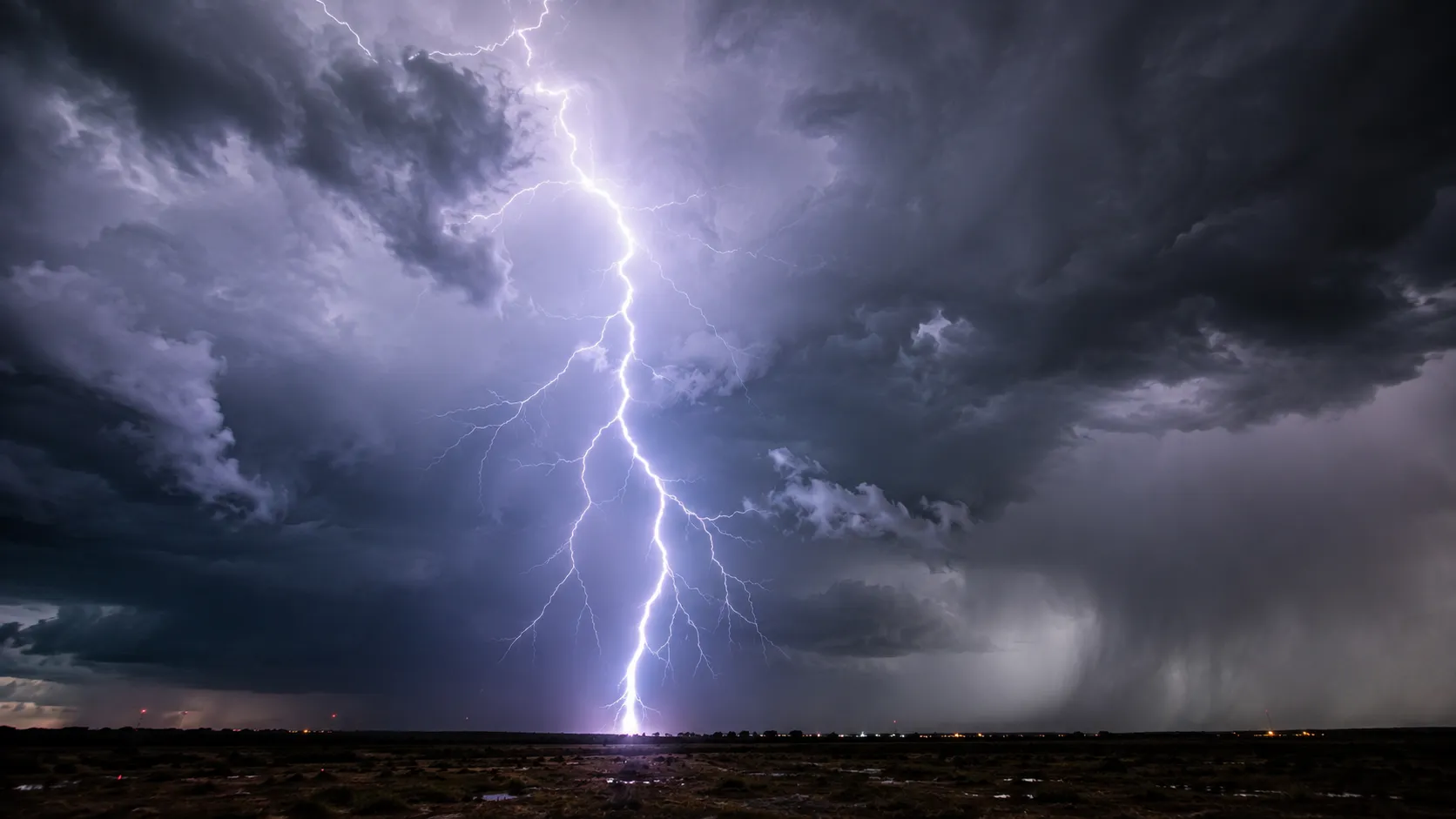
Visual answer
How a lightning bolt forms and travels
A lightning strike involves several steps happening faster than the eye can follow.
Charge separation
Ice crystals and water droplets collide inside the cloud, separating positive and negative charges.
Stepped leader
An invisible channel of ionized air extends down from the cloud in steps toward the ground.
Return stroke
When the leader connects with a rising channel from the ground, a massive current flows. This is the bright flash.
Thunder
The stroke instantly superheats the surrounding air to extreme temperatures. It expands explosively, creating the sound wave.
How charge builds
Why charge builds up in storm clouds
Inside a thunderstorm, ice crystals and water droplets are constantly colliding as they are pushed around by powerful updrafts and downdrafts.
These collisions transfer electric charge. Lighter particles carrying positive charge get carried to the top of the cloud. Heavier negatively charged particles accumulate in the lower part.
The electric field between the bottom of the cloud and the ground below grows stronger until it overcomes the insulating resistance of the air.
Direction myth
Does lightning travel from cloud to ground?
What people think
Lightning shoots down from the cloud to the ground.
That is how it looks to the naked eye.
What actually happens
The bright flash travels upward.
The stepped leader moves downward invisibly. Once it connects with a rising channel from the ground, the powerful return stroke travels upward. The bright flash most people see is the return stroke, moving from ground to cloud.
Types of lightning
Different kinds of lightning
Cloud-to-ground
The most familiar type. About 25 percent of all lightning.
Intracloud
Occurs entirely within a single cloud. The most common type overall.
Cloud-to-cloud
Passes between separate clouds.
Sprites and elves
Rare electrical phenomena above storm systems, reaching into the upper atmosphere.
Why thunder follows
Why thunder always comes after the flash
Light travels about a million times faster than sound. The flash reaches your eyes almost instantly.
The sound of thunder, caused by the rapid expansion of superheated air around the lightning channel, travels at roughly 343 meters per second.
Every 3 seconds between the flash and the thunder equals about 1 kilometer of distance to the strike.
Quick answers
Common questions
What causes lightning? +
Charge separation inside storm clouds builds up until the electric field is strong enough to ionize the air and create a conductive channel.
How hot is lightning? +
The plasma in a lightning bolt reaches around 30,000 Kelvin, roughly five times the surface temperature of the sun.
Can lightning strike the same place twice? +
Yes. Tall structures like the Empire State Building are struck dozens of times per year. Lightning preferentially follows existing ionized channels and conductive paths.
Why does thunder rumble instead of being one sharp crack? +
A lightning channel can be several kilometers long. Thunder from different parts of the channel reaches you at different times, spreading the sound out into a rolling rumble.
Is it safe to be inside during a lightning storm? +
Inside a solid building or a hard-topped vehicle is generally safe. Avoid contact with water, electrical outlets, and corded phones during a storm.