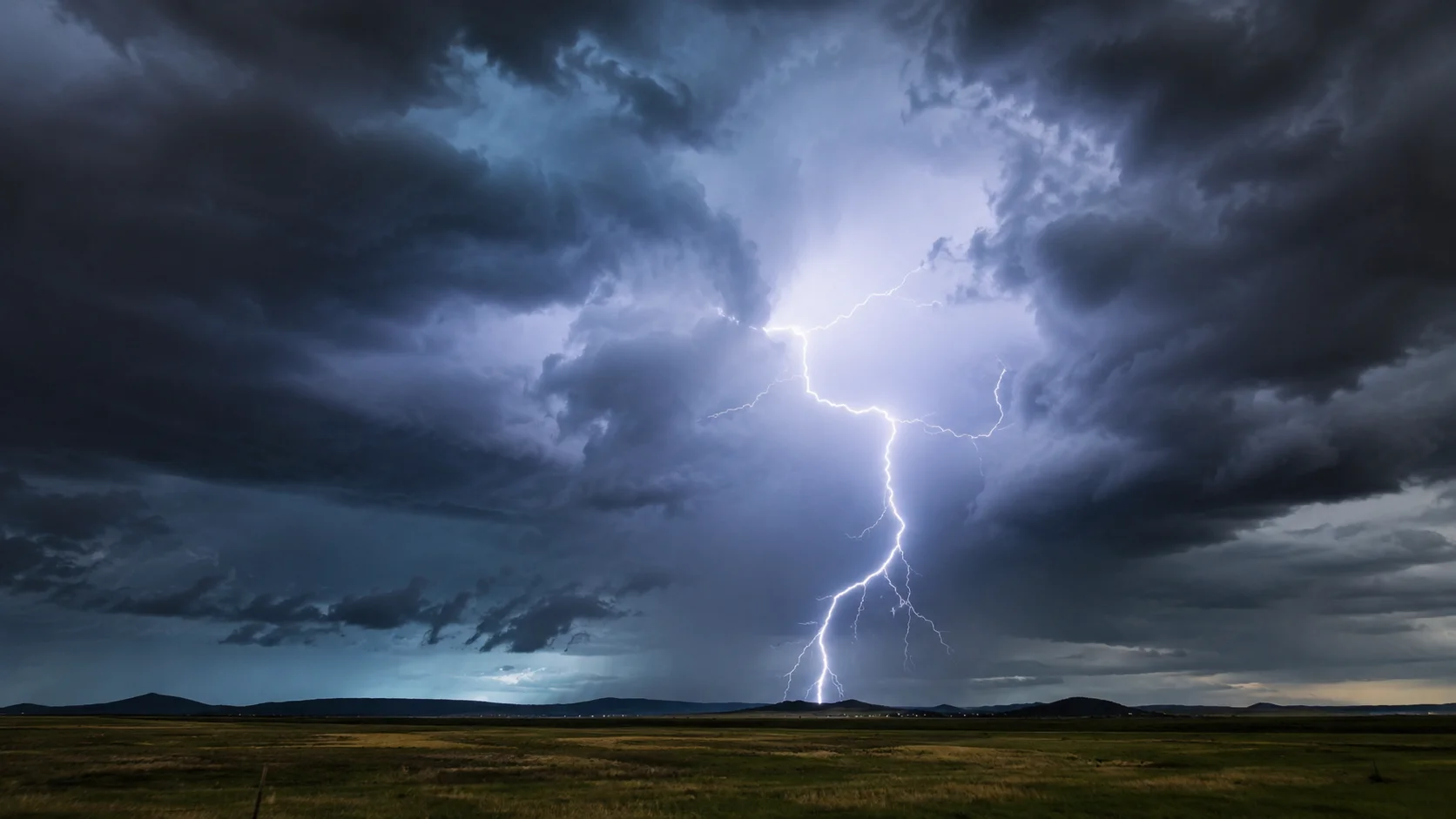
Visual answer
Why Light and Sound From the Same Event Reach You at Different Times
Light and sound leave the strike together but travel at vastly different speeds.
Lightning and thunder are created simultaneously
The flash and explosive air expansion happen at the same instant.
Light leaves the bolt at 300,000 km/s
The flash reaches observers almost instantly over ordinary storm distances.
Sound leaves the bolt at 343 m/s
The pressure wave travels far more slowly through air.
The gap reveals the distance
Sound takes about 3 seconds to travel one kilometer.
What is thunder
Thunder Is the Sound of Air Exploding
When lightning fires, the air around the channel heats almost instantly and expands at supersonic speed, creating a shock wave.
Lightning is a long, branching channel, not a single point. Sound from different parts of the channel reaches you at different times.
That is why close thunder cracks sharply while distant thunder rolls and rumbles across several seconds.
Myth vs reality
Myth vs Reality
What people think
Heat lightning is a special kind of lightning with no thunder
Heat lightning is just ordinary distant lightning whose thunder dissipates before reaching you.
What actually happens
All lightning produces thunder
If you cannot hear the thunder, the strike is simply too far away or the sound has been absorbed and scattered.
Distance guide
How to Estimate Distance From the Flash-to-Thunder Gap
3 seconds
About 1 kilometer away. The storm is very close.
10 seconds
About 3.3 kilometers away. Still dangerous.
30 seconds
About 10 kilometers away. Shelter is advisable.
No thunder audible
Usually more than about 25 kilometers away, so the thunder has dissipated.
Quick answers
Common questions
Do lightning and thunder happen at the same time? +
Yes. Thunder is caused by lightning at the same instant; light just reaches you much faster than sound.
Why does thunder rumble? +
A bolt is long and branching, so sound from different sections arrives at different times.
What is heat lightning? +
Regular distant lightning from a storm too far away for thunder to be audible.
Is counting 5 seconds for a mile accurate? +
Yes, roughly. Sound travels one mile in about 4.7 seconds, so dividing by 5 is close enough.