Quick Facts
Quick Facts
Tesla worked for Thomas Edison, then quit after a dispute over money.
His AC system won the 'War of the Currents' because it could transmit power over long distances.
He built a 187-foot tower on Long Island to test wireless power. It was never completed.
He claimed to have invented a 'death ray' that could bring down airplanes.
He died alone in a hotel room, owing thousands of dollars in rent.
Visual answer
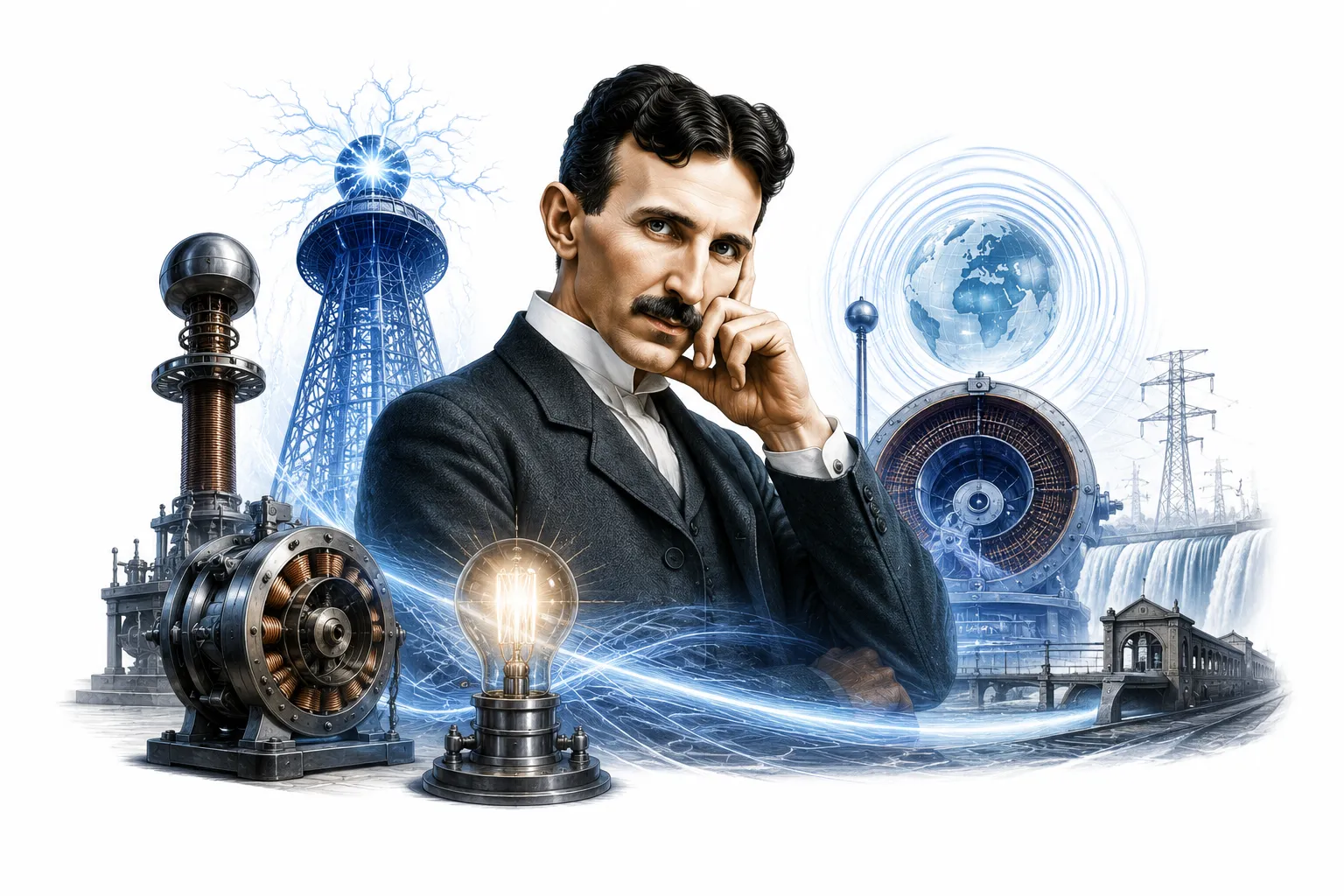
Tesla's Greatest Inventions
The ideas that made Tesla famous, then forgotten, then famous again.
Alternating Current (AC)
The system that powers the world. AC can travel hundreds of miles. DC, Edison's system, could only go about a mile.
Tesla Coil
A high-voltage transformer that produces spectacular lightning-like discharges. Still used in radios and televisions.
Radio
Tesla demonstrated radio in 1893, before Marconi. The Supreme Court later credited Tesla with the invention.
Wireless Power
Tesla dreamed of transmitting electricity through the air. He built a tower to test it. It failed, but the dream lives on.
Story in brief
Story in Brief
1884
Tesla moves to the United States and begins working for Thomas Edison.
1885
Tesla quits after Edison refuses to pay him. He nearly dies digging ditches to survive.
This feud defined the rest of his career.
1887
Tesla demonstrates his AC motor. The War of the Currents begins.
1893
Tesla's AC system lights the World's Fair in Chicago.
The public saw that AC worked. Edison lost.
1895
Tesla's laboratory burns down, destroying years of work.
1943
Tesla dies alone in a New York hotel room. He is largely forgotten.
1990s-2000s
Tesla is rediscovered. He becomes a cult hero and the namesake of a car company.
Elon Musk named his electric car company after Tesla, cementing his legacy.
The Story
How a Quitting Job Changed the World
When Nikola Tesla arrived in the United States, he had four cents in his pocket and a letter of introduction to Thomas Edison. Edison, already famous for the light bulb, hired the young immigrant immediately.
The two men were a perfect mismatch. Edison was a tinkerer who solved problems by trial and error. Tesla was a theorist who designed machines in his head and then built them perfectly on the first try. Edison promised Tesla a large bonus if he could fix a problem with Edison's direct current generators. Tesla did it. Edison said the bonus was a 'joke.' Tesla quit on the spot.
The feud that followed, the War of the Currents, was brutal. Edison publicly electrocuted animals to prove that Tesla's AC system was dangerous. Tesla staged spectacular lightning shows to prove it was safe. In the end, AC won because it could transmit power over long distances. Every time you plug in a phone charger, you are using Tesla's system.
Famous Quote
"I do not think there is any thrill that can go through the human heart like that felt by the inventor as he sees some creation of the mind unfolding to success."
, Nikola Tesla
Tesla felt this thrill many times. He also felt the opposite: the despair of seeing his ideas fail or be stolen.
Evidence
Why Tesla Is Famous Today
He invented the AC electrical system that powers the world.
StrongHis Tesla coil is a staple of science museums and laboratories.
StrongHe is the namesake of Tesla Motors, one of the world's most valuable car companies.
StrongHe has become a symbol of the misunderstood genius.
StrongKey Points
Key Points So Far
Tesla invented the alternating current (AC) system that powers your home.
He won the War of the Currents against Thomas Edison.
He invented the Tesla coil, still used in radios.
He dreamed of wireless power and built a tower to test it.
He died forgotten and then became a pop culture icon.
Analogy
Tesla Was Like a Rock Star Who Died Broke
The familiar part
Imagine a musician who sells out stadiums, then ends up forgotten, then becomes famous again decades after death, and then has a car company named after him.
How it applies
That was Tesla. In the 1890s, he was a celebrity. He gave public lectures with lightning bolts shooting from his hands. He was friends with Mark Twain. Then his ideas got too weird. He claimed to have invented a death ray. He fell in love with a pigeon. People stopped taking him seriously.
Where the analogy breaks
Rock stars usually have groupies. Tesla had pigeons.
Curiosity Notes
Details Most People Miss
Why this still matters
Why This Still Matters
Tesla's story is still told because it is the ultimate tale of the misunderstood genius. He was right about AC. He was right about radio. He was probably wrong about the death ray and wireless power. But the mix of brilliance and eccentricity makes him irresistible. He is the patron saint of inventors who are ahead of their time, which is to say, inventors who will die poor and unappreciated. The car company named after him is a monument to that irony.
Key Findings
- ✓Core findingTesla invented the AC electrical system that powers the modern world.
- ✓Strong evidenceHe won the War of the Currents against Thomas Edison.
- ⚠Main consequenceHe invented the Tesla coil and made breakthroughs in radio.
- ✓Wider legacyHe died poor and forgotten, then became a pop culture icon.
- ★Bottom lineTesla Motors (now Tesla Inc.) is named after him.
Final insight
A Last Thought
Nikola Tesla gave us the gift of electricity delivered to our homes. We owe him the lights that turn on, the phones that charge, and the screens that glow. He died broke in a hotel room, cared for only by a hotel manager and a collection of pigeons. There is no justice in that. But there is a lesson: the world does not always reward its greatest benefactors. Sometimes it forgets them. And sometimes, a century later, it remembers.
Quick answers
Common questions
Did Tesla invent the death ray? +
He claimed to have invented a 'teleforce' weapon that could bring down airplanes from 250 miles away. He tried to sell it to various governments. No one bought it. Most historians believe it was either a hoax or a delusion.
Was Tesla a genius or a madman? +
Both. He was undoubtedly a brilliant inventor. He also had obsessive-compulsive tendencies, a phobia of germs, and a romantic attachment to a pigeon. Genius and madness are not opposites. They are neighbors.