Quick Facts
Quick Facts
The assassination almost failed. The first bomb missed the Archduke's car.
Princip was eating a sandwich when the Archduke's car accidentally drove past him.
Germany had a secret plan to invade France through neutral Belgium.
Most leaders thought the war would be over by Christmas 1914.
Trench warfare was not part of anyone's original plan.
Visual answer
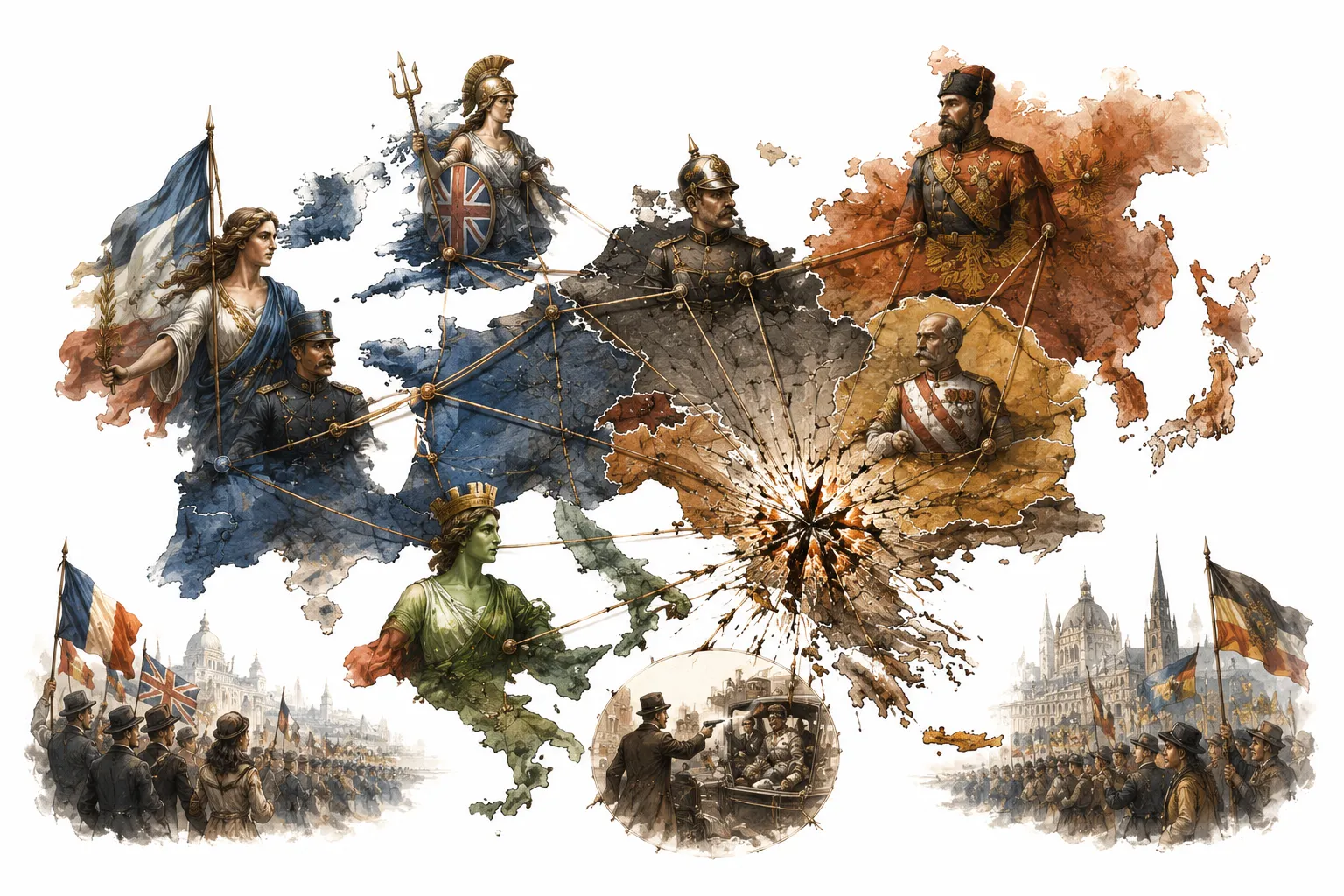
The Chain Reaction That Started WWI
How one assassination triggered a continental war in just five weeks.
June 28, 1914
Archduke Franz Ferdinand is assassinated in Sarajevo.
July 28
Austria-Hungary declares war on Serbia.
July 30
Russia mobilizes its army to defend Serbia.
August 1
Germany declares war on Russia.
August 3
Germany declares war on France and invades Belgium.
August 4
Britain declares war on Germany. Europe is at war.
Story in brief
Story in Brief
June 28, 1914
Archduke Franz Ferdinand is shot in Sarajevo.
July 23
Austria-Hungary gives Serbia an impossible ultimatum.
July 28
Austria-Hungary declares war on Serbia.
This was the first declaration. The dominoes started falling.
July 30
Russia mobilizes its army.
August 1
Germany declares war on Russia.
August 3
Germany declares war on France and invades Belgium.
August 4
Britain declares war on Germany.
The war was now truly a world war.
The Story
Europe Had Been Waiting for an Excuse
The assassination of Archduke Franz Ferdinand was not the cause of World War I. It was the excuse. Europe had spent decades building up armies, forming secret alliances, and looking for a reason to fight.
Germany wanted to challenge Britain's global power. France wanted revenge for losing a war to Germany in 1871. Austria-Hungary wanted to crush Serbian nationalism before it spread. Russia wanted to protect its reputation as the protector of Slavic peoples.
When Princip fired that pistol, he gave everyone the excuse they had been waiting for. Within weeks, millions of young men were marching off to war, convinced they would be home by Christmas. They were wrong.
Famous Quote
"The lamps are going out all over Europe. We shall not see them lit again in our lifetime."
, Sir Edward Grey, British Foreign Secretary
He said this on the evening Britain declared war on Germany. He was right.
Evidence
The Deeper Causes of WWI
Militarism: European powers were in an arms race.
StrongAlliances: Secret treaties forced countries to join wars they did not want.
StrongImperialism: Competition for colonies created bitter rivalries.
ModerateNationalism: Ethnic groups wanted their own nations.
StrongKey Points
Key Points So Far
The assassination was the spark, not the fire.
Secret alliances turned a local war into a world war.
Germany's invasion of Belgium brought Britain into the conflict.
Most leaders expected a short war. They were tragically wrong.
Analogy
The Domino Effect
The familiar part
Imagine a row of dominoes standing very close together, all leaning slightly.
How it applies
That was Europe in 1914. The assassination was the tiny push that tipped the first domino. The rest fell automatically. Countries that had no quarrel with each other suddenly found themselves at war because their alliances forced their hands.
Where the analogy breaks
Unlike dominoes, countries had a choice. They just made the wrong one.
Curiosity Notes
Details Most People Miss
Why this still matters
Why This Still Matters
World War I changed everything. It destroyed empires, redrew borders, and introduced industrial scale killing. The modern world, with its uneasy alliances and military tensions, was born in the trenches of the Western Front. And the lesson, uncomfortable as it is, is that wars can start even when no one really wants one.
Key Findings
- ✓Core findingThe immediate trigger was the assassination of Archduke Franz Ferdinand.
- ✓Strong evidenceDeeper causes included militarism, alliances, imperialism, and nationalism.
- ⚠Main consequenceGermany's invasion of Belgium brought Britain into the war.
- ✓Wider legacyMost leaders expected a short war. It lasted four years.
- ★Bottom lineThe war created the conditions for World War II.
Final insight
A Last Thought
The most tragic part of World War I is that almost no one wanted it. The leaders who started the war were not monsters. They were tired, nervous, and trapped by promises they had made years earlier. They stepped off a cliff, and they took a generation with them.
Quick answers
Common questions
Could World War I have been avoided? +
Maybe. Historians still argue about this. If Austria-Hungary had accepted Serbia's nearly full surrender, or if Germany had not given Austria a 'blank check' of support, the chain reaction might have stopped.
What was the Schlieffen Plan? +
Germany's secret plan to quickly defeat France by invading through neutral Belgium, then rush east to fight Russia. It failed when Belgium resisted longer than expected and Britain joined the war.