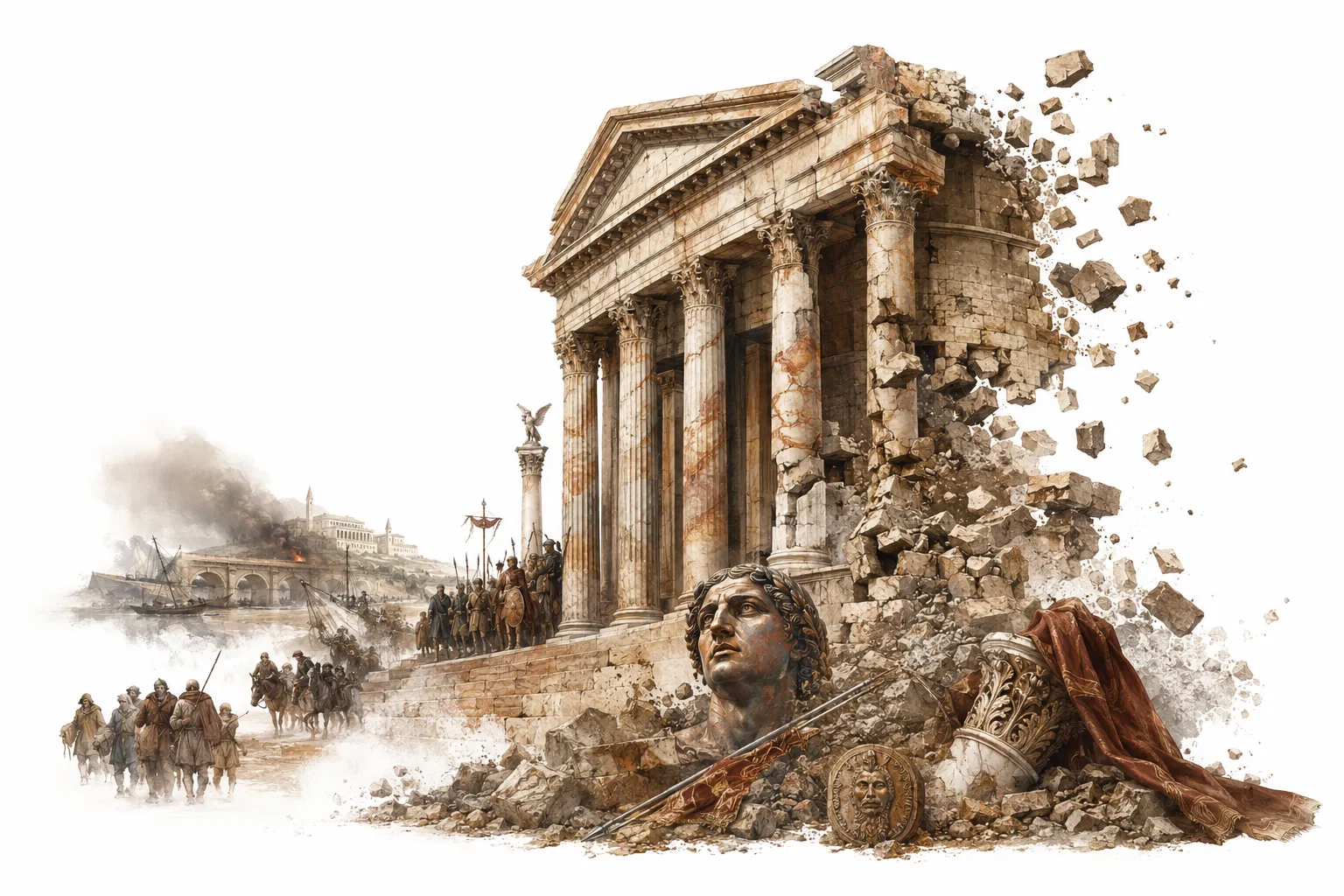
Quick Facts
Quick Facts
Rome hired barbarians as mercenaries because it was cheaper than training its own soldiers.
The empire split into East and West about 100 years before the West fell.
Lead poisoning from water pipes may have affected Roman leaders' mental health.
The Eastern Roman Empire (Byzantine) survived for nearly another 1000 years.
The 'fall' was not noticed by most ordinary Romans at the time.
Visual answer
How Rome Took Centuries to Collapse
The slow decline of the Western Roman Empire was a series of unfortunate events, not a single disaster.
Economic Trouble
Inflation soared as emperors reduced silver in coins. Taxes became crushing.
Military Overstretch
The empire grew too large to defend. Borders stretched thousands of miles.
Barbarian Mercenaries
Rome hired foreign fighters. These soldiers often had little loyalty to the empire.
Political Chaos
Emperors were assassinated constantly. Between 235 and 284 AD, Rome had over 20 emperors.
Final Collapse
In 476 AD, a barbarian general named Odoacer deposed the last emperor and sent his crown to Constantinople.
Story in brief
Story in Brief
117 AD
Roman Empire reaches its greatest size under Emperor Trajan.
286 AD
Empire splits into Eastern and Western halves.
The East became wealthy while the West slowly weakened.
376 AD
Goths flee into Roman territory seeking refuge from the Huns.
378 AD
Goths defeat a Roman army at the Battle of Adrianople.
The battle showed that barbarian groups could now beat Roman legions in open combat.
410 AD
Visigoths sack Rome.
455 AD
Vandals sack Rome again, giving us the word 'vandalism'.
476 AD
Last Western emperor is removed. The empire in the West is finished.
The Story
Rome Did Not Fall in a Day
There was no single battle where barbarians kicked down the gates and Rome disappeared overnight. The reality is much stranger and more awkward.
For decades, Rome had been hiring barbarian groups as soldiers. This was not a desperate last move. It was a cost cutting strategy. Why train your own young men when you could pay a ready made warrior from across the river?
The problem, in hindsight, is obvious. Those warriors felt no particular love for Rome. When the treasury ran low and payments stopped, they simply turned around and asked why they should keep protecting a place that could no longer pay them.
Famous Quote
"The decline of Rome was the natural and inevitable effect of immoderate greatness."
, Edward Gibbon
The 18th century historian spent over 20 years writing the famous history of Rome's fall.
Evidence
What Historians Agrees On
Political instability weakened central authority.
StrongHeavy taxes and inflation damaged the economy.
StrongThe Huns pushed other tribes into Roman territory.
ModerateKey Points
Key Points So Far
The Western Empire fell in 476 AD, but the Eastern Empire lasted another 1000 years.
Rome hired barbarian mercenaries who eventually turned against them.
Economic problems made it impossible to maintain the military.
Political chaos meant leadership was unstable for generations.
Analogy
Think of Rome Like a Failing Company
The familiar part
Imagine a huge corporation that stops innovating, promotes terrible managers, and outsources all its security to contractors.
How it applies
Rome did exactly that. The barbarians were not invaders so much as former employees who realized the company was out of money.
Where the analogy breaks
Unlike a company, Rome could not declare bankruptcy. It simply faded until someone finally turned off the lights.
Curiosity Notes
Details Most People Miss
Why this still matters
Why This Still Matters
The story of Rome's fall is still told because it raises uncomfortable questions. Can a superpower talk itself into decline? Can bad leadership undo centuries of success? And most awkward of all: do we see the same warning signs today?
Key Findings
- ✓Core findingThe Western Roman Empire fell in 476 AD, not 1453 AD.
- ✓Strong evidenceRome hired barbarian mercenaries who later turned against it.
- ⚠Main consequenceEconomic collapse and political chaos made the empire ungovernable.
- ✓Wider legacyThe Eastern half survived for nearly 1000 more years.
- ★Bottom lineMost ordinary people did not notice the 'fall' happening.
Final insight
A Last Thought
Rome did not die because of one bad day. It died because it spent centuries making small, terrible decisions that added up to a disaster. The most unnerving part? Almost everyone saw it coming. And no one could stop it.
Quick answers
Common questions
Did Rome really fall in one day? +
No. The fall took generations. The year 476 AD is just a convenient marker because that was when the last Western emperor was removed.
What happened to the Romans after the fall? +
They kept living there. The people of Italy did not disappear. They simply found themselves under new management, first barbarian kings and later various other rulers.