Visual answer
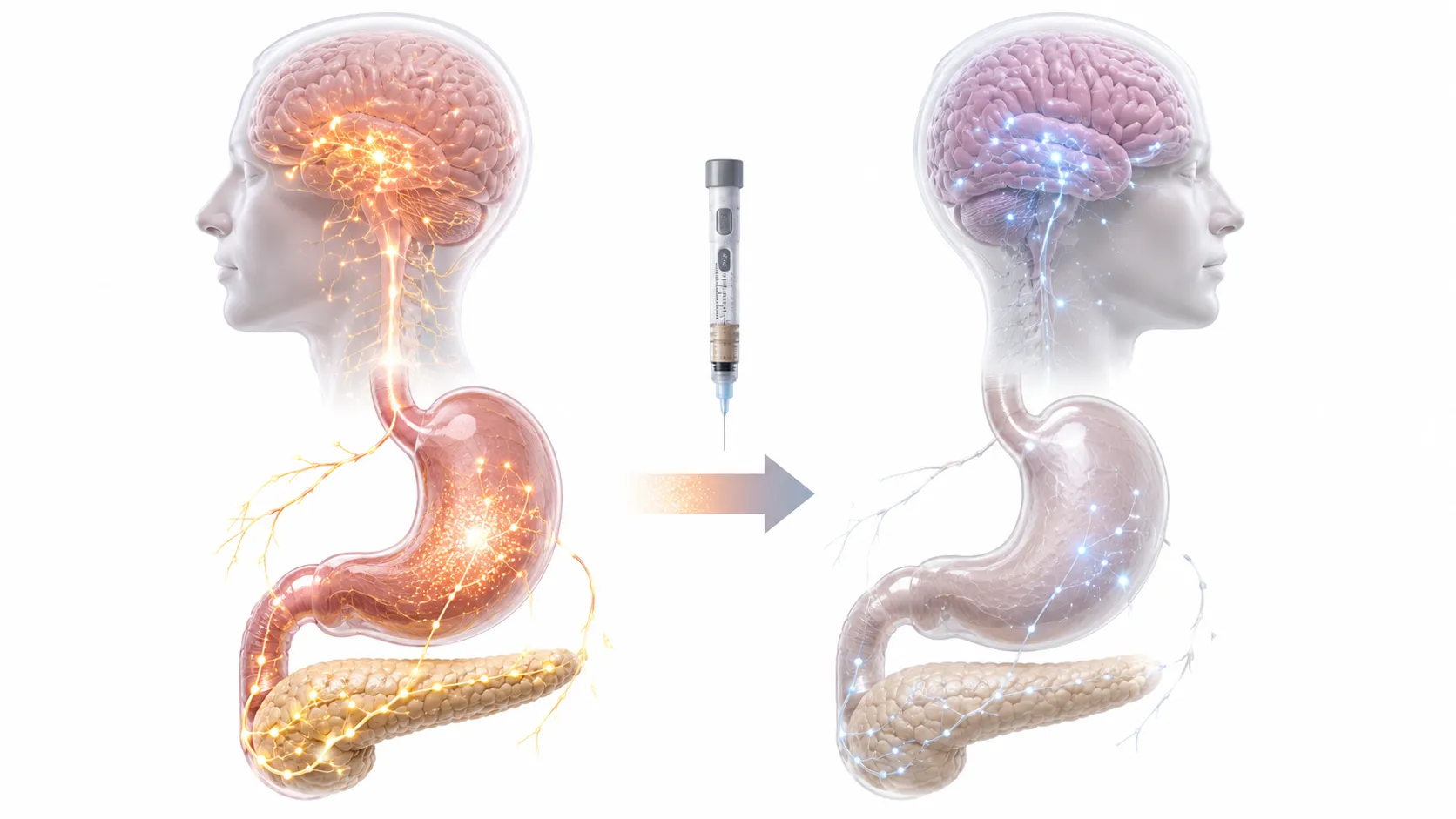
How Semaglutide Moves Through the Body
A single weekly injection of semaglutide triggers a cascade of signals across the gut, pancreas, and brain that together reduce hunger, slow digestion, and stabilise blood sugar.
GLP-1 receptor activation
Semaglutide binds to GLP-1 receptors throughout the body, the same receptors triggered by the natural post-meal hormone.
Pancreas: insulin and glucagon
The pancreas releases more insulin (lowering blood sugar) and less glucagon (which would otherwise raise it), stabilising glucose levels after meals.
Stomach: slowed emptying
The stomach empties its contents into the small intestine more slowly, stretching the sensation of fullness across hours instead of minutes.
Brain: appetite and reward
Semaglutide acts on the hypothalamus and reward centres, reducing the drive to eat and lowering food-related cravings and intrusive thoughts.
The hormone it copies
The Hormone Ozempic Copies
Every time you eat a meal, your gut releases a small hormone called GLP-1, glucagon-like peptide-1. Think of it as a biological receipt: it tells your pancreas to release insulin, signals your stomach to slow down, and sends a message to your brain that says food has arrived, you can stop looking for more.
The problem is that GLP-1 is extraordinarily short-lived. Within two to three minutes of being released, enzymes in the blood break it down. The signal fades almost before it can act.
Semaglutide, the active ingredient in Ozempic, is a synthetic molecule engineered to look almost identical to GLP-1, but with one crucial difference: it is resistant to those degrading enzymes. Instead of lasting minutes, semaglutide lingers in the body for approximately seven days. A single weekly injection keeps the fullness signal switched on at a low, steady hum for the entire week.
It is the biological equivalent of playing a note on a piano, and then rigging the key so it never stops sounding.
What it does to your brain
What Ozempic Does To Your Brain
Hunger is not simply a growling stomach. It is a neurological state, a set of signals firing inside your brain that create urgency, focus attention on food, and make eating feel rewarding. The hypothalamus, a small region deep inside the brain, is the master control room for appetite. It monitors hormone levels, blood sugar, and body fat, then adjusts hunger accordingly.
GLP-1 receptors, the docking stations that semaglutide binds to, exist throughout the brain, including the hypothalamus. When semaglutide activates them, it effectively tells the hypothalamus: the body is fed, stand down.
But the effect goes deeper than simply reducing physical hunger. Semaglutide also acts on the brain's reward pathways, the dopamine-driven circuits that make food feel pleasurable and that generate cravings. Many users report something they describe as a reduction in 'food noise': the constant background thoughts about eating, snacking, and what to have next. The mental pull of food simply becomes quieter.
This is why Ozempic's effects feel so different from simply deciding to eat less. Willpower works against hunger. Semaglutide reduces how much hunger exists in the first place.
What it does to your stomach
What Ozempic Does To Your Stomach
Your stomach is not just a storage bag. It is a timed-release system. After a meal, it churns food and releases it gradually into the small intestine, and the speed at which it does this affects how full you feel and for how long.
Semaglutide activates GLP-1 receptors in the stomach wall, slowing this emptying process significantly. A meal that might normally leave the stomach within two hours might take three or four hours instead. The stomach stays more distended, fuller, for longer. Physical stretch receptors in the stomach wall send fullness signals to the brain, and those signals persist well past the time they normally would.
The practical result is that meals feel larger than they are. A portion that would ordinarily feel modest feels satisfying. The moment when most people would reach for a second helping arrives and simply does not feel compelling.
This is not a shrunken stomach, the stomach itself has not changed size at all. It is the same organ processing the same food, just doing it more slowly.
How weight loss happens
How Ozempic Actually Causes Weight Loss
The weight loss chain is straightforward, even if each link in it is biological rather than purely behavioural. Semaglutide reduces hunger signals from the brain. It slows stomach emptying. It dampens food cravings and reward-driven eating. The combined effect is that most people simply eat less, not through discipline, but because the desire to eat has genuinely diminished.
Fewer calories consumed over days and weeks creates a caloric deficit. A caloric deficit causes the body to draw on stored energy, body fat. Fat is metabolised. Weight decreases.
Ozempic does not directly dissolve, burn, or metabolise fat. There is no chemical in semaglutide that targets adipose tissue. The fat loss is a downstream consequence of eating less, not a direct pharmacological effect. This distinction matters because it explains both why Ozempic works and what happens when you stop taking it.
If the hunger suppression disappears, caloric intake can return to its previous level, and with it, the weight.
Does it melt fat?
Myth vs Reality: Fat Loss
What people think
Ozempic melts or burns fat directly
Social media coverage and dramatic before-and-after photos suggest the drug is chemically attacking fat tissue.
What actually happens
Ozempic changes hunger behaviour; fat loss follows from eating less
Semaglutide has no direct fat-metabolising mechanism. It reduces appetite and caloric intake. Any fat loss is a consequence of sustained caloric deficit, not a direct drug effect on fat cells.
Why it was made for diabetes
Why Ozempic Was Originally Created For Diabetes
Type 2 diabetes is fundamentally a problem with blood sugar regulation. After a meal, blood glucose rises. The pancreas is supposed to respond by releasing insulin, the hormone that moves glucose from the blood into cells where it can be used as energy. In type 2 diabetes, this response is blunted or the body's cells have become resistant to insulin's signals.
GLP-1 has a direct role in this system. It tells the pancreas to release more insulin when blood sugar is high, and simultaneously tells it to release less glucagon, a hormone that raises blood sugar. It is a natural blood sugar stabiliser.
Researchers developing semaglutide were trying to create a longer-lasting version of this mechanism for diabetic patients. They succeeded, and then noticed, somewhat unexpectedly, that patients in clinical trials were also losing significant weight. The appetite-suppressing effects of GLP-1 receptor activation turned out to be as powerful as the blood sugar effects.
Ozempic (semaglutide for diabetes management) and Wegovy (the same semaglutide molecule at a higher dose, licensed specifically for obesity treatment) are both products of that original diabetes research.
Why it causes nausea
Why Ozempic Can Cause Nausea
Nausea is among the most commonly reported early side effects of Ozempic, and it has a direct biological explanation.
The digestive system is not accustomed to having its emptying speed suddenly and significantly reduced. When semaglutide slows the stomach's transit of food, the gut's normal rhythms are disrupted. The vagus nerve, a major communication highway between gut and brain, interprets unusual digestive patterns as a potential problem and can trigger nausea as a precautionary response.
The same slowed digestion that creates sustained fullness can also make the stomach feel uncomfortably loaded. Food that would normally have moved further through the digestive tract sits longer than expected.
For most people, the nausea is strongest during the first few weeks of treatment and at dose increases. The digestive system gradually adapts to the new pace. This is why Ozempic is typically started at a low dose and increased slowly over months, the gradual approach gives the gut time to adjust rather than confronting it with the full effect immediately.
Does it shrink the stomach?
Myth vs Reality: Stomach Size
What people think
Ozempic physically shrinks the stomach
Because people eat smaller portions and feel full faster, it seems logical that the stomach must have become smaller.
What actually happens
The stomach remains the same size; it just empties more slowly
Semaglutide slows gastric emptying, the rate at which food moves out of the stomach. The organ itself does not change in size or capacity. Smaller meals feel satisfying because they sit in a slower-moving stomach for longer, triggering stretch receptors for an extended period.
How long it takes to work
How Long Does Ozempic Take To Work?
Changes in appetite and fullness can often be noticed within the first one to two weeks, even at the starting dose. Many users describe feeling satisfied with smaller meals earlier than expected, or noticing that the impulse to snack between meals has faded.
Measurable weight changes typically become apparent over four to eight weeks, depending on starting weight, diet, and activity level. The drug's full appetite-suppressing effect builds gradually as the dose increases over several months according to the standard titration schedule.
Clinically significant weight loss, the kind documented in trials, tends to accumulate over six to twelve months or longer. The process is not a switch being flipped. It is a gradual biological recalibration.
Individual variation is substantial. Some people respond strongly at low doses. Others see more modest changes. Starting weight, metabolic rate, dietary habits, and genetic factors all influence outcomes. The drug does not override all of these variables, it adjusts one part of the system.
Realistic expectations
Can You Lose 10kg in 2 Months With Ozempic?
This question reflects the dramatic results some people report, often amplified by social media. The honest answer is: it depends, and those three words matter more than almost anything else in this context.
People with significantly higher starting body weights tend to lose more in absolute terms, because a caloric deficit creates a larger proportional impact. Someone eating far more than their energy requirements has more reduction available to them. Someone already close to their maintenance intake will see more modest changes.
The clinical trial data for semaglutide shows average weight loss of roughly 10–15% of body weight over approximately 68 weeks, not 8 weeks. That is a meaningful, sustained reduction, but it is not the dramatic short-term transformation sometimes implied online.
Ozempic is not a bypass for energy balance. It makes achieving a caloric deficit easier and more sustainable by reducing the biological signals that drive overeating. The same underlying physics still apply: sustained weight loss requires sustained caloric deficit, regardless of the mechanism that creates it.
What happens when you stop
What Happens If You Stop Taking Ozempic?
When semaglutide clears the body, which takes a few weeks after the last injection, its effects on the GLP-1 receptors cease. The hunger suppression it provided disappears.
For most people, this means the return of previous appetite levels. The 'food noise' comes back. Stomach emptying returns to its normal pace, so meals feel less filling for less time. The biological conditions that led to overeating before treatment are restored.
Studies tracking people after they stop semaglutide consistently show that a significant portion of the lost weight returns within a year. This is not a personal failure, it is a predictable biological consequence of removing a hormone signal that was actively suppressing appetite.
This is why researchers increasingly describe obesity as a chronic condition requiring ongoing management, and why the conversation around GLP-1 medications is shifting toward long-term maintenance rather than short-term treatment. The underlying biology does not permanently change from a course of treatment.
Why it went viral
Why People Call Ozempic a 'Miracle Drug'
For decades, the dominant cultural narrative around weight was one of individual responsibility and willpower. People who struggled to lose weight were told to eat less and move more, as if the biological machinery of hunger were simply an inconvenience to be overridden by determination.
Ozempic disrupted that narrative in a way that few medical developments have. When people who had spent years battling appetite suddenly found themselves feeling indifferent to food they had previously been unable to resist, the experience was genuinely shocking to them. Not just 'I'm eating less.' More like: 'The constant thoughts about food have simply stopped.'
The results visible among celebrities, influencers, and public figures accelerated the cultural moment. Before-and-after photographs spread across social media. Prescriptions surged. Shortages developed. The drug became shorthand for a new era of weight management.
What makes Ozempic genuinely significant is not just its effectiveness but what its effectiveness implies: that for many people, overeating is not a character flaw but a hormonal one. Hunger is biological. Altering the biology alters the behaviour. That is a fundamental shift in how we understand weight, and why a diabetes drug became one of the most talked-about medicines in recent history.
Mechanism overview
Where Ozempic Acts and What It Changes
Brain (hypothalamus)
Reduces hunger signals. Quiets food-related cravings and intrusive thoughts about eating. Lowers the reward pull of food.
Stomach
Slows gastric emptying. Food sits in the stomach longer, triggering stretch receptors and prolonging the feeling of fullness.
Pancreas
Stimulates insulin release when blood sugar rises. Suppresses glucagon, which would otherwise raise blood sugar. Helps stabilise glucose after meals.
Appetite overall
Reduced caloric intake through reduced hunger and portion sizes, not through direct fat burning or metabolic acceleration.
Stomach size
No change. The stomach does not physically shrink. Only its emptying speed is affected.
Fat tissue
No direct effect. Fat loss occurs downstream as a consequence of sustained caloric deficit caused by reduced appetite.
Quick answers
Common questions
How does Ozempic cause weight loss? +
By mimicking GLP-1, a natural fullness hormone, semaglutide reduces hunger signals in the brain, slows stomach emptying, and dampens food cravings. People consume fewer calories as a result, and sustained caloric deficit leads to weight loss.
How does Ozempic work in the brain? +
Semaglutide activates GLP-1 receptors in the hypothalamus (the brain's appetite control centre) and in reward pathways, reducing both physical hunger and the psychological pull of food cravings.
Does Ozempic burn fat directly? +
No. There is no direct fat-burning mechanism in semaglutide. Fat loss is a downstream consequence of eating less due to reduced appetite, not a direct pharmacological effect on fat tissue.
Does Ozempic reduce cravings? +
Yes. Many users report a significant reduction in food-related cravings and intrusive thoughts about eating, an effect attributed to semaglutide's action on the brain's reward circuits.
Why does Ozempic make people feel full? +
Ozempic slows gastric emptying, the rate at which food leaves the stomach. Food stays in the stomach longer, keeping stretch receptors activated and maintaining fullness signals to the brain beyond what a meal would normally produce.
Does Ozempic shrink the stomach? +
No. The stomach does not physically shrink. Semaglutide slows how quickly the stomach processes and releases food, which makes it feel fuller for longer, but its actual size and capacity do not change.
Why does Ozempic cause nausea? +
The same slowed gastric emptying that creates extended fullness can also cause the stomach to feel overloaded. The vagus nerve interprets the unusual digestive pace as a potential problem and can trigger nausea. This typically diminishes over the first weeks as the body adapts.
How long does Ozempic take to work? +
Changes in appetite and fullness are often noticeable within one to two weeks. Visible weight changes typically emerge over four to eight weeks. Clinically significant results accumulate over six to twelve months or longer.
Can you lose 10kg in two months with Ozempic? +
Possibly, for people with high starting weight and significant caloric reduction, but this is not a typical or predictable result. Clinical trial data shows average weight loss of 10–15% of body weight over approximately 68 weeks, not eight.
What happens when you stop taking Ozempic? +
As semaglutide clears the body over a few weeks, its GLP-1 receptor activation stops. Hunger signals return to their previous levels, gastric emptying normalises, and food cravings often return. A significant portion of lost weight is typically regained within a year of stopping.