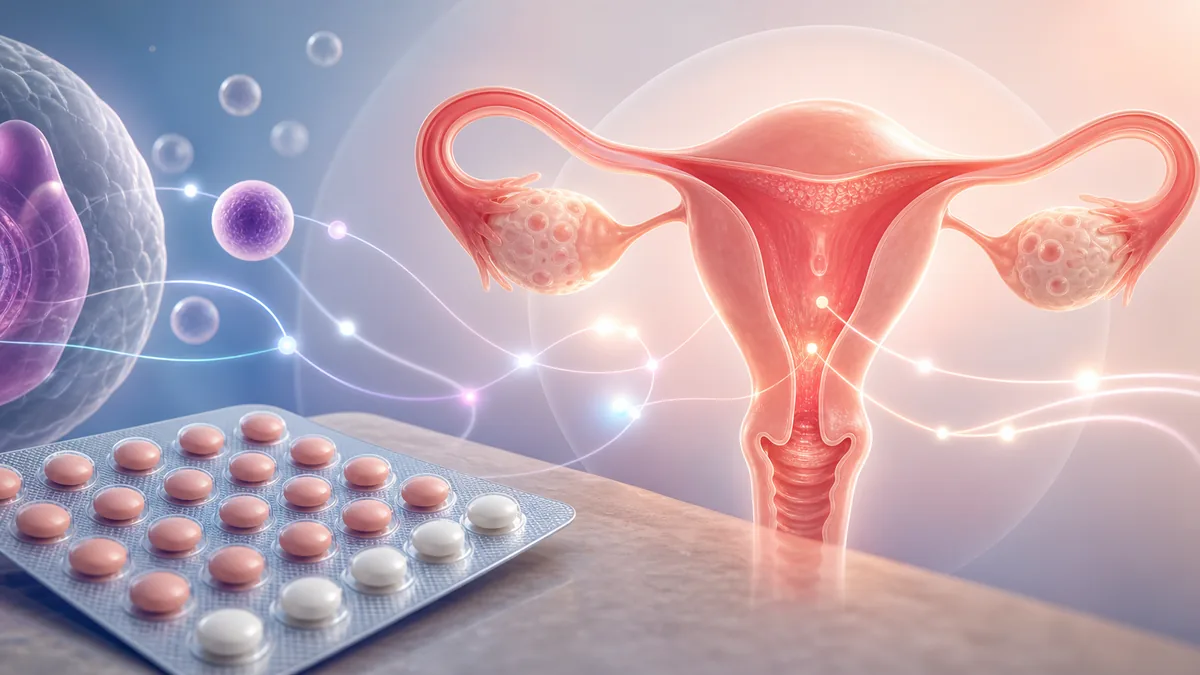
Visual answer
How Contraceptive Pills Reduce the Chance of Pregnancy
From swallowing a pill to the body's altered reproductive response, the six stages.
Pill is taken
The pill is swallowed and begins to pass through the digestive system, where its synthetic hormones are absorbed.
Hormones enter the bloodstream
Synthetic estrogen, progestin, or both are absorbed through the gut and enter the bloodstream, where they begin to circulate.
Brain and ovaries receive altered signals
The hormones reach the hypothalamus and pituitary gland in the brain, which regulate ovulation. The altered hormone levels change the signals sent to the ovaries.
Ovulation is prevented or reduced
The usual hormonal surge that triggers the release of an egg may not happen. Without ovulation, there is no egg available to be fertilised.
Cervical mucus becomes thicker
Progestin causes the mucus at the cervix to thicken, making it much harder for sperm to travel through and reach the uterus.
Pregnancy becomes much less likely
With ovulation reduced or absent and the cervical barrier strengthened, the chance of pregnancy is greatly reduced.
How they work
How Do Contraceptive Pills Work?
The reproductive cycle runs on hormones, chemical signals that tell different parts of the body what to do and when. The cycle is not random. It follows a timetable, and specific hormones are responsible for specific events at specific times: preparing an egg, triggering its release, and preparing the uterus for potential implantation.
Contraceptive pills introduce synthetic versions of two of those hormones, estrogen and progestin, or just progestin alone. When these synthetic hormones enter the system, the body reads them as part of the existing hormonal landscape. That altered landscape changes the signals going out from the brain to the ovaries.
The result is a reproductive cycle that runs differently. Ovulation may be prevented entirely, or reduced in reliability. The cervical mucus thickens. The uterine lining changes. Each of these effects individually reduces the chance of pregnancy. Together they make it very unlikely.
Preventing pregnancy
How Do Contraceptive Pills Prevent Pregnancy?
The primary mechanism in combined pills is preventing ovulation. The brain has a small structure called the pituitary gland that sends hormonal signals to the ovaries, telling them when to release an egg. The synthetic hormones in the pill suppress the specific signal, a surge of luteinising hormone, that normally triggers egg release. Without that signal, ovulation often does not occur.
The second mechanism is cervical mucus thickening. Progestin causes the mucus at the entrance to the uterus to become thicker and more viscous. Sperm are not strong swimmers under normal conditions. Against thick mucus, their chances of reaching an egg, even if one were available, are reduced significantly.
The third mechanism involves the uterine lining. The hormones can alter the endometrium, the lining of the uterus, making it less receptive. This is a secondary effect, and the extent to which it acts as an additional layer of protection is a subject of ongoing discussion in reproductive medicine.
The hormones
How Do the Hormones in Contraceptive Pills Work?
The body's reproductive cycle is essentially a conversation between the brain and the ovaries, conducted in the language of hormones. The hypothalamus sends a signal. The pituitary gland amplifies it. The ovaries respond. Everything runs on chemical messages.
Estrogen and progestin are the two synthetic hormones used in most contraceptive pills. They are not the same as the hormones the body produces naturally, they are synthetic versions designed to bind to the same receptors and produce similar effects. When they enter the bloodstream, the brain interprets their presence as a signal that certain hormone levels are already elevated, and reduces its own output accordingly.
Progestin-only pills, sometimes called the mini-pill, work primarily through the cervical mucus and uterine lining effects, with ovulation suppression that is less consistent than in combined pills. Combined pills, which contain both estrogen and progestin, tend to suppress ovulation more reliably.
Inside the body
What Happens Inside the Body After Taking the Pill?
Within a few hours of swallowing a pill, the synthetic hormones are absorbed through the wall of the small intestine and enter the bloodstream. From there they travel to hormone-sensitive tissue throughout the body, including the hypothalamus and pituitary gland in the brain, the ovaries, the cervix, and the uterine lining.
At each location, the hormones bind to receptors and alter the tissue's behaviour. The brain adjusts the hormonal signals it sends to the ovaries. The cervix changes the consistency of its mucus. The uterine lining responds to the altered hormonal environment.
This all happens continuously as long as the pill is being taken regularly. The key is maintaining consistent hormone levels in the bloodstream. Taking pills at a similar time each day helps maintain that consistency, which is why timing, and not missing doses, matters for effectiveness.
How soon they work
How Soon Do Contraceptive Pills Start Working?
How quickly a contraceptive pill becomes effective can depend on which type of pill is being taken, when in the menstrual cycle it is started, and individual factors. It is not always immediate.
Some guidelines suggest that combined pills started on the first day of a period may be effective from the start. Pills started at other points in the cycle are often recommended to be used alongside an additional form of contraception for the first seven days, while hormone levels establish themselves.
Progestin-only pills may reach effective cervical mucus thickening within 48 hours of starting, but the specific guidance varies. Medical decisions about when a particular pill becomes effective, and what additional precautions are sensible during the initial period, are best made with a qualified healthcare professional who knows the specific pill and the individual's circumstances.
After ovulation
Do Contraceptive Pills Work After Ovulation?
Regular daily contraceptive pills are not designed to be used as emergency contraception after the fact. They work continuously, building and maintaining the hormonal environment that prevents ovulation from occurring in the first place. By the time ovulation has already happened, the mechanism that was meant to prevent it has already been bypassed.
If ovulation has occurred during a cycle, whether due to a missed pill, delayed timing, or other factors, regular contraceptive pills cannot reverse it. The egg has been released. The pill's primary protective mechanism for that cycle is no longer in play.
During ovulation, the picture is similarly complex. The pill's suppression of ovulation is most reliable when hormone levels have been consistently maintained throughout the cycle. If pills have been taken reliably, ovulation is unlikely to be occurring. If consistency has been disrupted, the situation becomes less predictable. For questions about specific circumstances and what to do if a pill has been missed around the time of suspected ovulation, a healthcare professional or pharmacist is the right source of guidance.
Types of pills
Do All Contraceptive Pills Work the Same Way?
Not exactly. The two main categories are combined oral contraceptive pills and progestin-only pills, and they work through overlapping but not identical mechanisms.
Combined pills contain both synthetic estrogen and synthetic progestin. They suppress ovulation consistently, thicken cervical mucus, and alter the uterine lining. They are taken in cycles, typically 21 active pills followed by a 7-day break or 7 placebo pills, which is what produces the monthly withdrawal bleed that resembles a period but is not technically one.
Progestin-only pills, the mini-pill, are taken every day with no break. Their primary effect is on cervical mucus, which they thicken significantly. Their effect on ovulation is less consistent, some people using progestin-only pills continue to ovulate, relying on the cervical barrier as the main protection. Within each category there are also many different formulations using different types and doses of synthetic hormones, which is why different people may respond differently to different pills.
Pills and PCOS
How Do Contraceptive Pills Work for PCOS?
Polycystic ovary syndrome (PCOS) is a hormonal condition where the ovaries can produce higher than typical levels of androgens, hormones like testosterone. This can disrupt the regular hormonal cycle, affecting ovulation, causing irregular periods, and contributing to other symptoms including skin changes and hair growth patterns.
Contraceptive pills are commonly prescribed for people with PCOS not necessarily for contraception but for hormonal regulation. The synthetic hormones in the pill can help regulate the cycle, reduce androgen levels, and manage symptoms. The estrogen in combined pills also causes the liver to produce more of a protein that binds to androgens, reducing their activity in the body.
The pill does not cure PCOS or address its underlying causes. It manages the hormonal environment in a way that can significantly reduce certain symptoms for many people. The specific pill, dose, and formulation that works best varies between individuals, and decisions about using contraceptive pills for PCOS management are best made with a healthcare professional familiar with the individual's situation.
Emergency contraception
How Do Emergency Contraceptive Pills Work?
Emergency contraceptive pills are a distinct category from regular daily contraceptive pills. They are not the same thing taken in a higher dose, they work through specific mechanisms timed to the circumstances of use.
The most widely available type contains levonorgestrel, a synthetic progestin. Taken as soon as possible after unprotected sex, and within the time window specified on the packaging, it primarily works by delaying or preventing ovulation. If ovulation has not yet occurred, the hormonal disruption may push it past the window when sperm can cause fertilisation.
Emergency contraception is significantly less effective if ovulation has already occurred. It cannot interrupt an established pregnancy. Effectiveness also decreases with time, the sooner it is taken after unprotected sex, the more likely it is to be effective. For specific advice about which type of emergency contraception is appropriate and when, a pharmacist or healthcare professional can advise based on individual circumstances.
Expired pills
Do Expired Contraceptive Pills Still Work?
Pharmaceutical expiration dates are not arbitrary, they mark the point up to which the manufacturer can guarantee that the medication contains the stated dose of active ingredient at the stated potency. Beyond that date, the guarantee expires, not necessarily the medication.
For most solid oral medications stored correctly, cool, dry, away from direct light, active ingredients tend to degrade slowly rather than suddenly. A pill a month past its expiry date is unlikely to have become completely inert. But how much potency has been lost is unknown, and for contraception, where reliability matters considerably, reduced potency is not a theoretical concern to dismiss.
Using expired contraceptive pills as a form of contraception is not recommended. The predictability and reliability that make them effective under normal circumstances cannot be assumed once the expiry date has passed. The sensible course of action is to obtain a current supply and speak to a pharmacist or healthcare professional if that is not immediately possible.
Misconception
Common Misconception
What people think
Contraceptive pills always stop ovulation completely.
Contraceptive pills always stop ovulation completely.
What actually happens
Reality
Combined pills suppress ovulation reliably when taken consistently. Progestin-only pills can allow ovulation to continue in some people, their primary protection comes from thickening cervical mucus. No contraceptive pill is 100 percent effective in all circumstances, which is why consistent and correct use matters.
Quick answers
Common questions
How do contraceptive pills work? +
Contraceptive pills use synthetic hormones, estrogen, progestin, or both, to alter the body's reproductive signals. They can prevent or reduce ovulation, thicken cervical mucus to block sperm, and change the uterine lining. Together these effects make pregnancy much less likely.
How do they prevent pregnancy? +
Primarily by suppressing the hormonal signal that triggers ovulation, so no egg is released. A secondary effect is thickening cervical mucus, which makes it harder for sperm to reach the uterus. The uterine lining is also affected. Multiple mechanisms work together.
Do contraceptive pills stop ovulation? +
Combined pills usually suppress ovulation reliably when taken consistently. Progestin-only pills have a more variable effect on ovulation and rely more heavily on cervical mucus thickening. Whether ovulation is fully suppressed can depend on the type of pill and how consistently it is taken.
How soon do contraceptive pills work? +
This depends on the type of pill and when in the cycle it is started. Some combined pills started on the first day of a period may be effective immediately. Others are recommended to be used alongside additional contraception for the first seven days. A healthcare professional or the pill's instructions can clarify for the specific type.
Do contraceptive pills work immediately? +
Not always. Effectiveness can depend on when in the cycle the pill is started and which type is being taken. Building up consistent hormone levels takes time. Following the guidance provided with the specific pill, and seeking professional advice if uncertain, is the recommended approach.
Do they work after ovulation? +
Regular contraceptive pills are not designed to be effective after ovulation has already occurred in a given cycle. Their primary mechanism, preventing ovulation, has already been bypassed at that point. They are not a form of emergency contraception.
Do all contraceptive pills work the same way? +
Not exactly. Combined pills use estrogen and progestin to suppress ovulation consistently. Progestin-only pills rely more on cervical mucus thickening and have a less consistent effect on ovulation. Different formulations also use different types and doses of synthetic hormones.
How do emergency contraceptive pills work? +
Emergency contraceptive pills primarily work by delaying or preventing ovulation when taken soon after unprotected sex. They are most effective the sooner they are taken. They cannot interrupt an established pregnancy and are less effective if ovulation has already occurred.
Can expired contraceptive pills still work? +
They may retain some potency after the expiry date, but the reliability cannot be guaranteed. For contraception, where consistent effectiveness matters, using expired pills is not recommended. Obtaining a current supply and consulting a pharmacist is the sensible approach.
How do contraceptive pills affect hormones? +
They introduce synthetic versions of estrogen and progestin into the bloodstream, altering the hormonal signals the brain sends to the ovaries. The body reads the elevated synthetic hormone levels as a signal to reduce its own hormonal output, changing the reproductive cycle as a result.