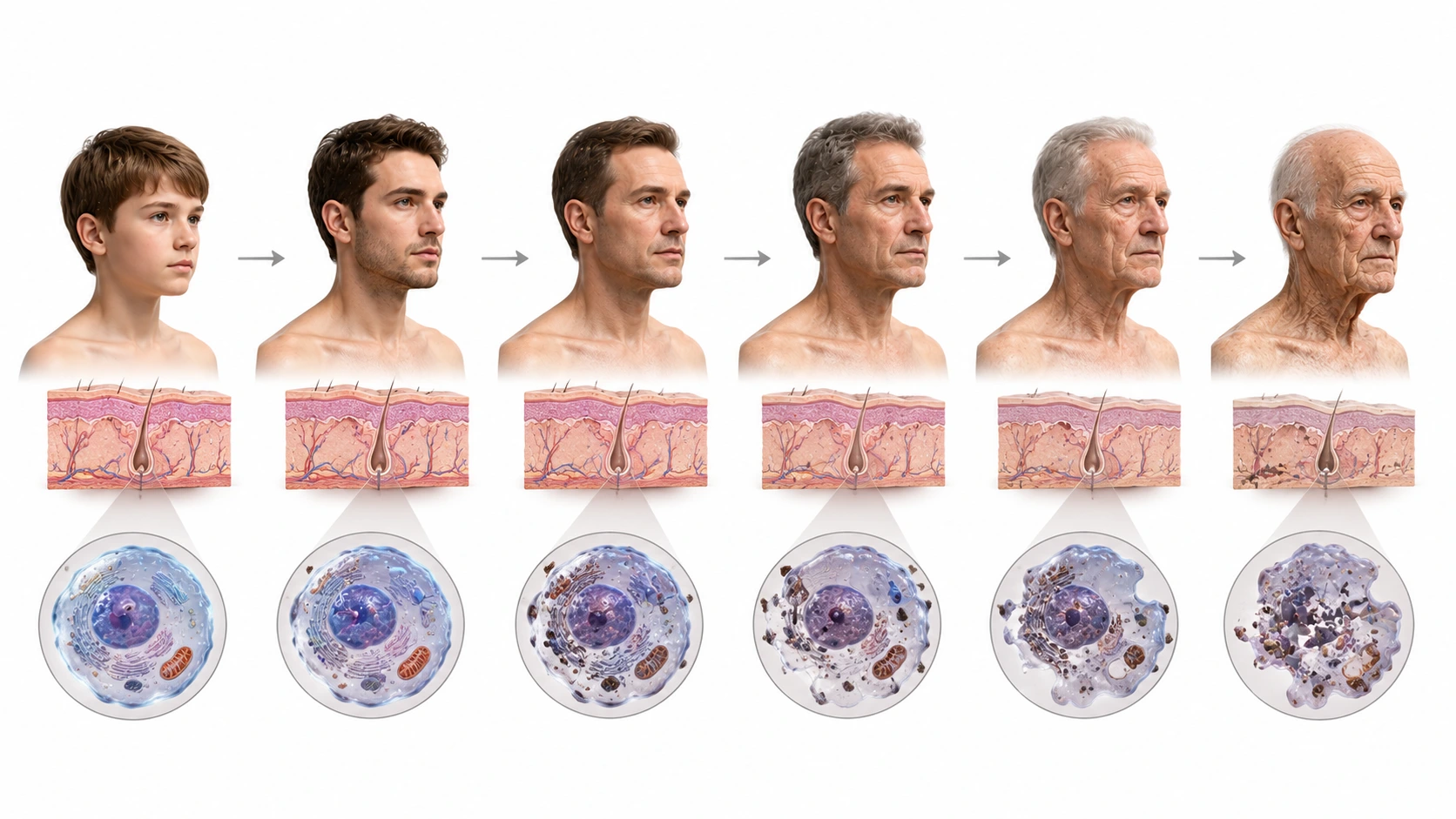
Visual answer
The Cellular Mechanisms of Aging
The key biological processes that cause cells, and then bodies, to age over time.
Telomere Shortening
Telomeres are protective caps at the ends of chromosomes, like the plastic tips on shoelaces. Every time a cell divides, telomeres get slightly shorter. When they become too short, the cell can no longer divide safely.
DNA Damage Accumulation
DNA copying is imperfect. Each of the roughly 37 trillion cells in your body divides periodically, and each division risks small errors. Repair mechanisms catch most of them. Over decades, subtle errors accumulate in long-lived cells.
Mitochondrial Decline
Mitochondria, the cell's energy generators, accumulate their own DNA damage over time. Declining mitochondrial function means cells produce less energy, and more toxic byproducts. This contributes to the fatigue and reduced resilience that characterises aging.
Cellular Senescence
When a cell's telomeres become critically short, or when damage reaches a threshold, the cell enters a state called senescence. It stops dividing but does not die. Senescent cells accumulate with age and release inflammatory signals that damage neighbouring tissue.
Proteostasis Failure
Cells have systems for detecting and clearing misfolded or damaged proteins. With age, these quality-control systems become less efficient. Damaged proteins accumulate. This is directly implicated in age-related neurological conditions including Alzheimer's disease.
Epigenetic Drift
Gene expression is controlled by chemical tags on DNA, collectively called the epigenome. These tags change with age in predictable ways. The epigenetic clock, which can predict biological age from a DNA sample, measures these changes and is one of the most reliable biomarkers of aging.
Telomeres
What Are Telomeres and Why Do They Matter?
Imagine the chromosomes in each of your cells as shoelaces. At the end of every shoelace is a small plastic tip that stops it fraying. Telomeres are that plastic tip. They are repetitive DNA sequences that cap the ends of chromosomes and protect them during cell division.
Every time a cell divides to replace itself, the copying process cannot quite reach the very end of the chromosome. So each new copy is slightly shorter. After enough divisions, telomeres become critically short and the cell can no longer divide. This is the Hayflick limit, the maximum number of times a cell can replicate, and it varies by cell type but typically sits between 40 and 70 divisions.
Telomere length is not the whole story of aging, but it is one of the clearest measurable markers. Shorter telomeres correlate with biological age, disease risk, and mortality. Chronic stress, smoking, and poor sleep all accelerate telomere shortening. Exercise, surprisingly, is associated with longer telomere length.
Senescent cells
The Cells That Refuse to Die and Why That Is a Problem
When a cell reaches its division limit or sustains too much damage, it faces a choice. It can self-destruct through a process called apoptosis, or it can enter a state called cellular senescence, where it stops dividing but stays alive.
Senescent cells were once thought to be neutral bystanders. They are not. They pump out a toxic cocktail of inflammatory proteins called the senescence-associated secretory phenotype, or SASP. This chronic low-grade inflammation damages surrounding tissue, disrupts nearby cells, and contributes to most of the major diseases of aging, including cancer, cardiovascular disease, and neurodegeneration.
Research into drugs called senolytics, which selectively clear senescent cells, has produced striking results in animal studies. Mice treated with senolytics show reduced age-related disease and in some experiments live measurably longer. Human trials are underway, and the results may reshape how we think about aging in the coming decades.
Lifespan vs healthspan
Lifespan Is Not the Same as Healthspan
Lifespan is how long you live. Healthspan is how long you live in good health, with full cognitive and physical function. These two numbers are currently very different for most people in wealthy countries. Average life expectancy has risen dramatically over the past century, largely due to reduced infant mortality, antibiotics, and better treatment of acute illness. But the final years of many long lives involve significant disability.
The goal of longevity research is increasingly not to extend lifespan at any cost, but to compress morbidity, pushing disease and decline closer to the very end of a longer and healthier life. The aspiration is not to live to 150 in a nursing bed. It is to remain biologically young for most of a longer life.
Blue zones, the geographic regions with the highest concentrations of centenarians, including Sardinia, Okinawa, and Loma Linda in California, consistently share features that support both lifespan and healthspan: strong social connection, regular moderate movement, plant-heavy diet, and a sense of purpose.
Can aging be reversed?
Can Aging Actually Be Reversed?
In recent years this question has shifted from philosophical to scientific. Nobel Prize-winning research by Shinya Yamanaka showed that adult cells could be reprogrammed back to a stem-cell-like state by activating a small set of genes. Partial reprogramming, activating these genes briefly rather than fully, has restored biological markers of youth in aged mouse cells without causing cancer.
Separately, studies on parabiosis, connecting the circulatory system of an old mouse to a young one, showed that young blood factors improved cognitive function, muscle repair, and organ health in the old animal. The hunt for the specific factors responsible is one of the most competitive areas in ageing biology.
We are not at the point of reversing human aging. But the conceptual shift is significant. If aging is a process driven by specific molecular changes rather than an inevitable physical wearing out, it may eventually be a target for intervention in ways that seemed impossible even twenty years ago.
Why we age
Why Did Evolution Not Build Us to Last Longer?
Aging exists partly because evolution optimises for reproductive success, not longevity. Once an organism has passed its genes to the next generation and helped offspring survive, natural selection loses interest in it. Mutations that are beneficial early in life but damaging later cause no reproductive penalty, so they persist.
This concept, called antagonistic pleiotropy, explains why many biological processes that are helpful when young, like cell division and inflammation, can become harmful when sustained over decades. Evolution tuned these systems for a world where most animals died young from predation, disease, or accident. Living to old age was rare enough that aging itself was not a significant evolutionary pressure.
Humans are unusual. Our long lifespans relative to body size are partly explained by the grandmother hypothesis: post-reproductive older individuals in a social group who help raise grandchildren substantially increase the reproductive success of their children. Evolution did have some reason to extend human lifespan beyond reproduction. Just not much reason to extend it indefinitely.
Misconception
Common Misconception
What people think
Aging is just the body wearing out like a machine
The intuitive model of aging is entropy: parts wear out, systems fail, and eventually the whole thing stops. This feels obvious. Machines wear out. Why should bodies be different?
What actually happens
Reality
Unlike a machine, your body is constantly repairing and replacing itself. Almost every cell is periodically renewed. What changes with age is the efficiency and accuracy of these repair processes, not simply passive deterioration. Aging is not things breaking down. It is the maintenance systems becoming less effective at keeping up. This distinction matters because it means aging might eventually be addressable by targeting those repair systems directly.
Quick answers
Common questions
Why do cells age and die? +
Cells age because of accumulated DNA damage, telomere shortening from repeated division, declining mitochondrial function, and the buildup of damaged proteins the cell cannot clear. When these processes reach critical levels, cells either stop dividing, self-destruct, or enter a senescent state.
What is the role of telomeres in aging? +
Telomeres are protective caps on chromosome ends that shorten with every cell division. When they become too short, cells can no longer divide safely. Telomere length is one of the most studied biomarkers of biological aging, and accelerated shortening is associated with many age-related diseases.
Can aging be reversed or slowed? +
Evidence from animal studies suggests specific aging processes can be slowed or partially reversed. Senolytics clear harmful senescent cells. Partial cellular reprogramming restores biological youth markers in aged cells. Caloric restriction extends lifespan across many species. Human applications are being studied but remain early stage.
Why do some people age faster than others? +
Genetic factors influence the baseline rate of telomere shortening, DNA repair efficiency, and inflammatory responses. Environmental factors including chronic stress, sleep quality, exercise, diet, and smoking all significantly modify biological aging rate on top of genetics.
What is cellular senescence? +
Cellular senescence is the state a cell enters when it can no longer divide safely. Senescent cells stop dividing but do not die. They release inflammatory proteins that damage surrounding tissue. Their accumulation with age drives much of the chronic inflammation associated with age-related disease.
What is the difference between lifespan and healthspan? +
Lifespan is total years lived. Healthspan is years lived in good physical and cognitive health. Modern medicine has extended lifespan significantly but has been less successful at extending healthspan. Most longevity research now focuses specifically on extending the healthy, functional period of life.