Visual answer
How a Blood Clot Forms
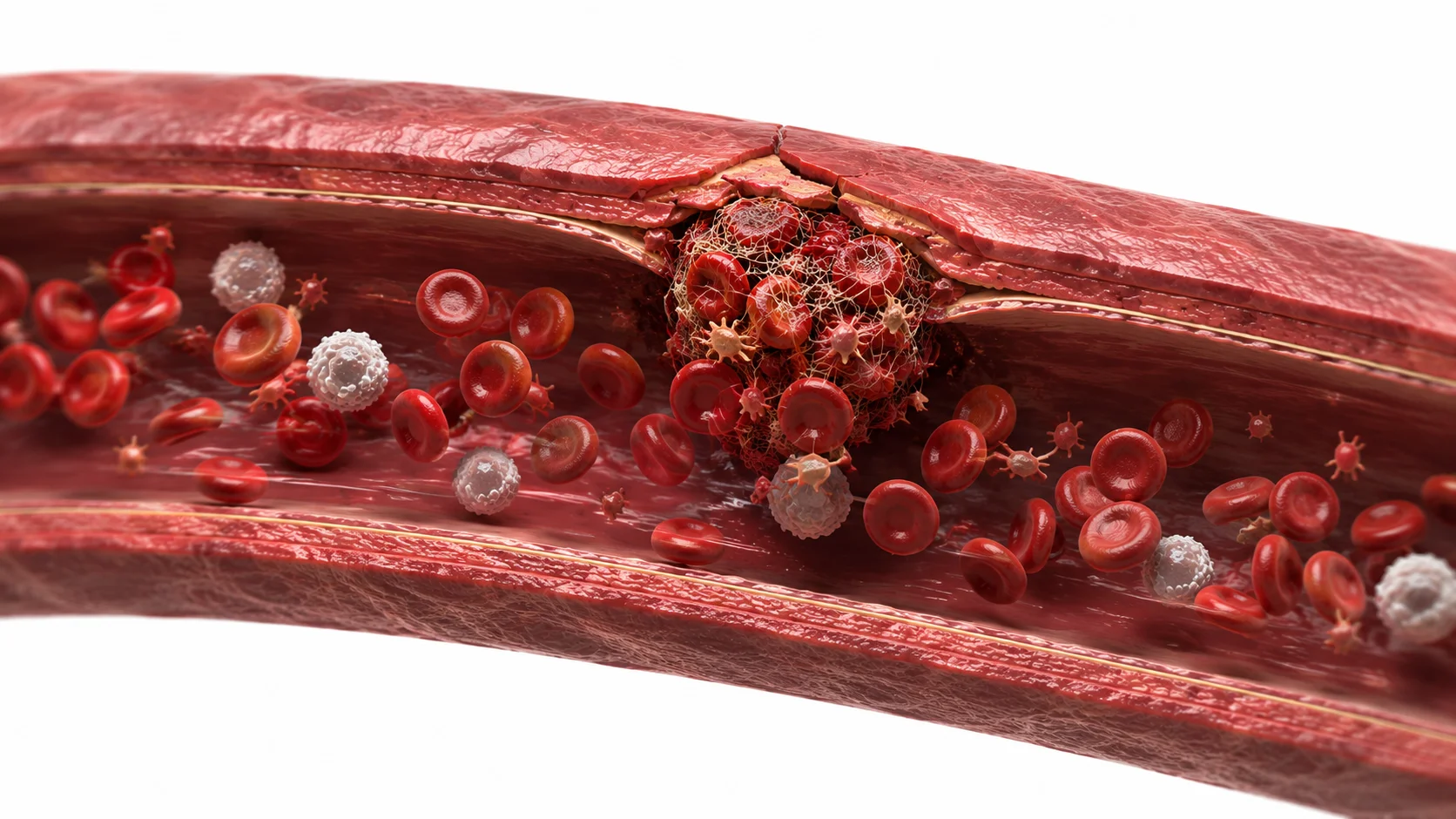
A clot starts as a platelet plug and becomes stronger when fibrin forms a mesh around it.
Vessel damage
The inner wall of a blood vessel is damaged, exposing material that platelets recognize.
Platelet plug
Platelets stick to the damaged area and to each other, forming a quick temporary seal.
Clotting cascade
Clotting proteins activate one another in a chain reaction that amplifies the repair signal.
Fibrin mesh
Fibrin strands weave through the plug, making the clot stronger and more stable.
Platelets
The First Helpers Are Platelets
Platelets are tiny fragments floating through your blood, waiting for trouble.
Most of the time, they pass through vessels quietly. But when a vessel wall is damaged, the hidden material beneath the smooth lining becomes exposed.
Platelets recognize that exposed surface as an alarm. They stick to it, change shape, and become much stickier than before.
Then they call for backup. Chemical signals attract more platelets, and soon a small pile of them forms over the damaged spot.
This first plug is fast, but it is not very strong. It is more like a finger pressed over a leak than a permanent repair.
Fibrin mesh
The Plug Needs a Net
A platelet plug can slow bleeding, but flowing blood is strong. Something tougher is needed.
That is where fibrin comes in.
Fibrin begins as fibrinogen, a soluble protein already floating in the blood. When clotting signals arrive, an enzyme called thrombin converts fibrinogen into fibrin.
Fibrin strands stretch across the platelet plug like threads. They weave through the mass, trap blood cells, and tighten the whole structure.
This is the moment a loose plug becomes a real clot.
The cascade
Why Clotting Works Like a Chain Reaction
The body does not make fibrin casually. It waits for a clear signal that a vessel has been damaged.
That signal launches the coagulation cascade, a sequence of clotting proteins that activate one another step by step.
The beauty of a cascade is amplification. One small injury signal can quickly become a large repair response.
This matters because bleeding is urgent. A slow system would be useless. A small cut can be handled gently, but a deeper injury needs a fast, decisive seal.
The cascade gives the body speed without keeping the whole bloodstream permanently ready to clot.
When clots go wrong
When the Same System Becomes Dangerous
A clot on a wound is a repair. A clot inside the wrong vessel is a threat.
If a clot forms in a deep vein, often in the leg, it can block blood flow and cause pain or swelling. If part of it breaks away and travels to the lungs, it can become a pulmonary embolism.
In arteries, clots can be even more sudden. A fatty plaque in a vessel wall may rupture, making the body think an injury has occurred.
Platelets gather, the clotting cascade begins, and a clot can block blood flow to the heart or brain.
That is why the same biology that saves you from bleeding can also cause a heart attack or stroke.
How clots dissolve
Clots Are Built to Be Removed
A clot is not meant to stay forever.
Once the vessel wall has repaired itself, the clot becomes scaffolding that has done its job.
The body then activates a cleanup system that breaks down fibrin. A protein called plasmin cuts the fibrin mesh apart piece by piece.
This process is slower than clot formation because healing takes time. The body does not want to remove the clot before the vessel is ready.
Eventually, the repair is cleared away and blood flow returns more normally.
Blood thinners
Myth vs Reality
What people think
Blood thinners make blood watery
The phrase makes it sound as if these medicines dilute the blood or change its thickness.
What actually happens
They reduce clotting, not blood thickness
Anticoagulants interrupt specific steps in the clotting process. The blood does not become watery. It simply becomes less likely to form certain dangerous clots.
Quick answers
Common questions
What is a blood clot made of? +
A clot is made from platelets, fibrin strands, trapped red blood cells, and other blood components. Fibrin provides much of the structure.
What is the difference between a thrombus and an embolus? +
A thrombus is a clot that forms and stays in one place. An embolus is something that travels through the bloodstream, often a piece of a clot that broke loose.
Why does aspirin help prevent heart attacks? +
Aspirin reduces platelet stickiness. That can lower the chance of clot formation in narrowed arteries, though it should only be used regularly when medically appropriate.
How does the body know when to stop clotting? +
The body has natural anticoagulant systems that limit clotting to the injury site. These systems help prevent the clotting reaction from spreading through the bloodstream.