Visual answer
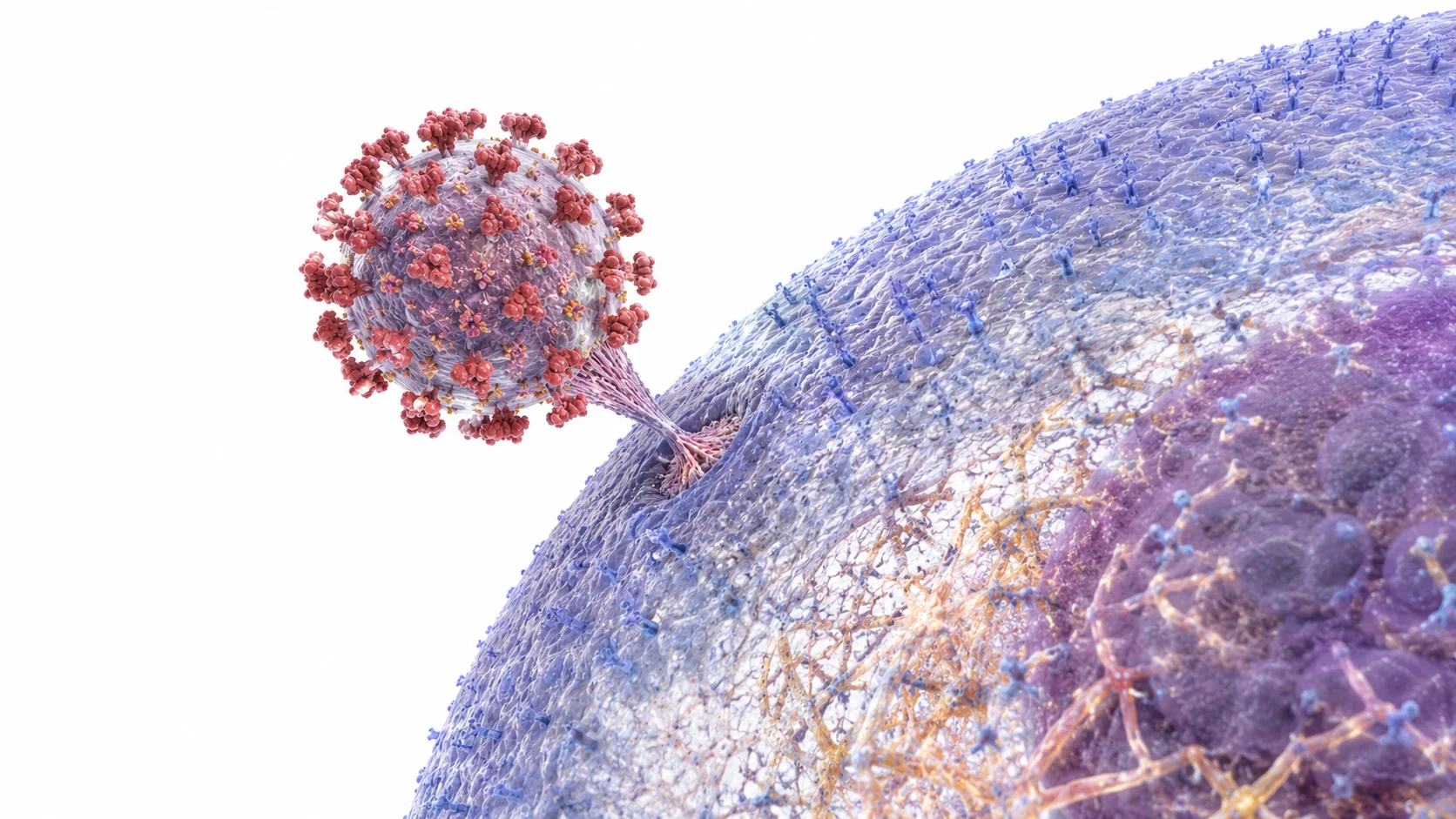
How a Virus Infects a Cell
The step-by-step process by which a virus enters, takes over, replicates, and spreads.
Attachment
The virus encounters a cell and its surface proteins lock onto matching receptors on the cell wall, like a key fitting a lock. This specificity is why most viruses can only infect certain cell types or certain species.
Entry
The virus injects its genetic material, either DNA or RNA, directly into the cell. Some viruses are engulfed whole by the cell. Either way, the viral instructions are now inside.
Takeover
The viral genetic material heads to the cell's nucleus or uses the cell's ribosomes directly. It hijacks the cell's protein-building machinery, forcing the cell to read viral instructions instead of its own.
Replication
The cell begins producing viral proteins and copying the viral genome thousands of times. The cell is now a virus factory, using its own energy and resources to produce copies of its captor.
Assembly
New viral components self-assemble into complete virus particles inside the cell, often with startling efficiency. Hundreds or thousands of new viruses can form in a single infected cell within hours.
Release
New viruses either burst out through the cell wall, killing it, or bud off gradually through the cell membrane. They are now free to infect neighbouring cells and repeat the process.
Are viruses alive?
Are Viruses Actually Alive?
This is one of biology's genuinely open questions. Viruses do not eat, breathe, grow, move, or reproduce on their own. Outside a host cell they are essentially inert chemical packages. Most biologists place them in a category of their own, not quite alive, not quite not.
What viruses do have is genetic information, either DNA or RNA, wrapped in a protein shell called a capsid, and sometimes an outer envelope stolen from the last cell they infected. That genetic information is the entire instruction set for their own replication. They are blueprints looking for a factory.
The question matters more than it might seem. If viruses are not alive, they cannot be killed, only dismantled or blocked. This is why antiviral drugs work very differently from antibiotics, and why the same approach cannot be used for both.
Virus vs bacteria
What Is the Difference Between a Virus and a Bacterium?
Bacteria are single-celled living organisms. They have their own metabolism, reproduce independently, and can be killed by antibiotics that disrupt their cell processes. A bacterial infection is an invasion by an independent living organism.
Viruses are not cells and have no independent metabolism. They are molecular instructions that can only operate inside a host cell. Antibiotics have no effect on viruses because viruses do not have the cellular structures that antibiotics target.
This distinction matters enormously in medicine. Taking antibiotics for a viral illness like the flu or a cold does nothing to treat the infection and contributes to antibiotic resistance, one of the most serious public health problems of the current era.
How vaccines work
How Do Vaccines Stop Viruses?
Vaccines work by showing the immune system a harmless version of a threat before the real one arrives. This can be a weakened or killed virus, a fragment of the virus's protein coat, or, in the case of mRNA vaccines, instructions for your own cells to briefly produce a viral protein.
The immune system responds to this preview by producing antibodies and creating memory cells. These memory cells persist for years or decades. When the actual virus arrives later, the immune system recognises it immediately and launches a rapid response before the infection can take hold.
This is not new technology. The principle of vaccination was understood before germ theory existed. Edward Jenner observed in 1796 that milkmaids who caught cowpox did not get smallpox, and used this observation to create the first vaccine. The disease smallpox caused was subsequently eradicated entirely from the planet in 1980, the only human infectious disease ever to achieve this.
How viruses mutate
How Do Viruses Mutate and Evolve?
Viruses mutate because copying genetic material is never perfectly accurate. Every time a virus replicates, there is a small chance of an error in the copy. Most errors are harmless or lethal to the virus. Occasionally, an error produces a variant that is better at infecting cells, evading the immune system, or spreading between hosts.
RNA viruses mutate particularly fast because their copying enzymes lack the proofreading mechanisms that DNA copying enzymes have. This is why influenza, HIV, and coronaviruses change so rapidly.
Evolution favours viruses that spread efficiently. A virus that kills its host too quickly spreads less far. This is why highly lethal viruses tend to be less successful in the long run than milder ones that allow the host to move around and transmit them further.
Discovery
When We Discovered Something Smaller Than a Bacterium
By the late 1800s, scientists had established that many diseases were caused by bacteria, which could be filtered out of liquid using fine porcelain filters. In 1892, Russian botanist Dmitri Ivanovsky was investigating a disease that devastated tobacco plants. He filtered infected plant sap, expecting to remove all pathogens. The filtered sap still caused disease.
Six years later, Dutch microbiologist Martinus Beijerinck repeated the experiment and concluded that the infectious agent must be something fundamentally different from bacteria. He called it a contagium vivum fluidum, a living contagious fluid. It could pass through filters that stopped bacteria. It could not be grown in a dish. It could only replicate inside living cells.
Beijerinck had discovered viruses without being able to see one. Viruses were not actually visualised until electron microscopes became available in the 1930s. What Ivanovsky and Beijerinck had found was an entirely new category of biological entity, and neither fully grasped what they had done.
Misconception
Common Misconception
What people think
Antibiotics will help fight a virus
When people feel unwell with a cold or flu, the instinct is often to seek antibiotics. Many people feel the prescription validates that something is being done. Doctors in many countries face significant pressure to prescribe them even when they know the illness is viral.
What actually happens
Reality
Antibiotics have absolutely no effect on viruses. They work by targeting structures that bacteria have and human cells do not, such as bacterial cell walls. Viruses have none of these structures. Taking antibiotics for a viral illness does nothing to treat it, disrupts the gut microbiome, and contributes to antibiotic resistance, a growing crisis that threatens to make routine bacterial infections untreatable.
Quick answers
Common questions
Are viruses alive? +
Most biologists say no, or not quite. Viruses cannot eat, grow, move, or reproduce independently. Outside a host cell they are inert chemical packages. They occupy a strange borderland between chemistry and life.
How does a virus enter a cell? +
The virus's surface proteins lock onto matching receptors on the cell wall, specific to each virus type. Some viruses then fuse with the cell membrane and inject their genetic material. Others trick the cell into engulfing them. Either way, the viral genome ends up inside the cell.
Why do antibiotics not work on viruses? +
Antibiotics target specific structures that bacteria have, such as cell walls or ribosomes, that human cells do not have. Viruses have none of these structures. They are not cells at all. Antivirals work differently, typically by blocking the steps in the viral replication cycle rather than attacking cellular structures.
How do viruses spread from person to person? +
Different viruses use different routes. Respiratory viruses spread through droplets or airborne particles when an infected person breathes, coughs, or sneezes. Others spread through physical contact, contaminated surfaces, bodily fluids, or insect vectors like mosquitoes. The route of transmission largely determines how controllable an outbreak is.
How do vaccines work against viruses? +
Vaccines prime the immune system by presenting a harmless version of the virus or one of its proteins. The immune system creates antibodies and memory cells. When the real virus arrives later, the immune system recognises it immediately and neutralises it before a serious infection develops.
What is the difference between DNA and RNA viruses? +
DNA viruses use DNA as their genetic material and tend to be more stable, with slower mutation rates. RNA viruses use RNA and have error-prone copying mechanisms that produce mutations rapidly. Influenza, HIV, and coronaviruses are RNA viruses, which is why they evolve quickly and are harder to vaccinate against permanently.