Quick Facts
Quick Facts
Joan was a peasant girl from Domrémy in eastern France.
She began hearing voices (which she identified as saints) at age 13.
At 17, she convinced the French crown prince to let her lead an army.
She led the French to victory at Orléans in 1429, turning the tide of the war.
She was captured by the English in 1430 and sold to the church court.
Visual answer
The Political Trial of Joan of Arc
How the English used the church to kill a teenage girl.
1429
Joan leads the French army to victory at Orléans. The tide of the Hundred Years' War turns.
May 1430
Joan is captured by the English during a skirmish near Compiègne.
January 1431
The English put Joan on trial for heresy. The court is controlled by English allies.
May 30, 1431
Joan is burned at the stake in Rouen. She is 19 years old.
1456
A posthumous retrial overturns the conviction. Joan is declared innocent.
1920
Joan is canonized as a saint by the Catholic Church.
Story in brief
Story in Brief
1425
Joan begins hearing voices. She identifies them as Saint Michael, Saint Catherine, and Saint Margaret.
1429, February
Joan convinces the French crown prince, Charles, to let her lead an army to Orléans.
She is 17 years old. She has never fought a battle.
1429, May
Joan leads the French to victory at Orléans. The siege is broken. The English retreat.
1429, July
Charles is crowned king of France at Reims. Joan stands beside him.
She has fulfilled her mission. She wants to go home. Charles wants her to keep fighting.
1430, May
Joan is captured by the English. They pay 10,000 francs for her.
1431, January-May
Joan is tried for heresy. The judges are loyal to the English.
She is convicted. She is burned at the stake on May 30.
1456
A new trial, ordered by the Pope, overturns the conviction. Joan is declared innocent.
It is too late. She has been dead for 25 years.
The Story
How a Peasant Girl Changed History and Was Killed for It
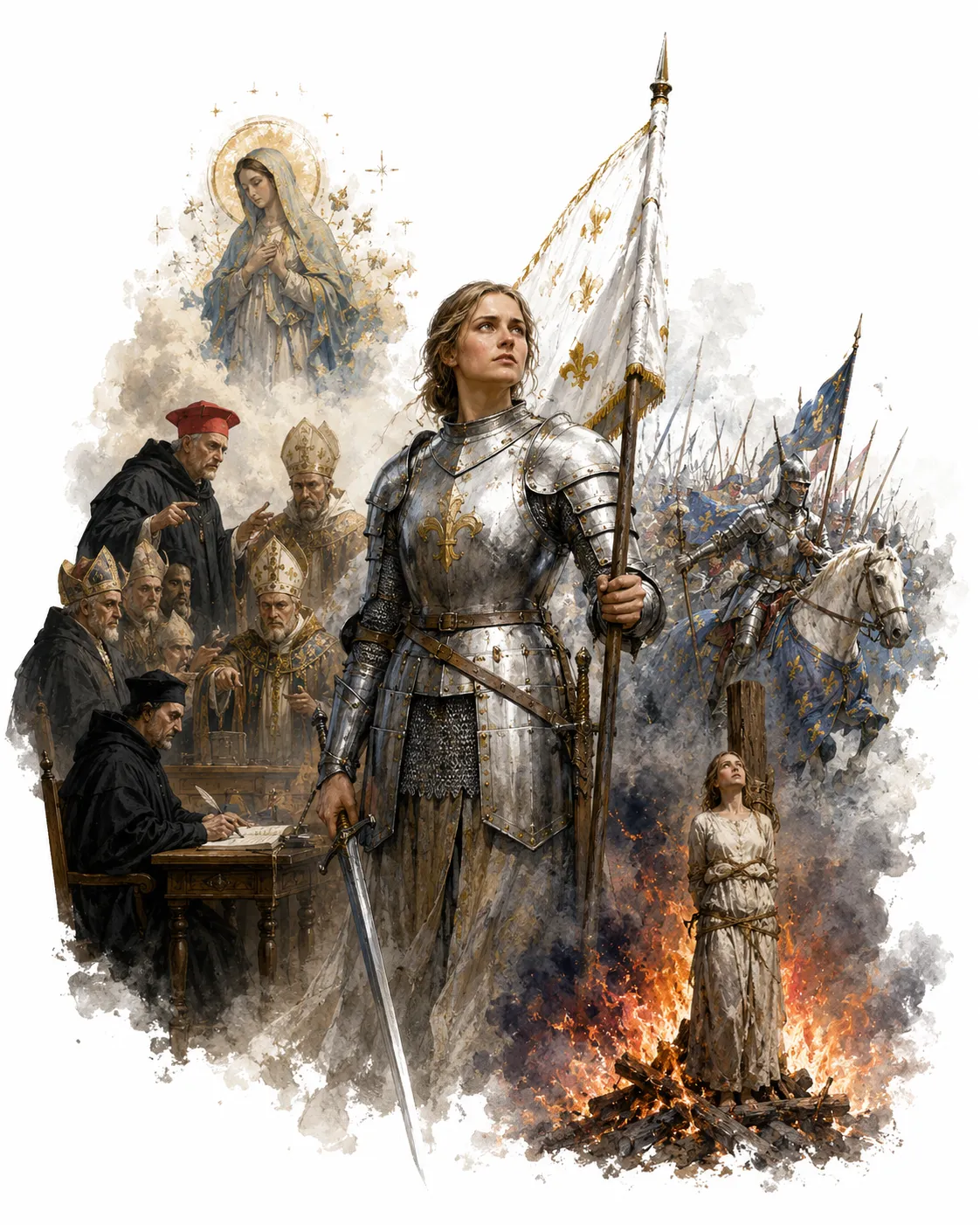
Joan of Arc was 17 years old when she met the future king of France. She told him that God had sent her to save France. The English were winning the Hundred Years' War. The French were desperate. Charles gave her an army.
Joan led the French to victory at Orléans. The English siege was broken. She followed up with more victories. Charles was crowned king. The tide of the war had turned. Joan wanted to go home. She had done what the voices asked. Charles wanted her to keep fighting.
She was captured by the English in 1430. They paid 10,000 francs for her. They wanted her dead. But they could not just kill her. She was a prisoner of war. So they turned her over to a church court controlled by English allies. The court found her guilty of heresy. The main charge was wearing men's clothing. The real crime was winning battles. She was burned alive on May 30, 1431. She was 19 years old.
Famous Quote
"I am not afraid. I was born to do this."
, Joan of Arc (attributed)
She said this before battle. She lived her life without fear. It is what made her dangerous to her enemies.
Evidence
Why Joan Was Executed
She claimed to hear divine voices. The church considered this heresy.
StrongShe wore men's clothing. This was forbidden by church law.
StrongThe trial was politically motivated. The English wanted her dead.
StrongShe had humiliated the English on the battlefield. They wanted revenge.
StrongKey Points
Key Points So Far
Joan led the French army to victory at Orléans when she was 17.
She was captured by the English at 19.
She was tried for heresy in a politically controlled court.
She was burned at the stake on May 30, 1431.
A posthumous retrial overturned the conviction in 1456.
Analogy
Like a Show Trial
The familiar part
Imagine a trial where the verdict is decided before the trial begins. The accused has no chance. The outcome is predetermined.
How it applies
That was Joan's trial. The judges were loyal to the English. The verdict was decided before she walked into the courtroom. It was not justice. It was theater.
Where the analogy breaks
Show trials usually have professional prosecutors. Joan faced priests who had already decided she was guilty.
Curiosity Notes
Details Most People Miss
Why this still matters
Why This Still Matters
Joan of Arc is still remembered because she was a symbol of courage. She was a teenage girl who defied an empire. She won battles. She crowned a king. She was killed by her enemies. Then she was declared a saint. Her story is a reminder that power does not always win. Sometimes a teenage girl with a sword and a voice can change the world. And sometimes the world kills her for it. But she is still remembered. Her executioners are forgotten.
Key Findings
- ✓Core findingJoan of Arc was burned at the stake for heresy on May 30, 1431.
- ✓Strong evidenceShe was 19 years old. The trial was politically motivated by the English.
- ⚠Main consequenceShe had led the French army to victory at Orléans, turning the tide of the Hundred Years' War.
- ✓Wider legacyHer conviction was overturned in a posthumous retrial in 1456.
- ★Bottom lineShe was canonized as a saint in 1920.
Final insight
A Last Thought
Joan of Arc was burned at the stake because she won. The English could not defeat her on the battlefield. So they killed her in a courtroom. It was not justice. It was murder. And it did not work. Joan's death inspired the French to keep fighting. Within 20 years, the English were driven out of France. Joan won. Even in death, she won. That is why she is a saint. That is why we remember her.
Quick answers
Common questions
Did Joan of Arc really hear voices? +
She believed she did. The voices told her to save France. Modern psychologists might diagnose her with a condition. But to her, the voices were real. And they changed history.
What happened to her remains? +
Her body was burned twice. The ashes were thrown into the Seine River to prevent relic hunters from collecting them. No physical remains survive.