Quick Facts
Quick Facts
France's debt from helping the American Revolution (1775-1783) was enormous.
The nobility and clergy paid almost no taxes. The peasants paid almost all.
The harvest of 1788 was the worst in decades.
The Bastille, when stormed, held only seven prisoners.
The revolution became increasingly violent. The Reign of Terror (1793-1794) killed over 40,000 people.
Visual answer
The Explosion of the French Revolution
How debt, hunger, and inequality combined to destroy a monarchy.
Royal Debt
France's support for the American Revolution bankrupts the treasury.
Bad Harvests
1788 and 1789 bring famine. Bread prices skyrocket.
Tax Inequality
The rich pay nothing. The poor pay everything.
Estates-General Convened
The king calls a meeting to raise taxes. It backfires.
Third Estate Revolts
Commoners declare themselves the National Assembly.
Storming of the Bastille
July 14, 1789. The revolution begins.
Story in brief
Story in Brief
1774
Louis XVI becomes king. He is young, well-meaning, and weak.
1775-1783
France supports the American Revolution, spending huge sums.
The victory was sweet. The bill was bitter.
1788
A catastrophic harvest leads to widespread hunger.
May 5, 1789
The Estates-General meets for the first time in 175 years.
June 17, 1789
The Third Estate declares itself the National Assembly.
The revolution's first act of defiance.
July 14, 1789
The Bastille is stormed.
August 26, 1789
The Declaration of the Rights of Man is adopted.
The revolution's founding document. It still influences human rights laws today.
The Story
The King Could Not Even Raise Taxes
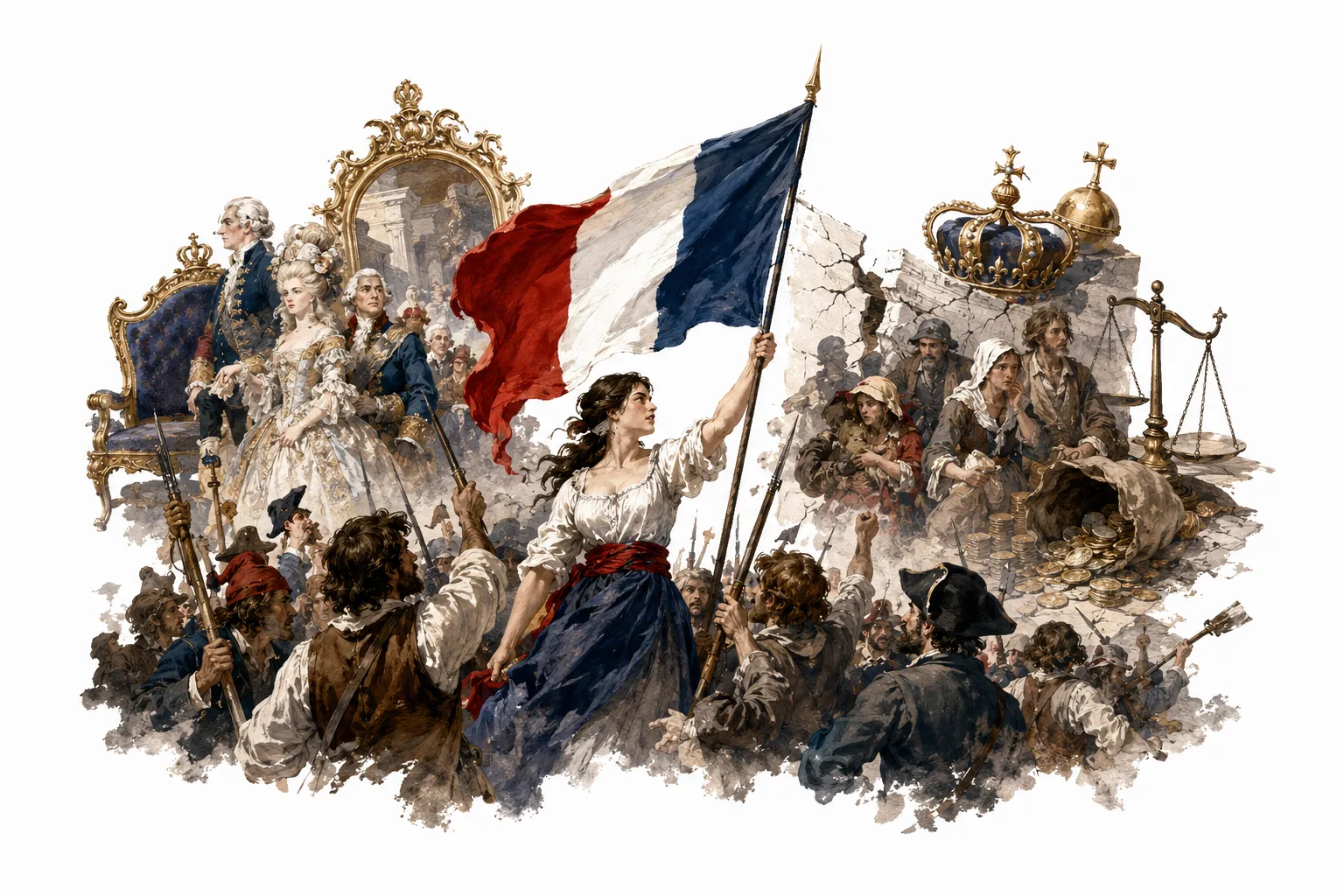
By 1789, France was in deep trouble. The government had borrowed so much money that half the national budget went to paying interest on the debt. The king wanted to raise taxes, but the nobility, who paid almost nothing, refused to approve new taxes on themselves.
So Louis XVI did something no French king had done in 175 years. He called a meeting of the Estates-General, a kind of parliament representing the three 'estates' of French society: the clergy (First Estate), the nobility (Second Estate), and everyone else (Third Estate). The Third Estate, which represented 98% of the population, got the same number of votes as the other two estates combined, but each estate voted as a bloc.
The Third Estate quickly realized they would always lose. So they walked out, formed their own National Assembly, and swore an oath to write a constitution. The king tried to lock them out of their meeting hall. They moved to a nearby tennis court and kept meeting. The revolution had begun.
Famous Quote
"Let them eat cake."
, Attributed to Marie Antoinette (almost certainly falsely)
The quote actually appeared in a book by Jean-Jacques Rousseau written when Marie Antoinette was a child. But the story stuck because it perfectly symbolized the monarchy's detachment from the suffering of the poor.
Evidence
The Causes of the French Revolution
Royal debt from the American Revolution and wars.
StrongTax inequality: the rich paid almost nothing.
StrongBad harvests led to famine and rising bread prices.
StrongEnlightenment ideas challenged the monarchy.
ModerateKey Points
Key Points So Far
France was bankrupt. The nobility refused to pay taxes.
Bad harvests caused famine. Bread prices skyrocketed.
The Estates-General was called. The Third Estate walked out.
The storming of the Bastille on July 14, 1789, is the symbolic start.
Analogy
Like a Family That Spent Too Much on a Vacation
The familiar part
Imagine a family that takes a luxurious vacation (helping the American Revolution). They put it on credit cards. Now they cannot pay the mortgage or buy groceries.
How it applies
That was France in 1789. The king had spent lavishly on wars and palaces. The people were starving. When the king asked the rich to contribute, they said no. The poor decided to take matters into their own hands.
Where the analogy breaks
When a family goes bankrupt, they do not usually chop off the father's head. The French Revolution did.
Curiosity Notes
Details Most People Miss
Why this still matters
Why This Still Matters
The French Revolution is the event that created modern politics. Before the revolution, most countries were monarchies. After the revolution, the idea spread that government should be based on the consent of the governed. The revolution also showed the dark side of that idea: when revolutions go bad, they can become more brutal than the regimes they replace. The tension between liberty and order, between equality and fear, is still being played out in politics today.
Key Findings
- ✓Core findingThe French Revolution started in 1789 due to debt, famine, and tax inequality.
- ✓Strong evidenceThe Third Estate (commoners) broke away from the Estates-General and formed a National Assembly.
- ⚠Main consequenceThe storming of the Bastille on July 14, 1789, is the symbolic start of the revolution.
- ✓Wider legacyThe revolution became increasingly violent, culminating in the Reign of Terror (1793-1794).
- ★Bottom lineThe revolution ended with Napoleon's coup in 1799.
Final insight
A Last Thought
The French Revolution began with noble ideals: liberty, equality, and fraternity. It ended with a military dictator, a guillotine that could not stop killing, and a Europe at war for over two decades. The lesson is uncomfortable: good intentions do not guarantee good outcomes. The revolutionaries wanted to create a just society. They created chaos, then tyranny. And then, years later, out of that chaos, they created democracy anyway. History is not a straight line. It is a circle. And revolutions, even the bloody ones, can still change the world for the better. Eventually.
Quick answers
Common questions
Did Marie Antoinette really say 'Let them eat cake'? +
Almost certainly not. The phrase appears in a book written when she was a child. She was an unpopular queen, so the story stuck. The real Marie Antoinette was not a monster, but she was deeply out of touch with the suffering of the poor.
What was the Reign of Terror? +
A period from 1793 to 1794 when the revolutionary government, led by Robespierre, executed tens of thousands of people suspected of opposing the revolution. Many were killed by guillotine in public executions designed to spread fear.