Quick Facts
Quick Facts
Gandhi trained as a lawyer in London. He was shy and nervous at first.
He developed his philosophy of nonviolence while fighting racism in South Africa.
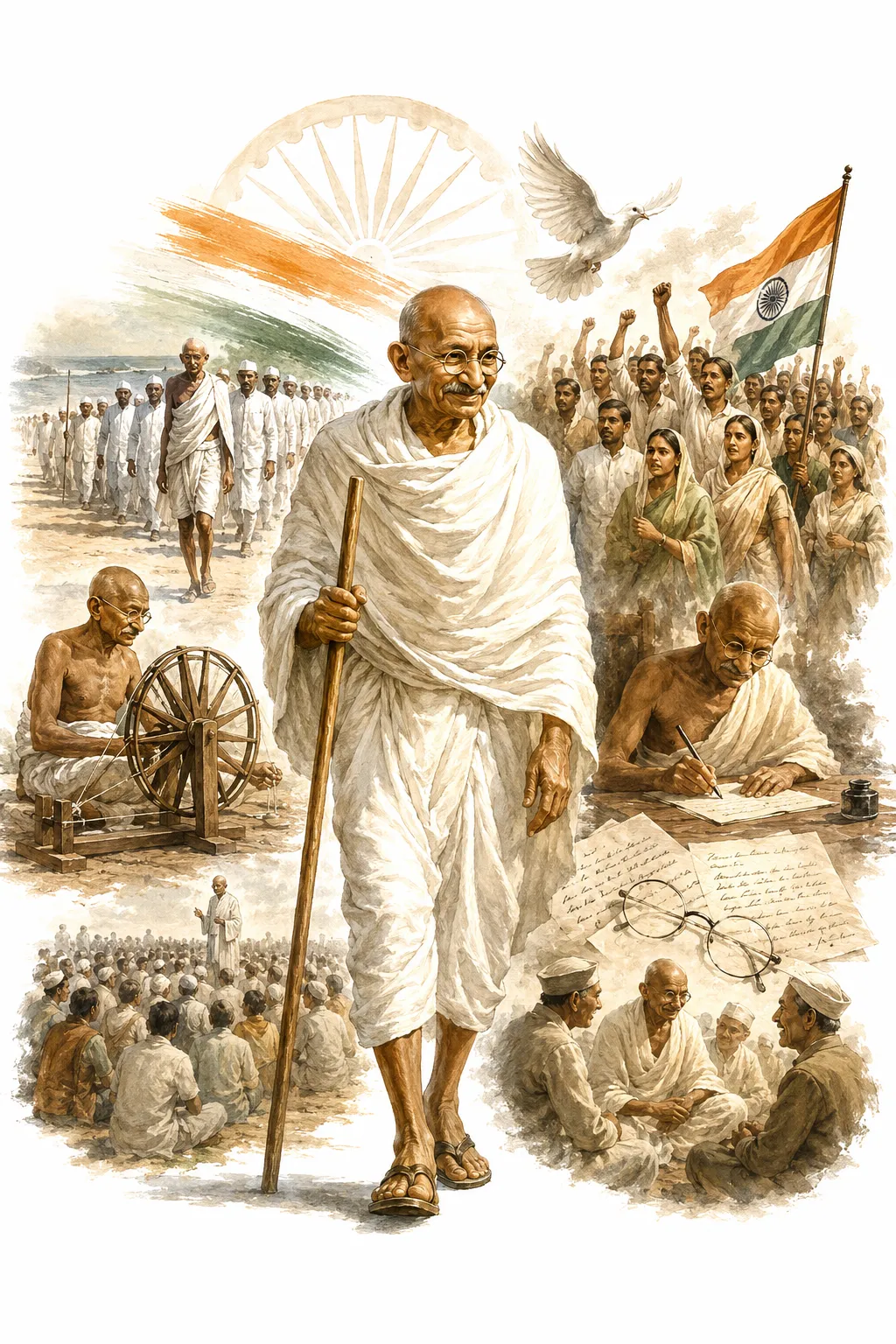
The Salt March was 240 miles. Gandhi walked for 24 days.
He was imprisoned many times. He spent over 2,000 days in jail.
He was assassinated by a Hindu nationalist who thought he was too friendly to Muslims.
Visual answer
Gandhi's Methods of Nonviolent Resistance
The tools he used to defeat an empire.
Boycotts
Gandhi urged Indians to stop buying British cloth and to spin their own. The British textile industry lost millions.
Marches
The Salt March was a 240-mile protest against the British salt tax. It drew global attention.
Fasting
Gandhi fasted to protest injustice and to stop violence between Hindus and Muslims.
Civil Disobedience
Refusing to obey unjust laws and accepting the punishment.
Story in brief
Story in Brief
1893
Gandhi is thrown off a South African train for being Indian. He begins fighting racism.
This event radicalized him. He decided to stay in South Africa and fight.
1915
Gandhi returns to India and joins the independence movement.
1920
He launches a non-cooperation campaign against British rule. He is arrested.
1930
The Salt March. Gandhi walks 240 miles to the sea to make salt illegally.
The march made global headlines. It was a public relations disaster for Britain.
1942
Quit India Movement. Gandhi calls for immediate independence. He is arrested and held for two years.
1947
India gains independence. Britain leaves.
Gandhi's dream had come true. But India was divided into two countries, India and Pakistan.
1948
Gandhi is assassinated by a Hindu nationalist.
He died trying to stop violence between Hindus and Muslims.
The Story
How a Man in a Loincloth Defeated an Empire
In 1930, the British Empire ruled India. It was the jewel in the crown of the largest empire in history. The British had guns, tanks, and airplanes. Gandhi had a walking stick and a belief in nonviolence.
He announced that he would walk to the sea to make salt. The British had a monopoly on salt. Making your own salt was illegal. Gandhi's 240-mile march drew thousands of followers. When he reached the sea, he picked up a handful of salt. Millions of Indians did the same.
The British arrested over 60,000 people. They beat peaceful protesters. The world watched. The British Empire, which prided itself on civilization, looked like a bully. Within 17 years, the British were gone. India was free. Gandhi had not fired a single shot.
Famous Quote
"Be the change that you wish to see in the world."
, Mahatma Gandhi (attributed)
This quote captures his philosophy perfectly. He did not wait for others to change. He changed himself. He spun his own cloth. He grew his own food. He lived the life he wanted others to live.
Evidence
Why Gandhi Is Remembered
He led India to independence without a violent revolution.
StrongHe inspired Martin Luther King Jr and the American civil rights movement.
StrongHe invented modern nonviolent resistance.
StrongHe is considered the father of modern India.
StrongKey Points
Key Points So Far
Gandhi developed nonviolent resistance while fighting racism in South Africa.
He led the Indian independence movement using boycotts, marches, and fasting.
The Salt March of 1930 was a turning point. It drew global attention.
India gained independence in 1947.
Gandhi was assassinated in 1948 by a Hindu nationalist.
Analogy
Like Shining a Light on Injustice
The familiar part
Imagine someone doing something wrong in a dark room. They think no one can see them. Then someone turns on a light.
How it applies
Gandhi turned on the light. The British Empire was doing wrong in India. Gandhi showed the world. Once the world was watching, the British could not continue. They left.
Where the analogy breaks
Turning on a light does not usually take 30 years. Gandhi's campaign took decades. But the light did turn on eventually.
Curiosity Notes
Details Most People Miss
Why this still matters
Why This Still Matters
Gandhi's methods are still used today. The Arab Spring, the Hong Kong protests, the Climate Strike movement all use nonviolent civil disobedience. Gandhi proved that you do not need weapons to fight injustice. You need courage, organization, and the willingness to suffer for what you believe. That lesson has not aged. It is as fresh as it was in 1930. The British Empire is gone. But injustice is not. And the tools Gandhi gave us still work.
Key Findings
- ✓Core findingGandhi led India to independence using nonviolent resistance.
- ✓Strong evidenceHe developed his philosophy in South Africa while fighting racism.
- ⚠Main consequenceThe Salt March of 1930 was his most famous campaign.
- ✓Wider legacyHe inspired Martin Luther King Jr and other civil rights leaders.
- ★Bottom lineHe was assassinated in 1948 by a Hindu nationalist.
Final insight
A Last Thought
Mahatma Gandhi was not a perfect man. He was a racist as a young man. He had strange beliefs about diet and sex. He slept next to young women to test his celibacy. He failed to stop the partition of India. He was killed by one of his own countrymen. And yet, he is still remembered as one of the greatest people of the 20th century. Because he tried. He tried to be better. He tried to love his enemies. He tried to tell the truth. He failed sometimes. But he never stopped trying. That is the real lesson of Gandhi. Not perfection. Persistence.
Quick answers
Common questions
What does 'Mahatma' mean? +
It means 'great soul.' It was a title given to Gandhi by the poet Rabindranath Tagore. Gandhi himself did not like the title. He preferred to be called 'Bapu,' which means 'father.'
Did Gandhi really walk 240 miles? +
Yes. The Salt March lasted 24 days. Gandhi walked about 10 miles per day. He was 60 years old at the time. Thousands of people joined him along the way.