Quick Facts
Quick Facts
Mark Twain was born during Halley's 1835 appearance and died during its 1910 appearance, exactly as he predicted.
The comet is essentially a giant dirty snowball made of ice, dust, and rock.
It has been observed by humans for over 2,000 years, appearing in the Bayeux Tapestry.
In 1910, people bought 'comet pills' and gas masks to survive the comet's tail passing through Earth's atmosphere.
The Prediction
Calling the Shot
Before Edmond Halley came along, comets were terrifying. They just appeared. No one knew where they came from or where they went. They were considered atmospheric phenomena, or messages from an angry God.
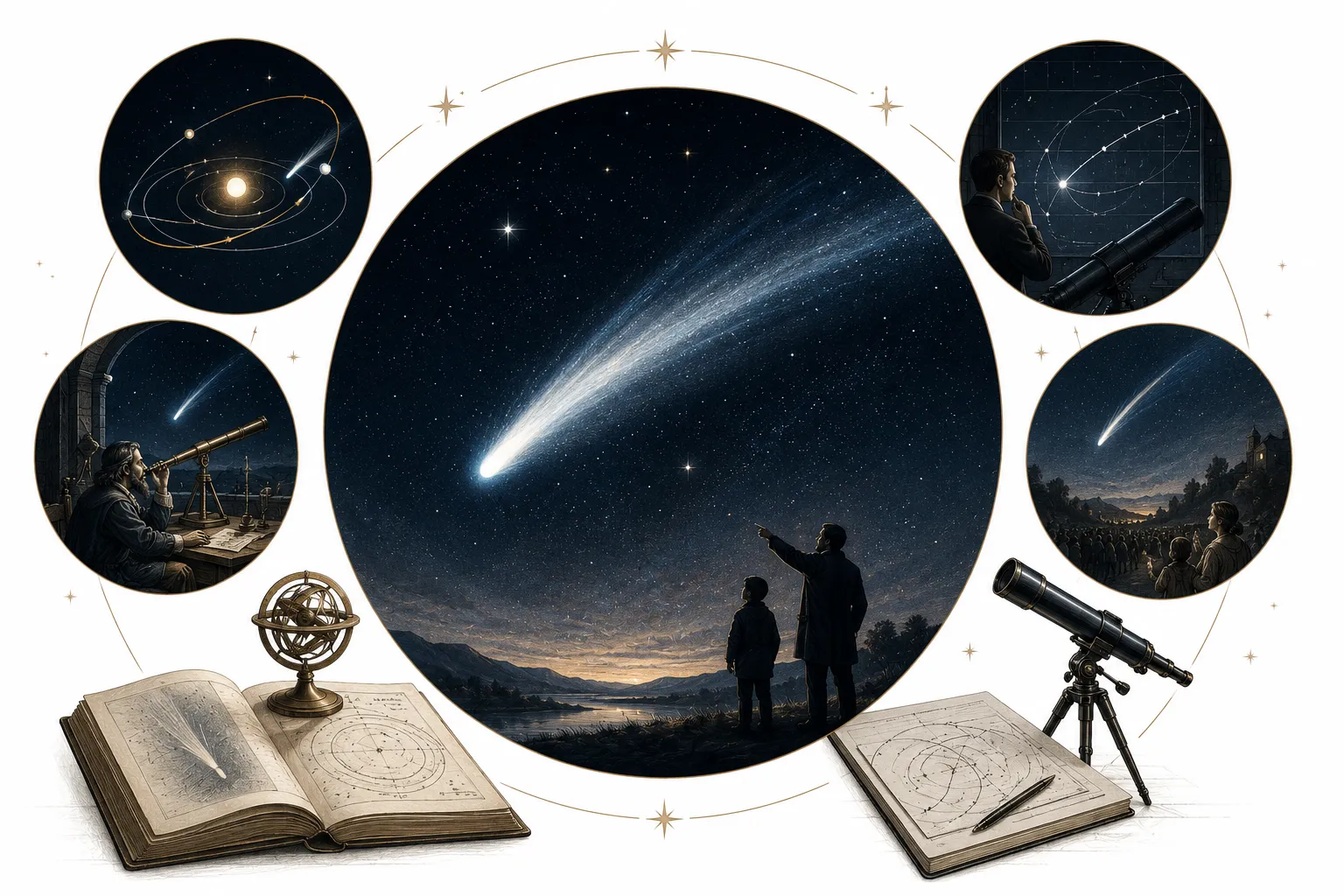
Halley, using his friend Isaac Newton’s new laws of gravity, looked at the orbits of a few comets from 1531, 1607, and 1682. He realized they were the exact same object. He calculated it would come back in 1758.
Halley died before he could see if he was right. But on Christmas night, 1758, a German farmer and amateur astronomer named Johann Palitzsch spotted it. Halley’s guess was correct. Science had just tamed a ghost.
Timeline
A History of Appearances
Earliest recorded sighting by Chinese astronomers.
240 BCEProves the comet has been a regular visitor for millennia.
Appears before the Battle of Hastings. Depicted in the Bayeux Tapestry.
1066It became a cultural symbol of upheaval.
Edmond Halley publishes his prediction that the comet will return in 1758.
1705The first time a comet's return was mathematically predicted.
The Earth passes through the comet's tail. Mass panic ensues.
1910Showed that scientific literacy had not kept pace with scientific discovery.
Analogy
Like a Ghost Train on a Schedule
The familiar part
Imagine a ghost train that appears out of the fog once every 75 years. Everyone thinks it's a supernatural illusion. Then a detective figures out the tracks, calculates the schedule, and predicts exactly when it will arrive next.
How it applies
That is what Halley did. He found the invisible tracks (gravity) and put a schedule to a ghost.
Where the analogy breaks
A train is powered by coal. A comet is just falling. It has no engine; it is perpetually losing energy and slowly spiraling.
Curiosity Notes
Details Most People Miss
Why this still matters
Why This Still Matters
Halley's Comet proved that the universe runs on rules. If you can predict a comet, you can predict an eclipse, a planet's position, or an asteroid's path. It was the moment humanity realized the cosmos wasn't chaos; it was a clock. We just needed to learn to read the face.
Key Findings
- ✓Core findingIt is the only short-period comet visible to the naked eye.
- ✓Strong evidenceEdmond Halley predicted its return using Newton's laws of gravity.
- ⚠Main consequenceIts successful return in 1758 proved comets orbit the sun.
- ✓Wider legacyIt caused a mass panic in 1910 when Earth passed through its tail.
Final insight
A Last Thought
Halley's Comet is famous because it was the first comet that lost its mystery. It went from being a terrifying omen to a predictable neighbor. It showed us that the universe is not a place of random magic, but a place of beautiful, calculable physics. Plus, it gave Mark Twain the best exit line in literary history.
Quick answers
Common questions
When will Halley's Comet come back? +
July 28, 2061. Mark your calendar.
Is Halley's Comet dangerous? +
No. It is a fragile snowball. Its tail is less dense than the best vacuum on Earth.