Quick Facts
Quick Facts
The phenomenon is named after Tanzanian student Erasto Mpemba.
Hot water often loses mass through evaporation.
Warmer water circulates differently inside the container.
Scientists still debate which mechanism is most important.
Visual answer
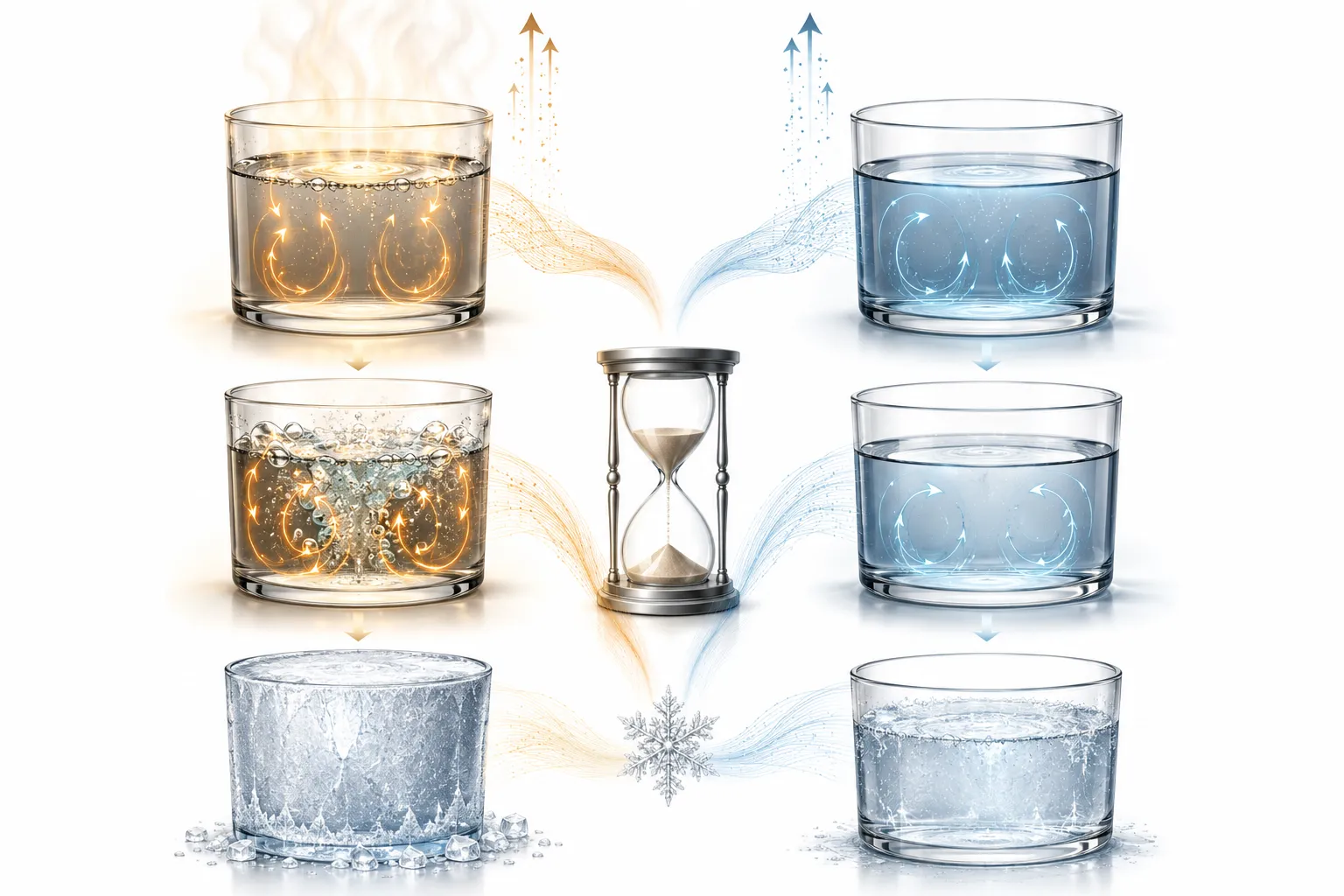
How hot water can freeze faster
The diagram shows several conditions that can let initially hot water overtake colder water during freezing.
Evaporation
Hot water can lose mass before freezing.
Convection
Temperature currents can move heat out more efficiently.
Conditions vary
Container shape, freezer airflow, and impurities can change the outcome.
The Surprise
It Doesn't Always Happen
If you place two identical containers of water into a freezer, the colder one usually freezes first. Physics remains reassuringly sensible most of the time.
The surprise is that under certain carefully controlled conditions, the hotter water occasionally reaches the finish line first.
That's why scientists describe the Mpemba effect as an unusual phenomenon rather than a universal rule.
Possible Reasons
The Water Changes As It Cools
Hot water evaporates more quickly, leaving less water behind to freeze.
It also develops stronger convection currents, constantly mixing warmer and cooler layers.
Heating removes some dissolved gases, and hot water may supercool differently than cold water. Together, these effects can occasionally allow hot water to freeze first.
Analogy
The Unexpected Shortcut
The familiar part
Imagine two cyclists heading to the same destination. One starts farther back but takes a route with fewer traffic lights and arrives first.
How it applies
Hot water begins hotter, but evaporation, convection, and other effects can sometimes give it unexpected advantages during the race to freezing.
Where the analogy breaks
Fortunately, water never argues about who technically won.
Curiosity Notes
Details Most People Miss
Why this still matters
Why This Still Matters
The Mpemba effect reminds scientists that even one of Earth's most familiar substances still holds surprises. Water continues to challenge researchers in fields ranging from climate science to engineering.
Key Findings
- ✓Core findingHot water usually does not freeze faster.
- ✓Strong evidenceUnder certain conditions it can, in what's called the Mpemba effect.
- ⚠Main consequenceSeveral physical processes may contribute at the same time.
- ✓Wider legacyScientists are still investigating why the effect occurs.
Final insight
A Last Thought
Water has a remarkable talent for refusing to be ordinary. It expands when it freezes, floats as a solid, and occasionally seems to ignore common sense by freezing faster when it starts out hotter. If any everyday substance deserves a reputation for keeping scientists humble, it's water.
Quick answers
Common questions
Can I test the Mpemba effect at home? +
Yes, but don't expect it every time. Small differences in containers, water volume, freezer conditions, and starting temperatures can change the outcome.
Who discovered the Mpemba effect? +
The phenomenon was known in ancient times, but it is named after Erasto Mpemba, whose observations in the 1960s revived scientific interest.