Quick Facts
Core Materials Science Facts
Crazing differs from shear yielding: crazing involves volume expansion and void formation, whereas shear yielding changes shape without density change.
The micro-voids in a craze are stabilized by thin polymer 'fibrils' bridging the gap before catastrophic fracture occurs.
Stress whitening is an early warning indicator of material fatigue and impending crack propagation.
Engineered polypropylene 'living hinges' utilize organized polymer orientation to sustain millions of flexes without breaking.
Visual answer
Polymer Chain Micro-Void Formation & Light Scattering
Tensile stress stretches polymer chains apart, opening micro-voids that reflect and scatter incident light rays.
Tensile Bending Stress
The outer radius of the bend experiences high stretching force.
Fibril Formation & Micro-Voids
Polymer chains pull into thin fibrils separated by 10-100 nm air gaps.
Diffuse Light Scattering
Light rays hit the refractive index boundary between polymer and air voids, scattering diffusely as white light.
Polymer Crazing
1. The Molecular Physics of Crazing
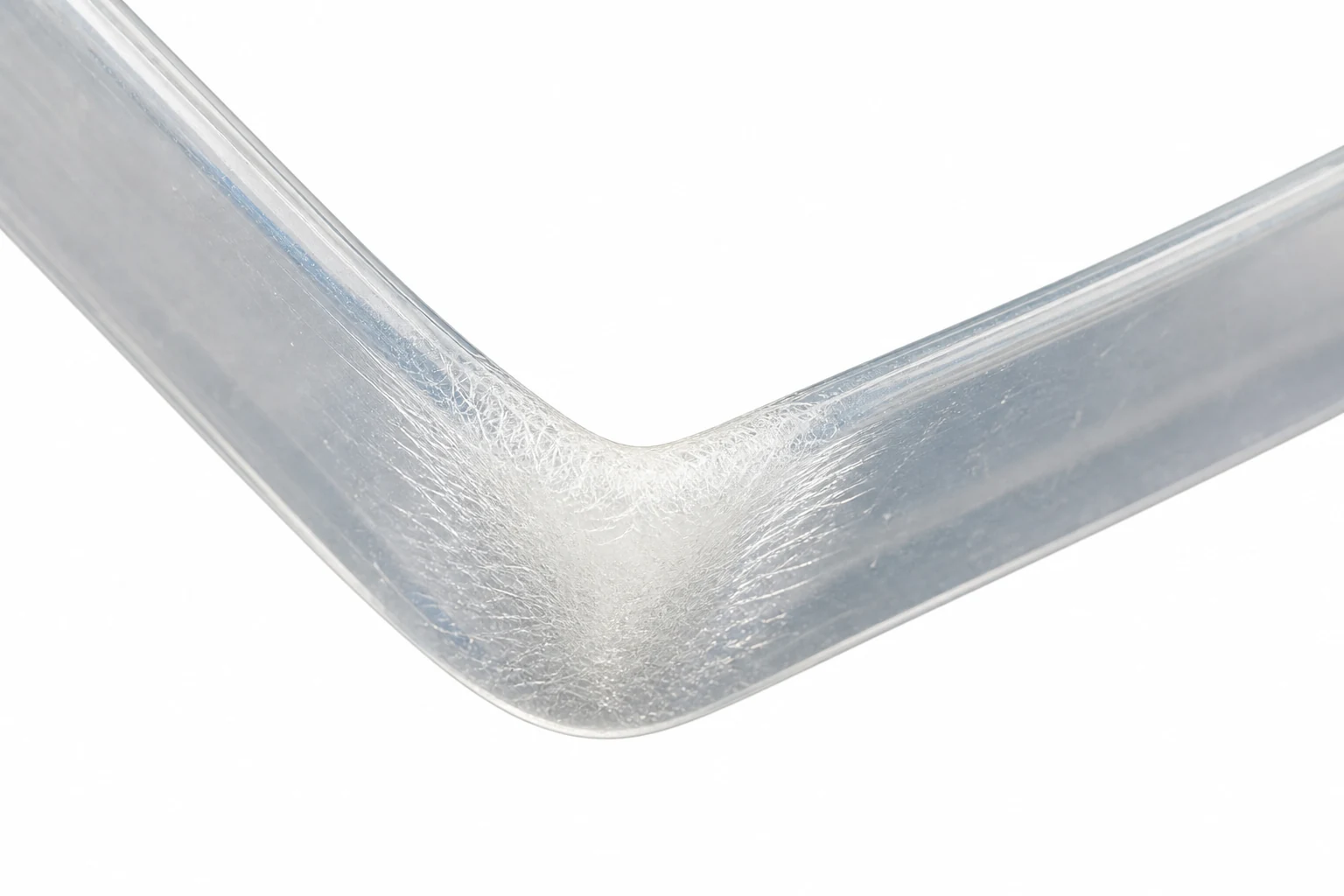
Plastics (polymers) consist of long, intertwined chains of repeating monomer units. When a plastic bar is bent, the outer curve experiences severe tensile (pulling) stress.
In glassy or semi-crystalline polymers, this tension initiates micro-crazes perpendicular to the stress direction. Small clusters of polymer chains stretch into thin, oriented threads called 'fibrils', leaving nanometer-wide air voids between them.
Because air has a refractive index ($n \approx 1.0$) drastically lower than the surrounding polymer matrix ($n \approx 1.49 - 1.59$), light passing through the bent region hits thousands of internal optical boundaries.
Light Scattering
2. Why Micro-Voids Appear Pale White
Why does scattering make the plastic look white instead of colored or dark?
The nanometer-scale micro-voids (typically 10 to 100 nanometers wide) scatter all wavelengths of visible light (red, green, blue) equally. This process, known as Mie scattering, is identical to how cloud droplets and snow crystals scatter sunlight.
Instead of light passing cleanly through the transparent plastic, the scattered white light bounces back to your eyes from the crease.
Living Hinges
3. Polypropylene & The Engineering of Living Hinges
If stress whitening indicates damage, why don't flip-top ketchup and shampoo bottle lids snap right off?
Living hinges are thin flexible strips molded directly between two plastic parts, almost exclusively made from polypropylene (PP). During injection molding, molten polypropylene is forced through a narrow hinge gate, causing the polymer chains to align parallel to the direction of flow.
When the hinge is flexed for the first time, this pre-aligned crystalline structure undergoes controlled molecular orientation rather than destructive crazing. Although it may show slight stress whitening, the aligned polymer fibrils absorb flexing strain for over a million open-and-close cycles.
Curiosity Notes
Details Most People Miss
Why this still matters
Why This Science Matters
Understanding stress whitening helps engineers design safer consumer products, from child-resistant pill bottle caps to durable automotive dashboard latches, by selecting the right polymer chemistry for mechanical strain.
Key Findings
- ✓Core findingStress whitening is caused by microscopic voids ('crazing') formed when polymer chains pull apart under bending tension.
- ✓Strong evidenceAir voids create refractive index boundaries that scatter all visible light wavelengths equally (Mie scattering).
- ⚠Main consequencePolypropylene living hinges resist failure because their polymer chains are pre-aligned during manufacturing.
Final insight
A Light-Scattering Record of Stress
The white crease on a bent plastic object is a optical confession written in nanometer voids—showing exactly where polymer chains fought against mechanical tension until light was forced to bounce back.
Quick answers
Common questions
Can you remove a white stress mark on plastic with heat? +
Applying mild heat (like a heat gun) can sometimes relax the polymer chains and close small micro-voids, reducing the white appearance, but the structural strength at the crease remains permanently reduced.
Do all plastics turn white when bent? +
No. Highly flexible elastomeric plastics (like silicone or rubber) undergo shear yielding without forming micro-voids, so they do not show stress whitening.