Visual answer
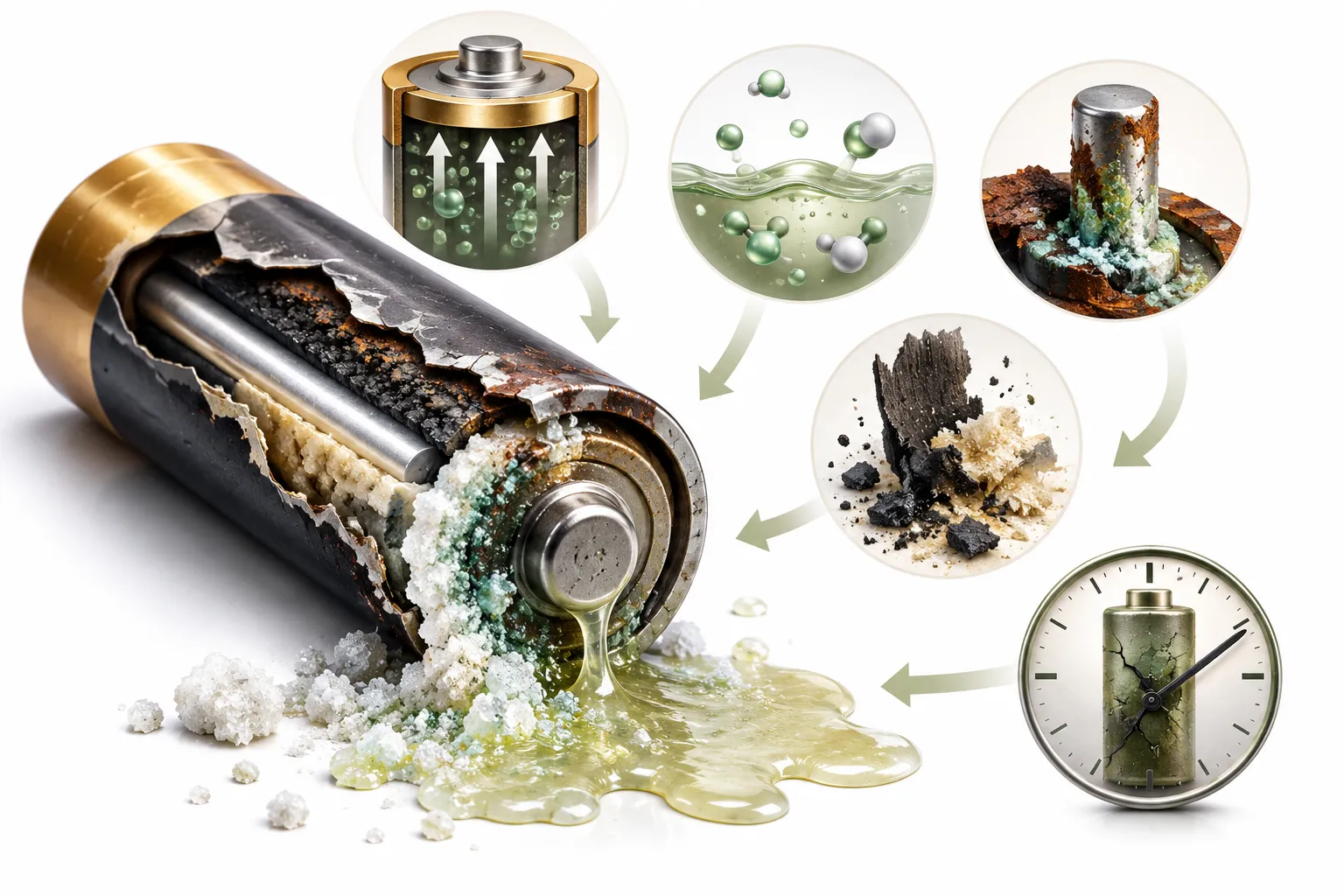
The Pressure-Cooker Failure
How over-discharging leads to a ruptured seal.
The Parasitic Drain
A device left on continues to pull current from a dead battery, forcing unwanted chemical reactions.
Hydrogen Gas Buildup
The degraded zinc anode produces hydrogen gas faster than the battery can internally reabsorb it.
Seal Rupture
Internal pressure exceeds the structural limit of the crimped metal seal at the top or bottom of the can.
Electrolyte Escape
The highly alkaline potassium hydroxide paste is pushed out through the breach, corroding the device contacts.
Where We Stand
Sealed Pressure Vessels
Current state
An alkaline battery is not just a container of energy; it is a miniature, sealed chemical reactor. It relies on a delicate balance of internal chemistry and physical seals. When the chemistry goes out of bounds, the physical container fails.
What supports this
Before the modern alkaline battery, we used zinc-carbon cells, which were notorious for leaking. When Lewis Urry invented the alkaline battery at Eveready in 1955, one of his primary goals was to create a longer-lasting battery that *didn't* leak. He succeeded in drastically reducing it, but couldn't eliminate the fundamental physics of gas pressure.
What could change this
Lithium batteries (the kind in your phone or expensive AA lithiums) use a completely different chemistry that doesn't produce gas during normal discharge, making leaks virtually impossible. But they are too expensive for general household use, so the vulnerable alkaline battery remains king.
The Core Idea
Think of It Like a Very Bad Houseguest
The familiar part
Imagine inviting someone over to help you move furniture. They do the job, but then they refuse to leave. They sit on your couch, start brewing terrible tea, and fill the room with so much hot air that the windows literally blow out, leaving a terrible mess on the floor.
How it applies
The battery is the houseguest. You put it in the remote to do a job (push electrons). When it runs out of energy, it should just sit there harmlessly. But if you leave it in the device, the device keeps 'asking' it for power. The battery, unable to produce voltage, starts breaking down its own internal components to try and comply. This breakdown creates hydrogen gas. The gas builds up until the battery's 'windows' (the crimped metal seals at the top and bottom) blow out, spilling the 'terrible tea' (potassium hydroxide) everywhere.
Where the analogy breaks
Unlike a houseguest, the battery isn't malicious. It's just obeying the laws of thermodynamics. When pushed past its design limits by a draining device, it has nowhere to put the byproducts of its chemical decay except out.
The Chemistry
The Alkaline Betrayal
To understand the leak, you have to look at what's inside: a zinc anode, a manganese dioxide cathode, and a highly caustic electrolyte called potassium hydroxide (KOH). Note the name: it is a *base* (alkaline), not an acid. This is why the white crusty stuff doesn't burn like acid; it feels slippery.
As the battery discharges normally, the zinc reacts with the OH ions, producing zinc oxide and water. A tiny bit of hydrogen gas is also produced, but the battery is designed to re-absorb it internally. But when a battery is fully dead and left in a device, the device's electronics act like a parasite. They pull a tiny, continuous current.
This reverse-pressure forces the zinc casing to undergo a different, unwanted chemical reaction. It starts producing hydrogen gas much faster than the battery can re-absorb it. The internal pressure spikes. The battery is a steel can with crimped seals. Those seals are only meant to hold normal operating pressure. When the hydrogen pressure exceeds the structural limits of the crimp, the seal ruptures. The caustic potassium hydroxide electrolyte, now mixed with zinc oxide, is pushed out through the breach.
The Evidence
The Chemical Crime Scene
Leaving a fully discharged battery in a device is the primary cause of rupturing.
StrongThe leaking substance is potassium hydroxide, a strong alkaline base.
StrongMixing old and new batteries in a device increases leak risk.
ModerateBatteries leak because the 'battery acid' eats through the metal shell.
StrongKeeping batteries in the fridge prevents leaks.
WeakThe Big Myth
The Most Common Misconception
What people think
"The white crusty stuff is toxic battery acid that will burn your skin."
Because we associate car batteries with 'battery acid' (sulfuric acid), people assume the leak from a Duracell or Energizer is the same thing.
What actually happens
It's a base, and it turns your skin into soap
It is the exact opposite of an acid: it's a strong alkali (potassium hydroxide). It doesn't immediately burn like acid; instead, it reacts with the fats and oils on your skin in a process called *saponification*. Yes, the slippery feeling you get if you touch it is literally the chemical turning the natural oils of your skin into soap. It is still highly corrosive and will irritate your eyes and damage metal contacts, but it is not 'acid.'
What If It's True?
What If Batteries Were Indestructible?
Imagine this
Imagine if we engineered an alkaline battery with a titanium shell and weld-sealed ends that could never, ever leak under any circumstances.
What would happen
It would be incredibly expensive and likely too heavy or thick to fit into standard devices. More importantly, if the gas *couldn't* escape, a severely over-discharged battery might actually explode like a small pipe bomb. The leak is, paradoxically, a safety valve. It sacrifices the device to prevent the battery from becoming a shrapnel hazard.
Why this matters
And maybe that's the thing about stored potential energy. It's only safe as long as the system is perfectly balanced. Once the chemical reaction goes out of bounds, the containment has to fail somewhere. We just prefer it fails by weeping white crust onto our remotes rather than blowing up in our hands.
Final insight
The Tragedy of Stored Potential
A battery is a promise of future work. But when that work is extracted unevenly, or demanded after the promise is broken, the battery turns on itself. The white crust is just the physical manifestation of disappointed chemistry, a quiet, corrosive reminder that nothing that stores energy does so without a cost.
Quick answers
Common questions
Is it dangerous to touch battery leakage? +
It's not an emergency, but you shouldn't. Potassium hydroxide is a strong irritant. If you get it on your skin, wash it with plenty of soap and water. If you get it in your eyes, rinse continuously for 15 minutes and seek medical attention. Always wash your hands after handling a leaking battery.
Can a leaking battery still work? +
Technically, the remaining chemical might still hold a tiny charge, but you should never use it. If the seal is broken, the risk of it leaking further or damaging the new device is 100%. Throw it away safely (in compliance with local hazardous waste rules, not in the regular trash if possible).
How do you clean up battery leakage safely? +
Wear gloves. Because it's an alkali, you should neutralize it with a mild acid. A cotton swab dipped in white vinegar or lemon juice will bubble as it neutralizes the potassium hydroxide. Wipe it thoroughly with a dry paper towel. Do not use water alone, as it can spread the corrosive chemicals further into the device.
Why don't batteries leak while they are in the original packaging? +
Because there is no circuit to complete. In the package, the battery is at rest. It's only when a device draws current, especially when it forces current out of a fully depleted battery, that the destructive, gas-producing secondary reactions begin.
Do rechargeable batteries leak like this? +
Rarely. NiMH and Li-ion batteries use different chemistries that are designed to be repeatedly driven to zero and recharged without producing excess hydrogen gas. They fail in other ways (losing capacity, dendrite growth), but they don't usually weep corrosive white powder.