Quick Facts
Quick Facts
Each tooth has a hook on one side and a hollow on the other.
When forced together by the slider, the hook of one tooth locks perfectly into the hollow of the opposite tooth.
If you look closely at a zipper slider, you can see the seam where the two halves of the metal wedge are joined.
A zipper fails when lateral force (pulling the fabric apart sideways) is strong enough to force the hooks out of the hollows.
Visual answer
How a zipper stays closed
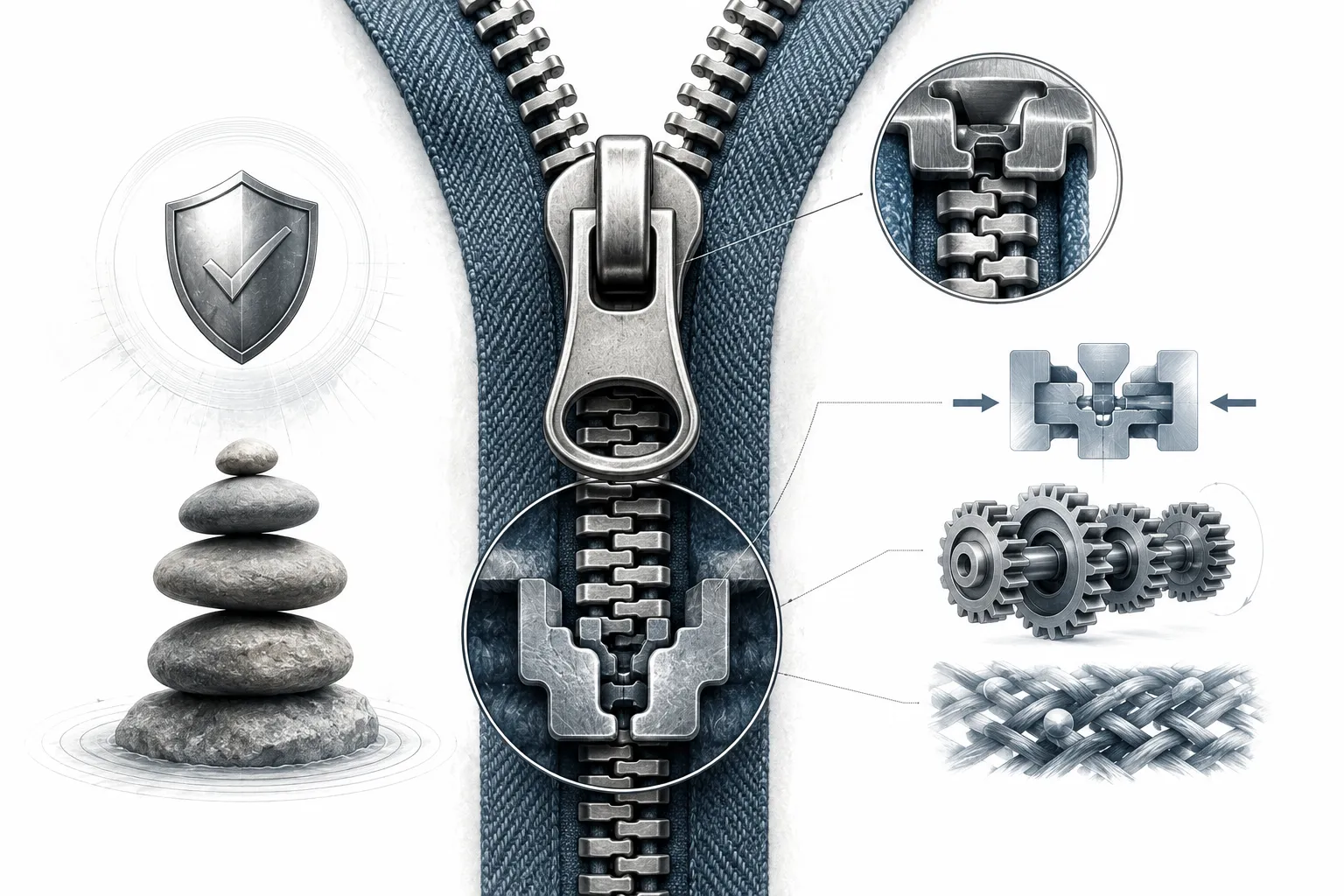
The diagram shows the slider guiding interlocking teeth together so they hold each other in place.
Teeth approach
Two rows of shaped teeth enter the slider from opposite sides.
Slider guides
The slider funnels the teeth into alternating positions.
Teeth lock
Each tooth hooks between teeth on the other side, resisting pull.
The Wedge
The Power of the Y-Shape
If you take a zipper apart, you'll see the teeth aren't just little bumps. They are shaped like tiny hooks or scoops. The left side has a hook that points right; the right side has a hollow that faces left.
When the zipper is open, these hooks and hollows are separated. But the inside of the slider is not a straight tube. It is shaped like a 'Y' lying on its side, with a wedge of metal right in the middle where the two arms meet.
As you pull the slider up, the teeth enter the wide part of the 'Y'. As they move forward, the space gets narrower. The central wedge forces the two rows of teeth together. By the time the teeth come out the bottom of the slider, the wedge has rammed them together so forcefully that the hooks snap into the hollows.
Step by Step
The Anatomy of a Zip
Here is what happens in the fraction of a second it takes to zip up your jacket.
1. Entry
The separated teeth enter the top of the slider, where the gap is wide. They are not yet touching.
2. Compression
As the slider moves, the internal wedge pushes the two rows of teeth toward the center line.
3. Interlock
The wedge angles the teeth just enough that the hook of the left tooth slips perfectly into the hollow of the right tooth.
4. Lock
Once interlocked, the shape of the teeth prevents them from pulling apart vertically. Only pulling the slider back down (which forces them apart at the wedge) can unlock them.
Curiosity Notes
Details Most People Miss
Why this still matters
Why This Still Matters
The zipper is a masterclass in doing a lot with very little. It uses no batteries, no glue, no screws. It just uses the simple physics of inclined planes (wedges) and interlocking shapes to create a fastener that can hold thousands of pounds of tension. It is minimalism in engineering at its absolute best.
Key Findings
- ✓Core findingThe slider contains a wedge that forces the teeth together.
- ✓Strong evidenceEach tooth has a hook and a hollow that interlock.
- ⚠Main consequenceOnce locked, the shape of the teeth prevents vertical pulling.
- ✓Wider legacyThe zipper only opens when the slider is pulled back down to separate the wedge.
Final insight
A Last Thought
A zipper is just a tiny ramp, forcing two rows of metal to hold hands. It is a mechanical handshake happening dozens of times a second as you pull it up. It’s easy to take for granted, but when you think about the sheer ingenuity of that little wedge, it’s hard not to look at your jacket with a little bit of respect.
Quick answers
Common questions
Why do zippers get stuck? +
Usually because a tooth gets bent out of alignment, or fabric gets caught in the wedge before the teeth can interlock properly.
Why does a zipper split open? +
Because the slider has worn out and the internal wedge no longer pushes the teeth tightly enough together to lock them.