Visual answer
Stress Concentration in Action
How a jagged edge turns an even pull into a cascading tear.
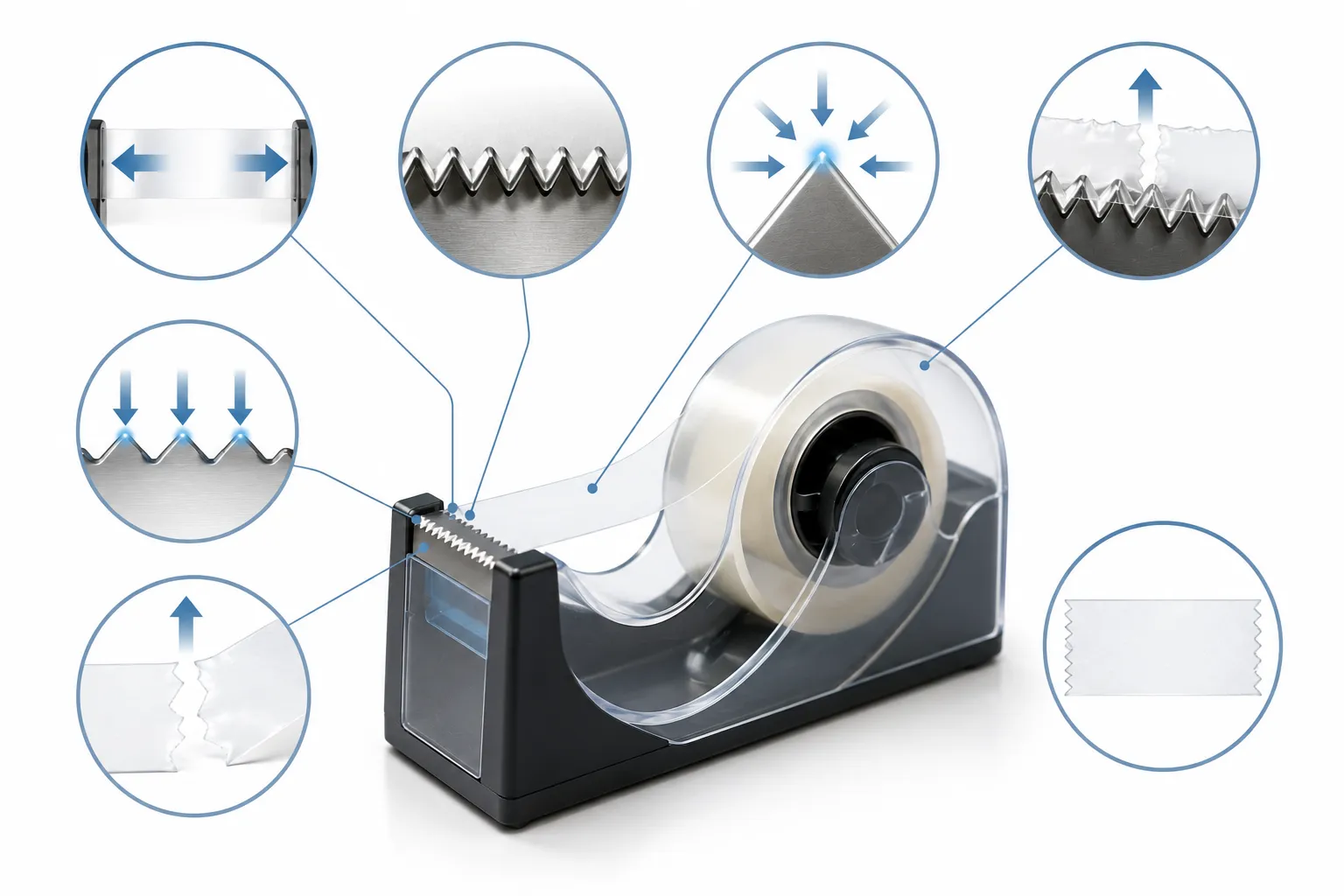
Flat Pull (Failure)
Force is distributed evenly. The tape stretches and deforms without breaking.
Force Meets Serration
The pulling force is funneled into the microscopic point of the first tooth.
Molecular Break
Stress at the point exceeds the tape's tensile strength. A micro-tear initiates.
Cascading Tear
The tear instantly transfers stress to the next tooth, zipping cleanly across the tape.
Where We Stand
A Masterclass in Controlled Failure
Current state
The serrated tape edge is a perfect example of designing for *controlled failure*. In engineering, you often don't want a material to be indestructible; you want it to break exactly where and how you tell it to. The jagged edge dictates the terms of the tape's destruction.
What supports this
This principle is ubiquitous in engineering. Airplane windows have tiny, drilled corners to prevent cracks from spreading. Steel beams have bolt holes. The tape dispenser applies this massive concept to a desk toy using a piece of stamped metal.
What could change this
Tape formulas could change to be inherently brittle enough to tear flat, but that would make the tape weak during actual use, defeating its purpose. The mechanical edge remains the most elegant solution.
The Core Idea
Think of It Like Tearing a Sheet of Paper
The familiar part
If you try to rip a piece of standard paper by pulling it flat from opposite ends, it’s incredibly difficult. You usually end up stretching and crumpling it. But if you make a tiny, sharp fold or a little tear at the edge first, it rips perfectly straight with almost no effort.
How it applies
That little fold is a manual stress concentrator. The tape dispenser’s jagged edge does this automatically. The peaks of the serrations act like tiny starter tears. When you pull the tape, the force gathers at these sharp points. The backing material (usually polypropylene or cellophane) is strong in tension but weak at sharp focal points. The points snap, and the tear zips across the tape in a straight line.
Where the analogy breaks
Paper tears fairly easily once started because its fibers are short. Plastic tape backing is highly resistant to tearing because it's designed to stretch under load. Without the extreme force multiplication of the serrated points, your hands simply can't generate enough force to break the polymer chains cleanly.
The Physics
The Geometry of Destruction
When you apply force to an object, the stress (force per area) is distributed across its cross-section. A flat pull on tape distributes stress evenly. The tape is strong enough to handle this, so it stretches instead of breaking, elongating the polymer chains until they just thin out into a weird, translucent mess.
Now introduce the jagged edge. The surface area of the peaks touching the tape is microscopic compared to the rest of the tape. The exact same pulling force is now applied to a fraction of a millimeter. The stress at those points skyrockets past the ultimate tensile strength of the plastic. The molecular bonds shatter.
Because the teeth are usually designed in a slight curve or angled line, as soon as the first tooth punctures and tears, the stress instantly transfers to the next tooth, and the next. It is a microscopic, cascading structural collapse that happens in milliseconds, resulting in a satisfying *zzzt*.
The Evidence
Why the Edge Wins
Serrations focus force into tiny areas, exceeding the material's tensile strength.
StrongPulling tape flat distributes force, causing plastic deformation (stretching).
StrongThe edge is usually slightly curved to ensure the tear propagates outward, not inward.
ModerateA perfectly smooth, sharp blade would work just as well.
WeakThe Big Myth
The Most Common Misconception
What people think
"The edge is just a tiny saw blade cutting the tape."
It looks sharp, so people assume it works like a knife, slicing through the tape with a shearing action.
What actually happens
It tears, it doesn't cut
If you look closely, the edge isn't an acute blade; it's a row of blunt or slightly rounded teeth. It doesn't have the edge geometry required to cleanly sever the plastic fibers. It relies entirely on you pulling the tape *into* it. It creates a fault line; your arm provides the power to exploit it.
What If It's True?
What If We Removed All Stress Concentrators?
Imagine this
Imagine engineering a world where materials had zero stress concentrations, perfectly smooth, perfectly uniform objects.
What would happen
Things would be incredibly strong, but impossibly difficult to take apart. You couldn't tear open a bag of chips, snap a twig, or cleanly break a piece of chocolate. We rely on stress concentrators (tear notches, perforations, scored lines) to make the world manageable. The tape dispenser is just the most visible manifestation of this.
Why this matters
Sometimes, making something useful means intentionally building a weakness into it. The tape dispenser’s edge is a beautifully honest piece of engineering: it admits that the tape is too strong for us, and gives us a specific place to break it.
Final insight
The Art of Letting Go
We praise things for how well they hold together. But the tape dispenser deserves praise for how well it lets go. It is a tiny monument to the physics of separation, turning a frustrating tug-of-war into a decisive, clean break.
Quick answers
Common questions
Who invented the tape dispenser? +
While Richard Drew invented cellophane tape at 3M in 1930, the first tape dispenser with a built-in cutting edge was patented shortly after by 3M engineer John B. Biek. It was a revolutionary leap from using scissors or tearing with teeth.
Why do tape dispensers sometimes stop cutting well? +
The teeth can become dull (the microscopic points wear down, reducing stress concentration), or more commonly, adhesive builds up on the teeth, acting as a cushion that absorbs the force and prevents the tape from focusing on the points.
Does this apply to all tapes? +
Less so with paper masking tape, which tears relatively easily on its own due to the short paper fibers. But for glossy, slick tapes (Scotch tape, packing tape, duct tape), the serrated edge is absolutely critical to avoid the 'stretchy mess' scenario.