Visual answer
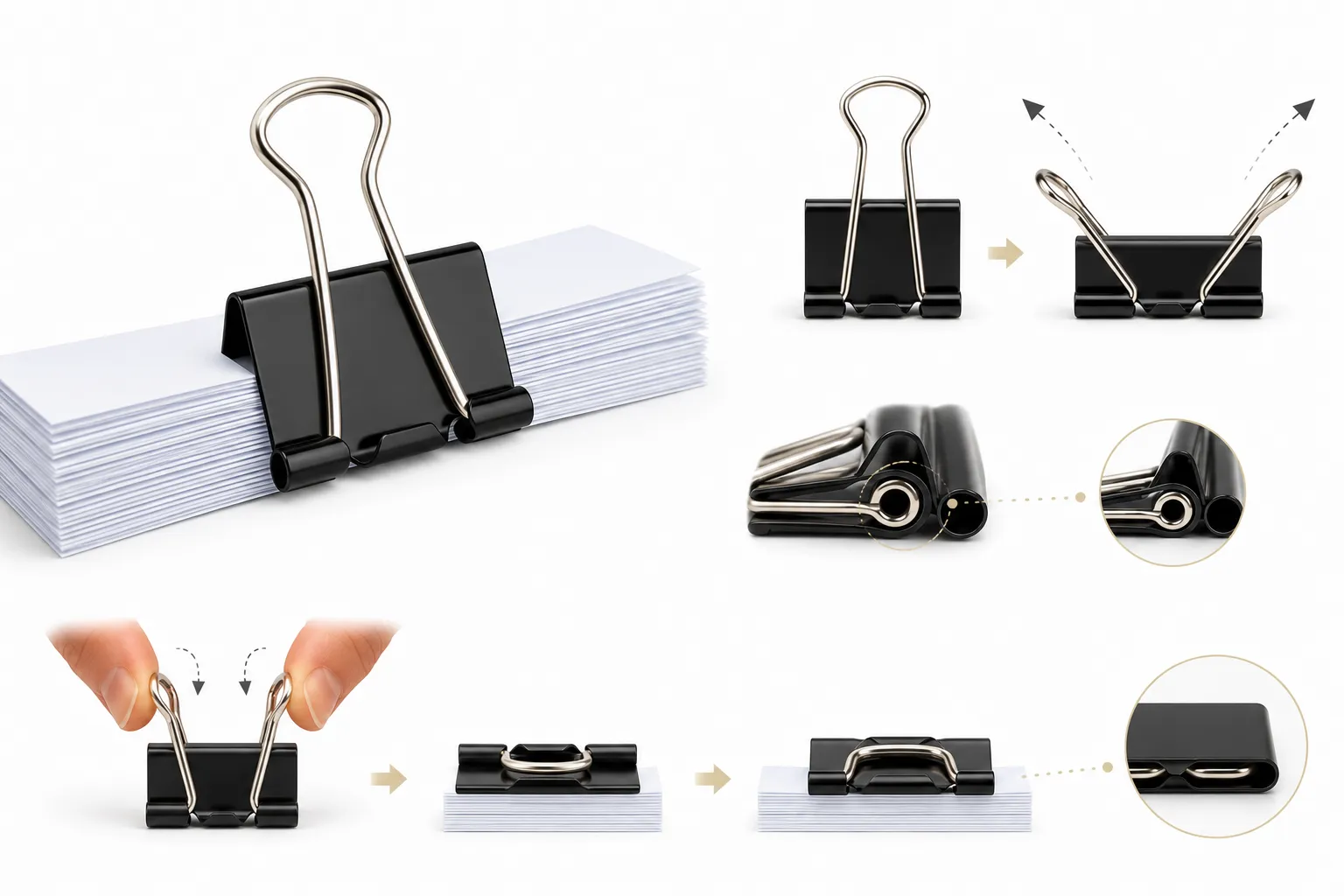
The Three States of a Binder Clip
How the handles transform the tool's function.
Leverage Mode (Handles Up)
Handles act as levers to pry open the stiff spring. Used for applying and removing the clip.
Locked Mode (Handles Folded)
Handles fold flat against the spine, locking the spring and creating a solid, stackable block.
Permanent Mode (Handles Removed)
Handles are pulled off their hinges. The spring retains enough clamping force for low-profile, semi-permanent binding.
Where We Stand
A Three-Mode Fastening Tool
Current state
The binder clip is one of the few consumer items that fundamentally transforms its shape and function based on how you manipulate its sub-components. It is an agile piece of hardware that outperforms staplers, paperclips, and binder rings in specific, high-capacity scenarios.
What supports this
Louis Baltzley invented the binder clip specifically because traditional methods damaged his father's documents. The design has barely changed in over a century because the tripartite functionality (lever, lock, removable) is incredibly difficult to improve upon without adding complexity.
What could change this
Only a shift away from physical paper could render it obsolete. As long as humans need to marshal 50+ pages of dead trees into a temporary, portable brick, the binder clip will reign.
The Core Idea
Think of It Like a Pair of Pliers That Swallows the Nut
The familiar part
If you need to loosen a very tight bolt, you use long-handled pliers. The long handles give you leverage (mechanical advantage) so your weak hands can overcome the bolt's strong resistance.
How it applies
The steel triangle of a binder clip is an incredibly strong spring. If you tried to pry it open with just your fingers on the jaws, you wouldn't have the strength. The wire handles are the long handles of the pliers. By pushing on the ends of the wires, you are using leverage to multiply your force, easily overwhelming the spring's resistance and forcing the jaws apart.
Where the analogy breaks
Unlike pliers, which you discard after use, the binder clip's handles are attached. If they just stuck straight up, the clip would be incredibly bulky and couldn't stack. So, they are hinged to fold flat.
The Transformation
The Quiet Act of Folding
This is where the binder clip elevates itself from a simple clamp to a minor work of art. Once the clip is fastened onto your paper, those two wire levers are just in the way. They stick up, catching on other documents, making the stack unstable.
But flip those handles forward 180 degrees, and something wonderful happens. They press flat against the triangular spine of the clip. Not only does this make the stack completely flat and stackable, but the rigid wire handles actually *lock* the spring in place. It transforms from a tension-based clamp into a rigid structural brace. The paper block becomes almost as solid as a book.
And if you need to mail that stack, or put it in a tight folder? You can grip the loops of the folded handles and simply pull them off the clip entirely. The black triangular spring is strong enough to hold the paper on its own, leaving a remarkably low-profile bind.
The Evidence
The Physics of the Grip
The wire handles act as Class 1 levers, with the hinge as the fulcrum.
StrongFolding the handles down applies counter-pressure to the spine, locking the spring.
StrongThe handles can be removed because the spring's clamping force is independent of the lever.
StrongThe handles are just there to make it easier to open.
WeakThe Big Myth
The Most Common Misconception
What people think
"You should always leave the handles up so you can open it easier next time."
Many people leave the wire handles sticking straight up after clamping, thinking it's the natural resting state.
What actually happens
Up is for working, down is for storage
Leaving the handles up is the equivalent of leaving a toolbox open. Folding them down is the intended 'resting' state. It secures the clamp, prevents the handles from getting bent in a drawer, and turns the clip into a tidy, stackable brick. You unfold them only when you need to release the grip.
What If It's True?
What If We Only Had Permanent Binding?
Imagine this
Imagine a world without temporary, high-capacity clamps like binder clips.
What would happen
Contract negotiations, manuscript edits, and legal briefs would be nightmares of logistics. You couldn't quickly assemble a 100-page document, review it, pull out three pages, replace them, and hand it over. You'd have to punch holes and use binders (which alter the document) or use rubber bands (which tear the edges).
Why this matters
The binder clip respects the integrity of the paper. It doesn't ask the document to change shape or suffer damage to be held together. It just gently, overwhelmingly insists that it stay exactly where you put it.
Final insight
The Art of Letting Go (Gently)
The binder clip is a rare tool that knows how to be aggressive and how to be polite. It bites down with terrifying force when you need it to, but the moment the job is done, it folds its hands neatly behind its back and becomes a quiet, flat citizen of your desk. It is a lesson in applied humility.
Quick answers
Common questions
Are binder clips recyclable? +
Technically yes, as they are steel wire and enamel. However, because they are small and mixed materials, they often fall through the sorting screens at recycling plants. It's better to reuse them until they break, and then throw them in the standard trash, unfortunately.
Can binder clips break? +
Yes. Usually, the failure point is the hinge where the wire handles meet the steel triangle. If you apply too much force prying them open, the metal fatigues and snaps. Occasionally, the triangular spring itself can crack if bent past its elastic limit.
Why are they usually black? +
The triangular spring is made of heavy steel wire to provide the clamping force. If left bare, it would rust from the moisture in the air and paper. It is dipped in a thick, resilient enamel, usually black, though colors are now common, to prevent corrosion and protect the documents.