Quick Facts
Quick Facts
The USSR was the largest country in the world, covering 11 time zones.
The Soviet war in Afghanistan (1979-1989) cost an estimated 15,000 Soviet lives.
Gorbachev was awarded the Nobel Peace Prize in 1990.
The collapse was largely peaceful. No civil war broke out.
Vladimir Putin, the future Russian president, resigned from the KGB during the collapse.
Visual answer
How Trying to Save the USSR Killed It
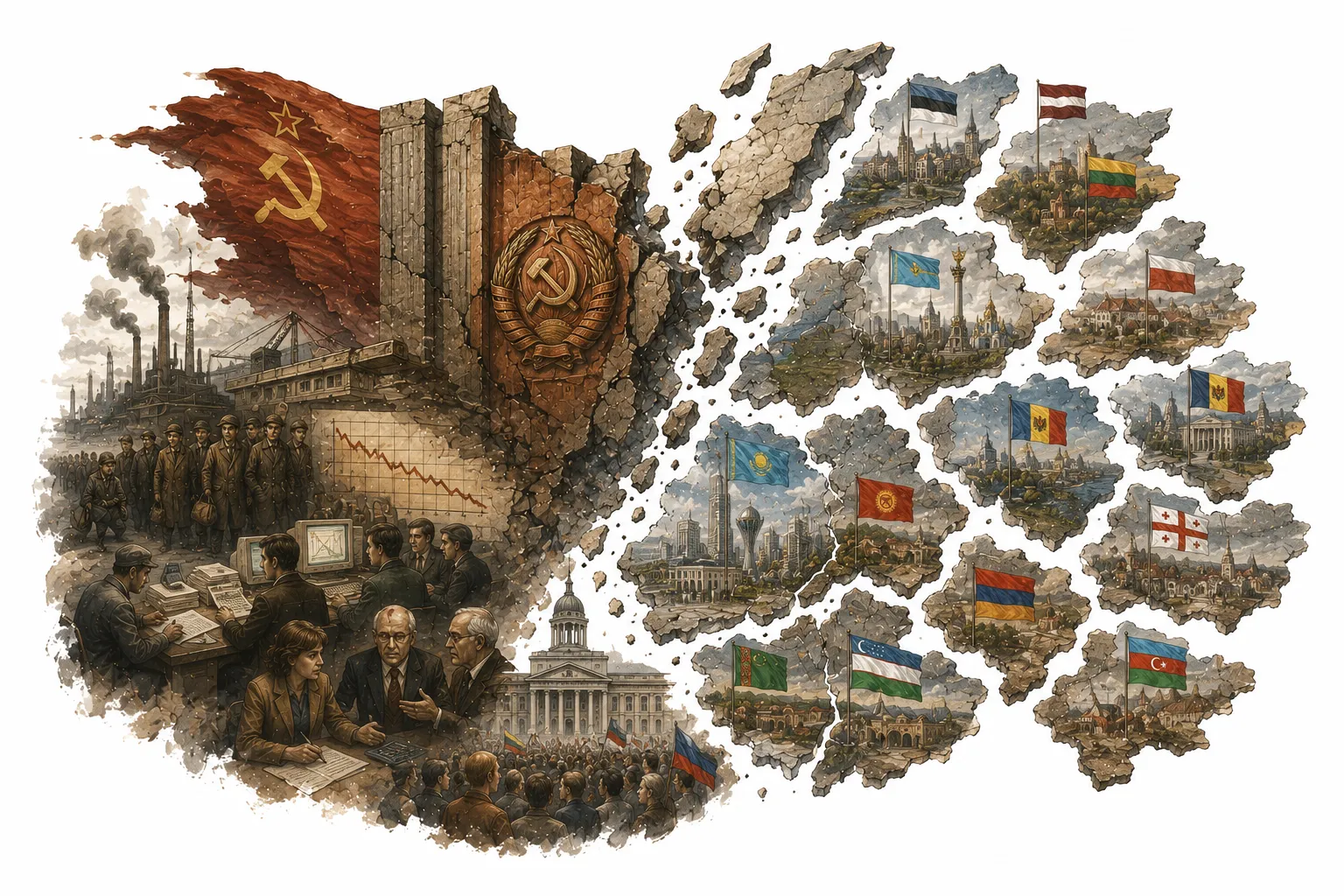
The unintended chain reaction of Gorbachev's reforms.
Economic Stagnation
The Soviet economy stops growing in the 1970s and 1980s.
Afghanistan War
Costly and unpopular war drains resources and morale.
Gorbachev's Reforms
Glasnost (openness) and Perestroika (restructuring) are introduced.
Unintended Consequences
Openness reveals corruption. Restructuring creates shortages.
Nationalist Movements
Soviet republics demand independence.
December 1991
The USSR is formally dissolved. Gorbachev resigns.
Story in brief
Story in Brief
1979
Soviet Union invades Afghanistan.
1985
Mikhail Gorbachev becomes leader of the USSR.
He was young, energetic, and determined to reform communism.
1986
Gorbachev introduces Glasnost (openness) and Perestroika (restructuring).
1989
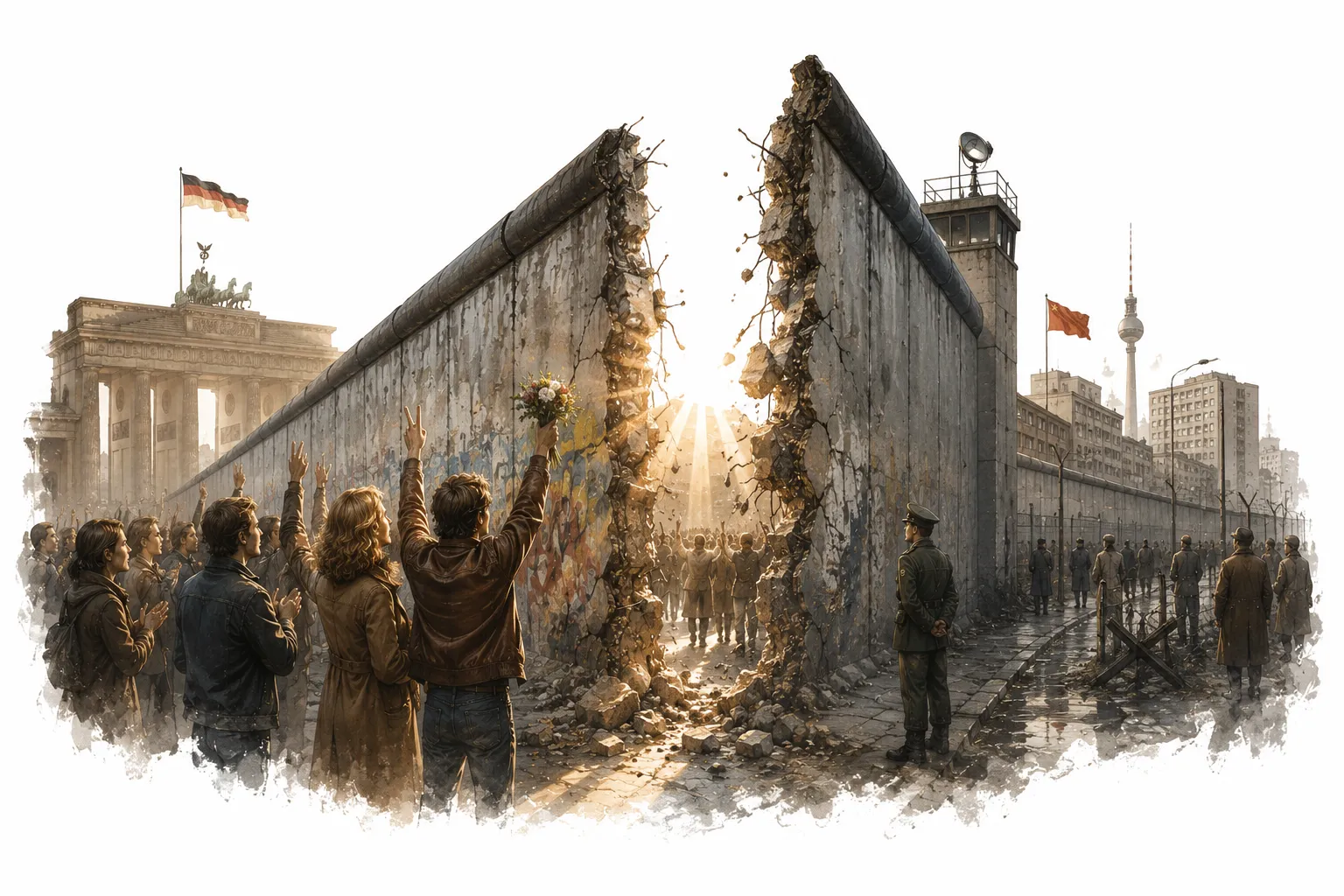
The Berlin Wall falls. Eastern European communist governments collapse.
The Soviet empire was shrinking faster than anyone expected.
1991, August
Hardline communists attempt a coup against Gorbachev.
1991, December 25
Gorbachev resigns as president of the USSR.
The Soviet flag is lowered over the Kremlin. The USSR is gone.
December 26, 1991
The Soviet Union is formally dissolved.
The Story
The Reforms That Killed the System
Mikhail Gorbachev was a true believer. He thought communism could be fixed. The economy was stagnant, the people were demoralized, and the war in Afghanistan was a quagmire. Gorbachev believed that a little openness and a little restructuring would get things moving again.
He was wrong. Glasnost, or openness, allowed Soviet citizens to finally speak freely about their government. What they said was not kind. They complained about food shortages, political repression, and corruption. The government, which had always claimed to be perfect, suddenly looked very imperfect.
Perestroika, or restructuring, made the economy worse. Removing central controls without creating markets led to chaos. Shops that once had empty shelves now had empty shelves AND confusion. By 1991, Soviet citizens were lining up for bread while their government argued about who was in charge.
Famous Quote
"He who does not miss the Soviet Union has no heart. He who wants it back has no brain."
, Vladimir Putin (attributed)
Putin, who came to power in 2000, has often been quoted saying this. It captures the complicated Russian attitude toward the Soviet collapse.
Evidence
Why the USSR Collapsed
The economy was stagnant and technologically backward.
StrongThe Afghanistan war was a costly failure.
StrongGorbachev's reforms had unintended consequences.
StrongNationalist movements in republics demanded independence.
StrongKey Points
Key Points So Far
Gorbachev introduced reforms to save the Soviet system.
Glasnost (openness) revealed the system's failures.
Perestroika (restructuring) made the economy worse.
Soviet republics demanded independence.
A failed coup in August 1991 accelerated the collapse.
Analogy
Like Fixing a Car While Driving It
The familiar part
Imagine trying to replace the engine of a car while the car is moving at 70 miles per hour.
How it applies
That was Gorbachev's project. He tried to reform the Soviet economy while the economy was still trying to function. The result was not a better car. It was a spectacular crash.
Where the analogy breaks
Car crashes usually leave wreckage you can see. The Soviet collapse left wreckage you could measure in 15 new countries.
Curiosity Notes
Details Most People Miss
Why this still matters
Why This Still Matters
The Soviet collapse is the most important political event of the last 50 years. It ended the Cold War. It freed Eastern Europe. It created 15 new countries, including Ukraine, which Russia invaded in 2014 and again in 2022. The collapse also left Russia humiliated and resentful, a wound that has not healed. The Cold War may be over, but its ghost is still very much with us.
Key Findings
- ✓Core findingThe USSR collapsed in 1991, not because of defeat in war, but because of internal failures.
- ✓Strong evidenceGorbachev's reforms, intended to save communism, killed it instead.
- ⚠Main consequenceGlasnost revealed the system's corruption. Perestroika made the economy worse.
- ✓Wider legacyA failed coup in August 1991 accelerated the collapse.
- ★Bottom lineThe collapse was largely peaceful, a rare event in the fall of empires.
Final insight
A Last Thought
The Soviet Union did not fall because of a foreign enemy. It fell because its own citizens stopped believing in it. For 70 years, the system survived by controlling information and crushing dissent. When Gorbachev opened the windows, the fresh air did not revive the patient. It revealed that the patient had been dead for years. The collapse was not a murder. It was a diagnosis.
Quick answers
Common questions
Could Gorbachev have saved the Soviet Union? +
Probably not. By the time he came to power in 1985, the economic problems were too deep. His only real alternative was to use force to crush dissent, as previous leaders had done. He refused. That refusal made him a hero to the West and a traitor to many Russians.
What happened to Gorbachev after the collapse? +
He retired from politics, wrote memoirs, and appeared in a Pizza Hut commercial. He won a Grammy Award for spoken word and a Nobel Peace Prize. He died in 2022 at age 91, largely forgotten in the country he once led.