Quick Facts
Quick Facts
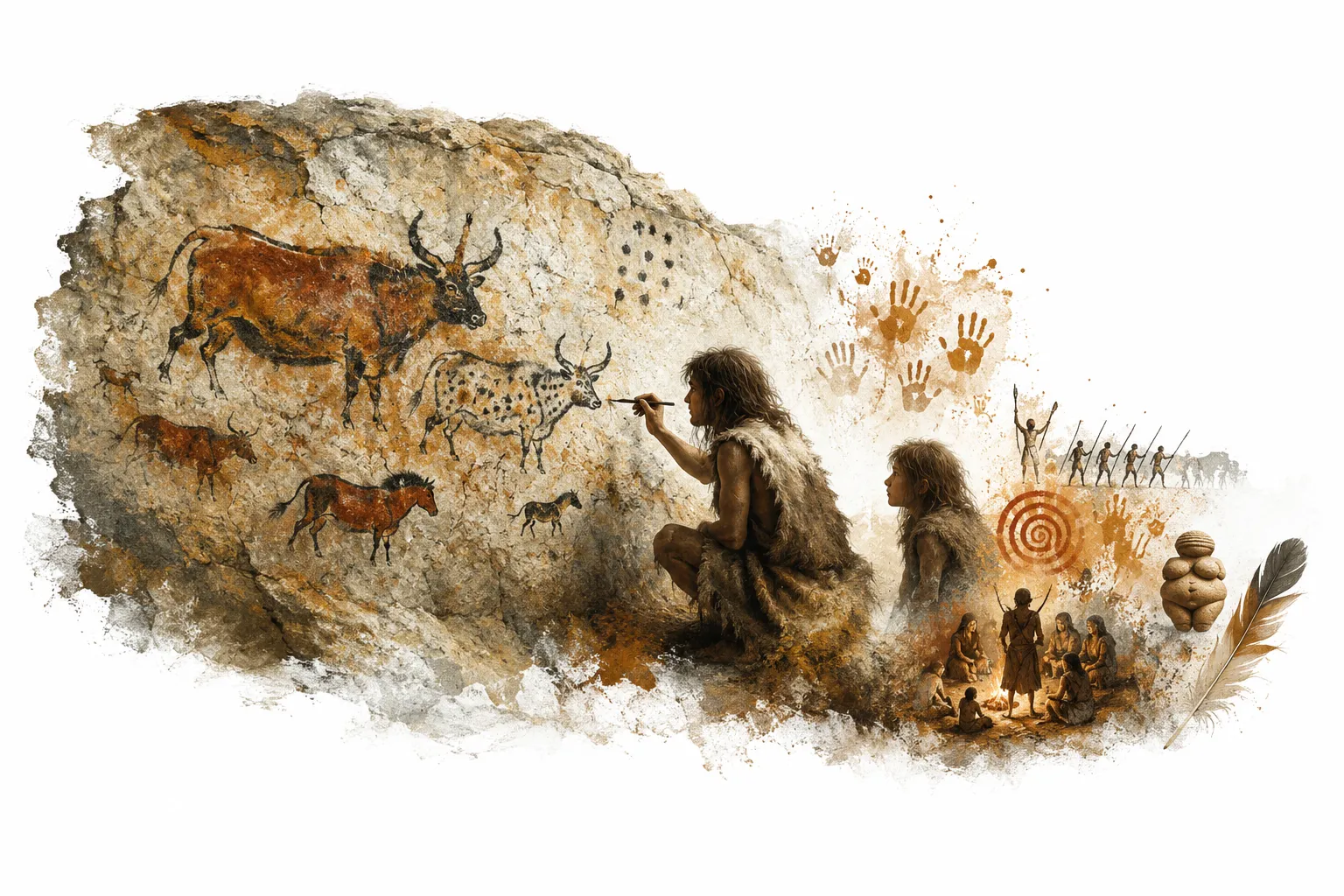
The largest painted animal in the cave, the Great Bull, is over 17 feet long.
The artists used scaffolding to reach the high ceilings.
They didn't use paint brushes; they used blowing techniques, sponges, and their fingers.
There is almost no human imagery, except for one stick-figure man with a bird head.
The caves had to be closed in 1963 because the breath of tourists was growing a destructive black fungus on the walls.
Visual answer
Why the Lascaux paintings matter
The diagram connects the cave's art, age, technique, and preservation to its importance.
Ancient art
The paintings preserve Ice Age images made by humans thousands of years ago.
Sophisticated technique
The artists used scale, motion, pigments, and cave surfaces deliberately.
Fragile evidence
The cave shows both early creativity and the challenge of preserving it.
The Myth of the Caveman
Goodbye, Dumb Brutes
Before Lascaux, a lot of people implicitly thought of early humans as grunting, hairy brutes whose primary hobby was hitting things with rocks. Lascaux buried that idea forever.
The painters at Lascaux understood perspective. They used the natural curves of the rock to give their animals 3D volume. They drew multiple legs on animals to imply motion, like a proto-stop-motion animation. They mixed mineral pigments to create colors.
This wasn't just survival instinct. This was art for art's sake. It required planning, time, and a shared cultural language. It meant they had complex brains, just like ours.
Analogy
The Paleolithic Sistine Chapel
The familiar part
When you walk into the Sistine Chapel, you are overwhelmed by the scale, the color, and the skill of Michelangelo. It feels like a pinnacle of human achievement.
How it applies
Lascaux is the exact same thing, just 16,800 years earlier. It is a dedicated art gallery, deep underground, painted by masters who we don't even have names for.
Where the analogy breaks
Michelangelo painted for the Pope and money. We still don't know exactly why the Lascaux painters went to such extreme, dangerous lengths to paint in the dark.
Curiosity Notes
Details Most People Miss
Why this still matters
Why This Still Matters
Lascaux reminds us that the drive to create is hardcoded into our DNA. When early humans weren't running from predators or starving, what did they do? They went deep into the dark earth and painted massive, beautiful bulls. It is a profoundly comforting thought.
Key Findings
- ✓Core findingThey proved prehistoric humans had high-level artistic and spatial intelligence.
- ✓Strong evidenceThey feature hundreds of animals, but almost no humans.
- ⚠Main consequenceThe artists used advanced techniques like perspective and motion lines.
- ✓Wider legacyThe caves are now closed because human breath was destroying the art.
Final insight
A Last Thought
Lascaux is important because it is a time machine. It takes you back 17,000 years and shows you a mind exactly like yours, looking at a wall, and deciding it needed a giant, galloping horse on it. We haven't changed. We just have better lighting.
Quick answers
Common questions
Who painted the Lascaux caves? +
We have no idea. They left no signatures, only their art.
Can you visit Lascaux? +
Not the original. You can visit 'Lascaux IV', an exact, high-tech replica built right next door.