Visual answer
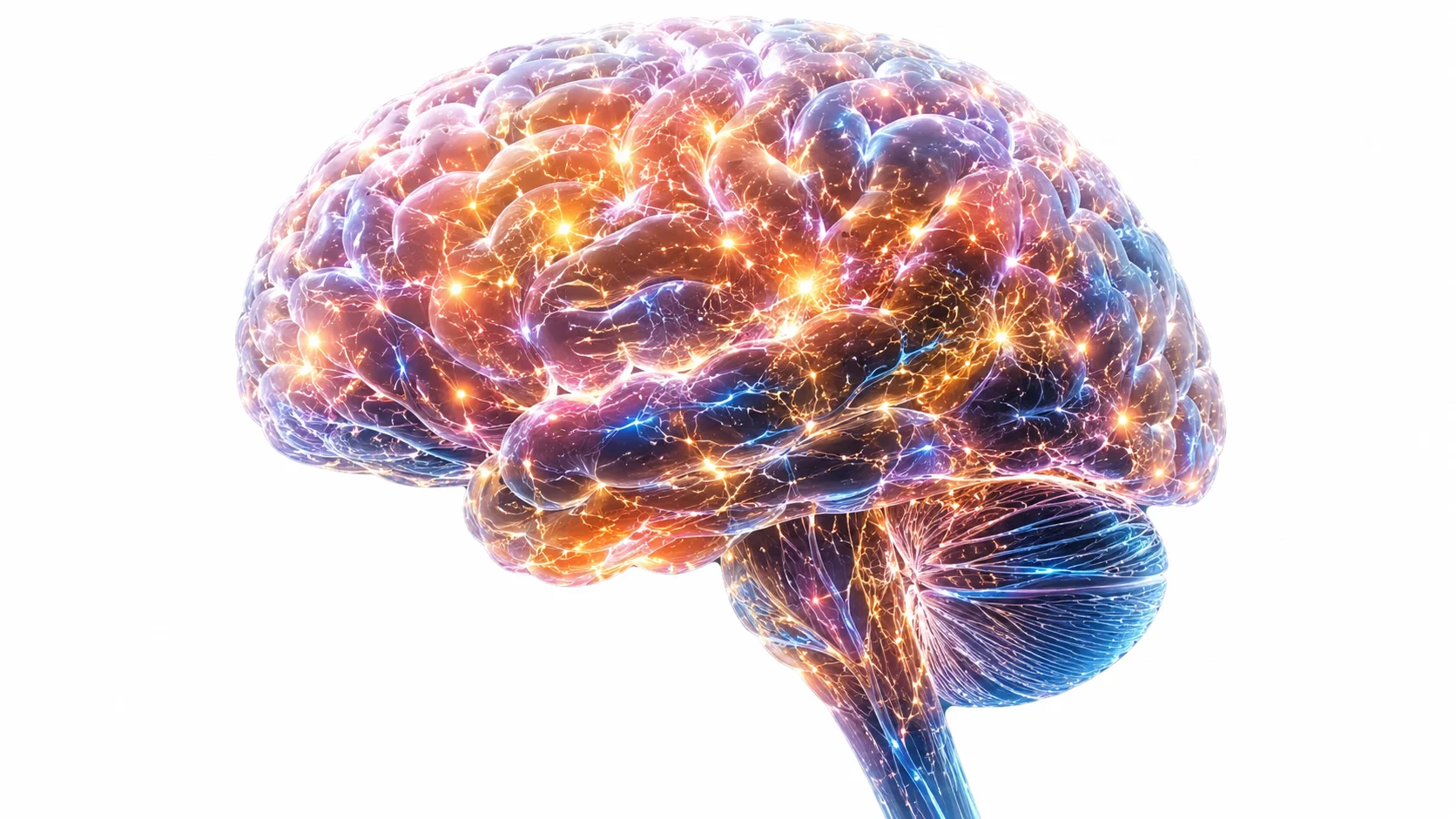
Key Brain Regions and What They Do
A map of the brain's major areas and the roles they play in thought, emotion, memory, and survival.
Cerebral Cortex
The wrinkled outer layer responsible for conscious thought, language, perception, and voluntary movement. Divided into four lobes, each handling different tasks.
Prefrontal Cortex
The front section of the brain and the last to fully develop, around age 25. It handles planning, decision-making, impulse control, and the ability to understand other people's minds.
Hippocampus
A seahorse-shaped structure deep in the brain that coordinates memory formation and spatial navigation. It acts as the brain's indexer, not its storage vault.
Amygdala
An almond-shaped structure that assigns emotional weight to experiences, especially fear and threat. It can trigger a full fear response before conscious thought has time to engage.
Cerebellum
Located at the back of the brain, the cerebellum coordinates movement, balance, and fine motor skill. It processes far more information than its size suggests.
Brain Stem
The most ancient part of the brain, connecting it to the spinal cord. It controls breathing, heart rate, blood pressure, and the basic reflexes that keep you alive without any conscious input.
Prediction machine
Your Brain Is Not a Camera. It Is a Prediction Machine.
Most people think the brain receives information from the world and processes it. That is backwards. The brain spends most of its time generating predictions about what is about to happen, based on everything it has experienced before. The senses are not the main show. They are the fact-checkers.
Incoming sensory data only gets your full attention when it contradicts the prediction. The rest of the time, you are essentially living inside your brain's best guess about reality. This is why optical illusions work: your brain's prediction overrides the raw data from your eyes.
Neuroscientists call this predictive processing, and it explains an enormous range of otherwise puzzling phenomena, from why chronic pain can persist after an injury has healed, to why placebo treatments sometimes produce measurable physical effects.
Neurons and signals
How Neurons Communicate: Electricity and Chemistry at Once
A neuron is a cell that specialises in sending messages. It receives inputs through branching dendrites, integrates those signals in the cell body, and if the combined signal is strong enough, fires an electrical pulse called an action potential down its axon at speeds up to 120 metres per second.
When that pulse reaches the end of the axon, it triggers the release of chemical messengers called neurotransmitters. These cross the synapse, the tiny gap between neurons, and bind to receptors on the neighbouring cell. Depending on the neurotransmitter, the receiving neuron becomes either more or less likely to fire.
The pattern of which neurons fire, in which sequence, at what frequency, is what produces every thought, feeling, and movement you have ever had. There is no single location for any experience. Everything is a pattern spread across a network.
Brain regions
What Each Part of the Brain Actually Controls
The cerebral cortex handles everything you think of as conscious: reasoning, language, sensation, voluntary movement. It is divided into four lobes. The frontal lobe manages planning and personality. The parietal lobe integrates sensory information. The temporal lobe processes sound and language. The occipital lobe at the back handles vision.
Deeper inside, the limbic system governs emotion and survival. The amygdala flags threats and stamps emotional weight onto memories. The hippocampus coordinates memory formation. The hypothalamus regulates hunger, thirst, body temperature, and hormone release.
At the base, the cerebellum coordinates movement with extraordinary precision, and the brain stem silently handles heartbeat, breathing, and consciousness itself. Damage here is almost always fatal. The further back and down you go, the more ancient and essential the function.
Neuroplasticity
The Brain Never Stops Rewiring Itself
For most of the twentieth century, scientists believed the adult brain was fixed and unchangeable. This turned out to be completely wrong. The brain rewires itself throughout life in response to experience, a property called neuroplasticity.
Learning something new builds new synaptic connections. Repeating a behaviour makes the supporting neural pathway faster and more efficient, like widening a road into a motorway. Neglecting a skill allows those connections to weaken and eventually disappear.
Even after serious brain injury, neighbouring regions can sometimes take over functions from damaged areas. Stroke patients relearn movement and language because healthy brain tissue gradually assumes responsibility. The brain is not a fixed structure. It is a living architecture that responds to how you use it.
Discovery
The Accident That Mapped the Brain
In 1848, a 25-year-old railroad foreman named Phineas Gage was working in Vermont when an accidental explosion drove an iron rod straight through his skull, entering beneath his left cheekbone and exiting through the top of his head. He survived. He sat up, spoke, and walked to the doctor.
But the Phineas Gage who recovered was, according to everyone who knew him, no longer Gage. His prefrontal cortex had been destroyed. He became erratic, unreliable, unable to make plans or follow through on them. His personality had changed completely.
His physician, John Harlow, recorded the case meticulously. It became the first hard evidence that personality, behaviour, and decision-making were located in a specific part of the brain, not distributed vaguely through the body or seated in the heart, as many believed. Gage's skull remains on display at Harvard Medical School.
Misconception
Common Misconception
What people think
You only use 10% of your brain
The idea that 90% of the brain sits dormant, waiting to be unlocked by the right technique or supplement, is one of the most persistent myths in popular science. It implies enormous untapped potential and has sold countless books, courses, and nootropics.
What actually happens
Reality
Brain imaging shows that virtually every region of the brain is active at some point during normal daily life. No significant area sits permanently idle. The myth may have originated from early neuroscience misunderstandings, or from the fact that only about 10% of brain cells are neurons. The other 90% are glial cells, which do not fire signals but are absolutely essential for brain function. Inactive 90% they are not.
Quick answers
Common questions
What are the main functions of the brain? +
The brain handles everything: voluntary movement, sensory processing, language, memory, emotion, decision-making, and every automatic function that keeps you alive, including breathing, heart rate, and hormone release. Different regions specialise in different tasks, but most complex functions involve networks spanning multiple areas at once.
How do neurons communicate with each other? +
Neurons use two systems simultaneously. An electrical impulse travels down the axon, then triggers the release of chemical messengers called neurotransmitters at the synapse. These cross the gap and bind to receptors on the neighbouring neuron, making it either more or less likely to fire. The combined pattern of billions of these interactions per second is what produces thought and behaviour.
What is neuroplasticity? +
Neuroplasticity is the brain's ability to physically reorganise itself in response to experience. Learning strengthens synaptic connections and builds new ones. Damage to one area can sometimes be compensated for by neighbouring regions. It operates throughout life, though most dramatically in early childhood.
What part of the brain controls emotions? +
Emotions involve a network of structures called the limbic system. The amygdala handles fear and emotional salience. The hippocampus links emotions to memories. The hypothalamus regulates the physical responses to emotion. The prefrontal cortex then modulates emotional reactions by providing rational oversight. Damage to the prefrontal cortex results in loss of impulse control and emotional regulation.
How does the left brain differ from the right brain? +
Language is predominantly left-hemisphere in most people, and some spatial reasoning leans right-hemisphere. But the popular idea that people are either left-brained or right-brained, logical versus creative, is a myth. Brain scans consistently show complex tasks recruiting both hemispheres simultaneously. The two halves communicate constantly through a thick band of fibres called the corpus callosum.
Does the brain grow new cells in adulthood? +
Yes, in limited regions. The hippocampus, which coordinates memory, shows ongoing neurogenesis in adults. Exercise, learning, and stimulating environments encourage new neuron growth. Chronic stress, sleep deprivation, and alcohol suppress it. The old view that the adult brain is completely fixed has been definitively overturned.