Visual answer
The Brain Under Anesthesia
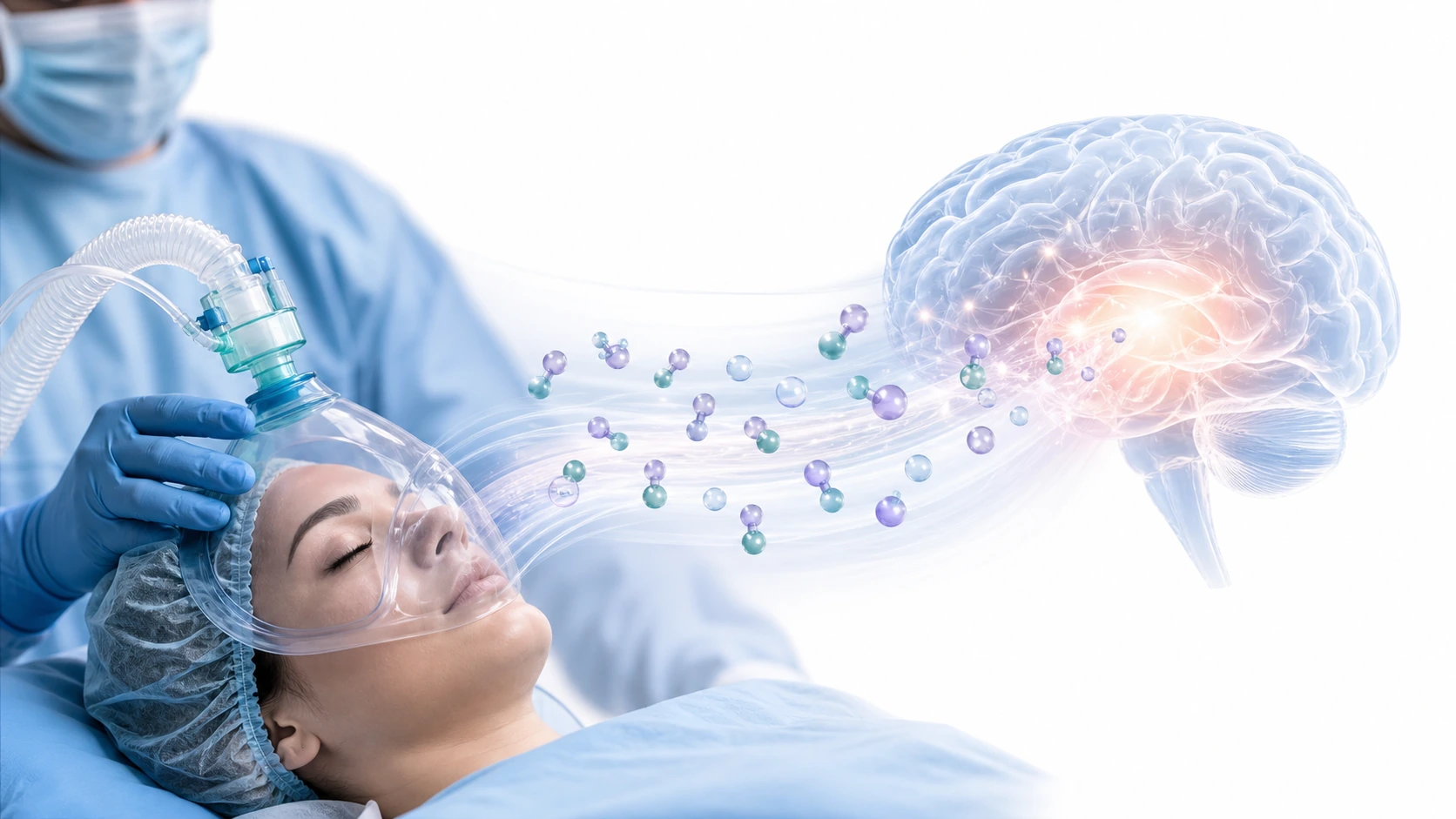
General anesthesia suppresses integrated communication across cortex and thalamus while vital brainstem functions are carefully maintained and monitored.
Drugs enter the bloodstream
Intravenous agents or inhaled gases reach the brain within seconds through circulation.
Ion channels are altered
Many anesthetics enhance inhibitory GABA signaling or suppress excitatory signaling, making neurons harder to fire.
Neural communication fragments
Large-scale coordination between brain regions breaks down, so information no longer integrates into conscious experience.
Sensory broadcasting is suppressed
Thalamocortical communication weakens, reducing the stream of sensory information available to awareness.
Memory formation is blocked
The brain cannot reliably encode the operation as an experience you later remember.
Answer
The Quick Answer
Anesthesia works by flooding the brain and nervous system with molecules that disrupt the electrical signals neurons use to communicate, pressing pause on consciousness, memory, and pain processing.
You close your eyes for one second. Then you wake up three hours later. Where did you go?
Mechanism
How Your Brain Gets Switched Off
Anesthesia works through a cascade across the nervous system, not a single on/off switch.
- 1
Drugs enter the bloodstream
Intravenous agents or inhaled gases reach the brain within seconds through circulation. Analogy: A fast-acting dye spreading through water.
- 2
Ion channels are altered
Many anesthetics enhance inhibitory GABA signaling or suppress excitatory signaling, making neurons harder to fire. Analogy: Jamming a door so it cannot swing open.
- 3
Neural communication fragments
Large-scale coordination between brain regions breaks down, so information no longer integrates into conscious experience. Analogy: An orchestra losing the ability to hear itself.
- 4
Sensory broadcasting is suppressed
Thalamocortical communication weakens, reducing the stream of sensory information available to awareness. Analogy: Cutting the cable between antenna and television.
- 5
Memory formation is blocked
The brain cannot reliably encode the operation as an experience you later remember. Analogy: A camera running without film.
Curiosities
Details That Make It Stranger
These are the facts that turn the simple explanation into a better story.
Fish can be anesthetized
Compounds added to water can sedate fish for veterinary and scientific procedures.
Propofol is milky white
Its appearance helped earn it the nickname milk of amnesia.
Ketamine preserves breathing
This made it especially valuable in emergency and battlefield medicine.
Plants respond too
Some plant electrical responses can be suppressed by anesthetic gases.
Story
The Day Surgery Changed Forever
On October 16, 1846, William Morton demonstrated ether anesthesia at Massachusetts General Hospital while surgeon John Collins Warren removed a neck tumor from Edward Abbott. Abbott awoke saying he had felt no pain.
Before anesthesia, surgery was limited by agony and speed. Painless surgery unlocked the entire modern surgical era.
Hidden mechanism
The Consciousness Paradox
Anesthesia lets researchers observe what vanishes when consciousness disappears. The brain does not simply turn off; it loses the global conversation that lets separate signals become one experience.
The deeper insight
Consciousness may be less a place than a pattern of information sharing. Anesthesia does not unplug every neuron. It unplugs the network.
Myths
Common Myths
What people think
Anesthesia puts you to sleep
Anesthesia puts you to sleep
What actually happens
Reality
Sleep is active and regulated. General anesthesia is a drug-induced breakdown of awareness, memory, and pain processing.
Another Misconception
What people think
It is perfectly understood
It is perfectly understood
What actually happens
Reality
The clinical practice is mature, but the exact link between anesthetic molecules and consciousness remains an open scientific problem.
Quick answers
Common questions
Why do some people need more anesthesia than others? +
Genetics, body composition, medications, tolerance, age, and organ function all affect anesthetic sensitivity.
Can you die from anesthesia? +
Modern anesthesia is very safe in healthy patients, but it is still powerful medicine and is monitored continuously.
Do redheads need more anesthesia? +
Some studies suggest people with red hair may require more inhaled anesthetic, likely related to MC1R genetics.
What does waking up feel like? +
Most people describe suddenly becoming aware with no sense of time passing, often with confusion or grogginess.