Visual answer
The procrastination loop
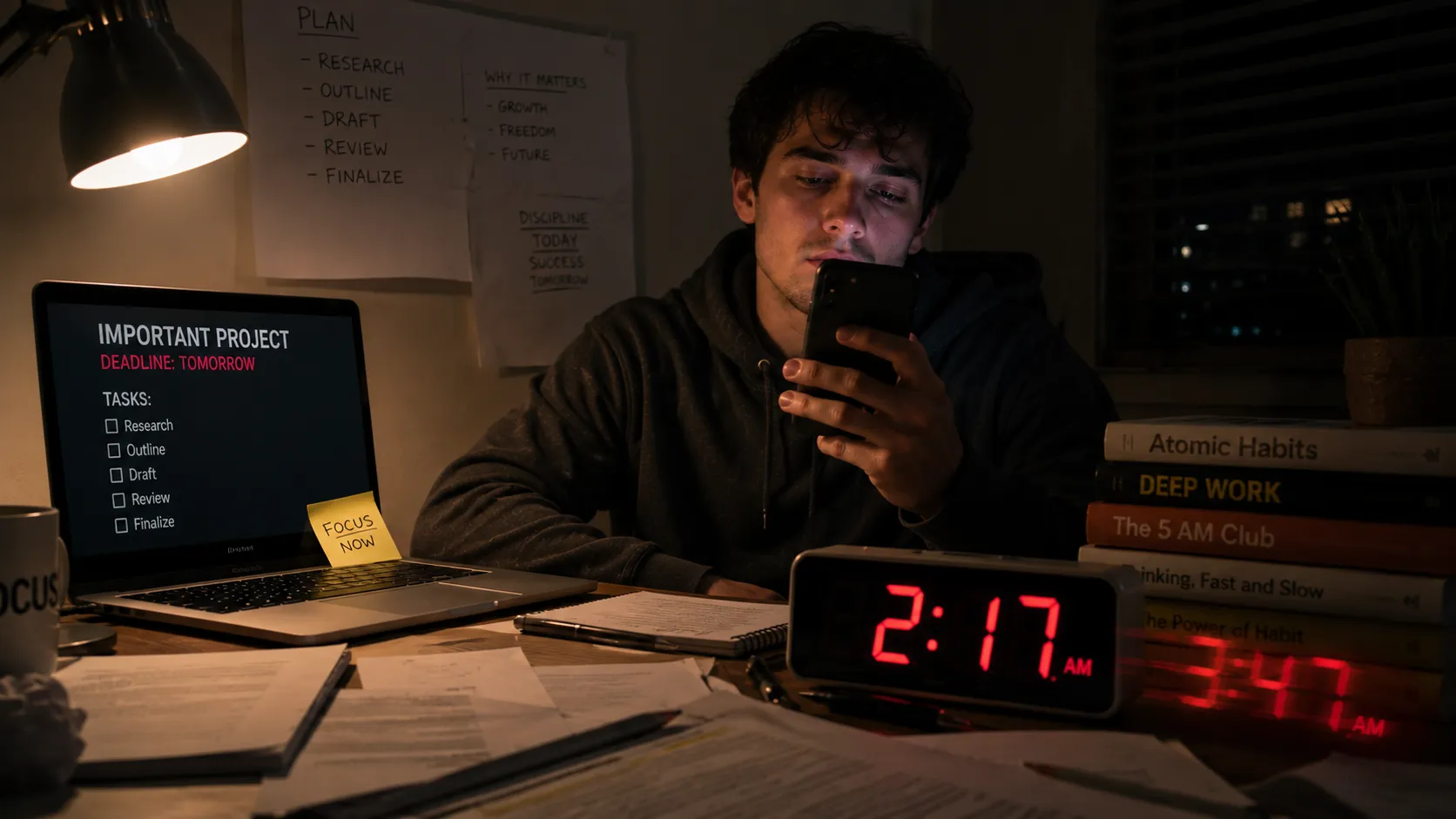
Procrastination follows a cycle. Once you see it, you can break it.
Task appears
Your brain quickly sizes up whether the task feels good or bad.
Discomfort signal
The amygdala fires a threat response. The task feels unpleasant or overwhelming.
Avoidance
You switch to something easier. Social media, snacks, cleaning. Anything else.
Temporary relief
Your mood lifts for a moment. This rewards the avoidance behavior.
Brain reason
Your brain is trying to protect you from discomfort
The part of your brain called the amygdala treats unpleasant tasks the same way it treats mild threats. It fires off a discomfort signal.
When that happens, the prefrontal cortex (your planning brain) has to fight for control. Sometimes it wins. Often it does not.
Avoiding the task removes the bad feeling immediately. That relief is a reward, and your brain learns to repeat it.
Lazy myth
Is procrastinating just being lazy?
What people think
Procrastinators are lazy.
Most people assume people who procrastinate just do not care or do not want to work.
What actually happens
It is emotional avoidance, not low effort.
Many people who procrastinate are actually perfectionists or high achievers who find certain tasks threatening to their sense of competence.
Types of procrastination
Not all procrastination is the same
Fear of failure
Avoiding a task because you are scared you will not do it well enough.
Task aversion
The task is boring, confusing, or just feels bad to do.
Decision paralysis
Too many options or too much uncertainty makes starting feel impossible.
Poor self-regulation
Difficulty managing impulses pulls you toward easier, more rewarding things.
How to fix it
What actually helps
The most effective approach is to shrink the task until it no longer triggers the discomfort signal. Two minutes to start is enough.
Implementation intentions help too. Instead of 'I will work on this later,' say 'I will work on this at 2pm at my desk.' Specificity makes follow-through far more likely.
Self-compassion also matters. People who beat themselves up over procrastinating tend to procrastinate more on the same task next time.
Quick answers
Common questions
Why do we procrastinate even on things we want to do? +
Even enjoyable tasks can trigger avoidance if they feel high-stakes or if you are unsure where to start. The brain reads uncertainty as a mild threat.
Is procrastination a mental health issue? +
Chronic procrastination is linked to anxiety, depression, and ADHD, but it is also extremely common in people without any of those. It exists on a spectrum.
Why do I procrastinate more when I am stressed? +
Stress reduces the brain's capacity for self-regulation. When your mental resources are stretched, emotional impulses win more often.
Does procrastination get worse with age? +
Research suggests procrastination tends to decrease with age. Older adults generally have better emotional regulation skills.
Is last-minute pressure actually useful? +
Deadlines do create urgency that can cut through avoidance. But consistently relying on last-minute pressure leads to higher stress and lower quality work over time.