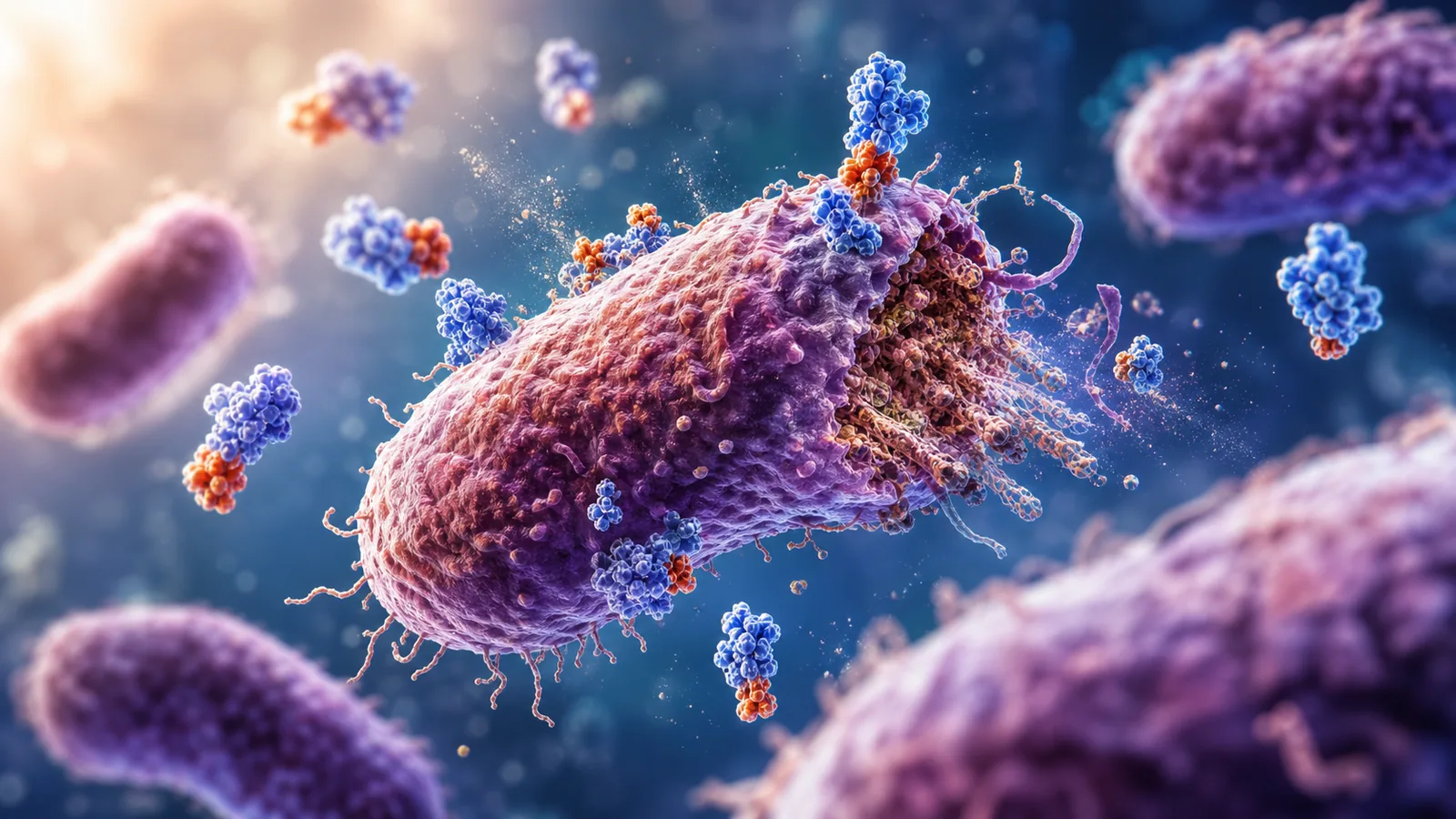
Visual answer
What Happens Inside Your Body When You Take an Antibiotic
From multiplying bacteria to a cleared infection, the six stages of how antibiotics work.
Bacteria are multiplying
Harmful bacteria reproduce inside the body, damaging tissue and triggering the symptoms of infection, pain, swelling, heat, fever.
Antibiotic enters the bloodstream
After being swallowed, the antibiotic is absorbed through the gut into the bloodstream, usually within one to two hours.
Medicine reaches the infection
The antibiotic circulates through the body and begins concentrating in the tissues where the bacteria are active.
Antibiotic attacks bacterial targets
Depending on the type, the antibiotic disrupts the bacteria's cell walls, protein-making process, or ability to copy DNA. Human cells work differently and are not affected.
Bacteria die or stop multiplying
Some bacteria are killed outright. Others are stopped from reproducing, halting the spread of the infection.
Immune system clears the rest
Your immune system mops up what remains. Symptoms ease as the infection clears and inflammation settles.
How they work
How Do Antibiotics Work?
Antibiotics are chemical compounds, originally found in nature, now often made in laboratories, that are toxic to bacteria but largely harmless to human cells. They work by exploiting the differences between bacterial biology and human biology.
Bacteria have structures and processes that our cells simply do not have: different types of cell walls, different protein-building machinery, different ways of copying their DNA. Antibiotics target those specific bacterial features. They are precision weapons aimed at things the bacteria need and we do not.
One crucial point: antibiotics do not work on viruses. Viruses and bacteria are entirely different kinds of organisms. A virus does not have a cell wall to break down or bacterial protein machinery to disrupt. Taking antibiotics for a cold or flu does nothing to treat the illness.
Against bacteria
How Do Antibiotics Work Against Bacteria?
Different antibiotics use different strategies. Some are bactericidal, they actively kill bacteria by attacking the cell wall, which human cells do not have. Without its cell wall, the bacterium cannot hold its shape and bursts. Penicillin and amoxicillin work this way.
Others are bacteriostatic, they do not kill bacteria directly but stop them from reproducing. They interfere with the mechanisms bacteria use to make proteins or copy their DNA. Without the ability to multiply, the bacterial population stalls while your immune system destroys what is already there.
Your doctor's choice of antibiotic depends on what type of bacteria is causing the infection, where in the body it is, and which antibiotics are likely to work against that particular strain.
In the body
How Do Antibiotics Work in the Body?
Once you swallow an antibiotic, it moves into your digestive system and is absorbed into the bloodstream, usually within an hour or two. From there, it travels around the body and starts reaching the tissues where the bacteria are active.
The antibiotic does not navigate on its own, it circulates broadly. This is why some antibiotics are better suited to certain locations. An antibiotic that concentrates well in urine is more useful for a UTI than one that does not reach that tissue effectively.
As the antibiotic reaches the bacteria, it begins attacking them while your immune system continues to fight alongside it. The two work in parallel, the antibiotic weakening or killing bacteria, your immune defences clearing the remnants. When you stop taking an antibiotic, levels in your body drop, which is why completing the full course matters.
Why they work fast
Why Do Antibiotics Sometimes Work So Fast?
You might take your first dose and feel noticeably better within a day. What has usually happened is that the bacteria have stopped multiplying, which immediately reduces the pace of damage, and the inflammation in your body is beginning to settle.
But feeling better and being free of infection are not the same thing. Surviving bacteria may still be present, just not reproducing at the rate they were. Stop taking the antibiotic early and those bacteria can rebound, and the ones that survive are more likely to be resistant to that medicine.
How quickly you feel improvement also depends on where the infection is. Skin infections can respond within a day or two. Deeper infections in the lungs, sinuses, or ears take longer because it takes time for the antibiotic to reach those tissues in effective concentrations.
How quickly
How Quickly Do Antibiotics Work?
This depends on several things at once: the type of infection, the specific antibiotic, the dose, and the person's own immune response. There is no single answer that applies to all situations.
For many straightforward infections, a UTI, strep throat, a simple skin infection, people often notice some improvement within 24 to 48 hours. For others, a chest infection, sinus infection, or ear infection, symptoms can take several days to ease noticeably even when the antibiotic is working as it should.
Anyone who is not improving as expected, or who gets worse during a course of antibiotics, should speak to a healthcare professional rather than waiting and hoping.
How long they work
How Long Do Antibiotics Keep Working?
Antibiotics are active in your body as long as they maintain a therapeutic level in your blood and tissues. The dosing schedule, twice a day, three times a day, or once a day, is designed to keep levels high enough to remain effective throughout.
The course length, typically five to ten days depending on the infection, is set to ensure bacteria are fully suppressed long enough for your immune system to finish the job.
Once you stop, levels drop. The bacteria are no longer held back. This is why completing the full course as prescribed matters, even if you feel completely better before it ends. Stopping early is one of the main drivers of antibiotic resistance.
Fleming's discovery
The Forgotten Petri Dish That Changed Medicine
In September 1928, Alexander Fleming returned to his laboratory at St Mary's Hospital in London after a summer holiday. He had left bacterial cultures in petri dishes before he left. When he came back, one had been contaminated by mould.
Most scientists would have thrown it away. Fleming looked closer. The bacteria around the mould were dead. A clear ring of empty space surrounded it, as though whatever the mould was producing had refused to let anything live nearby.
The mould was Penicillium notatum. The substance it produced became penicillin, the world's first antibiotic. Within two decades, it was being manufactured at industrial scale and saving lives on a staggering scale. Fleming did not set out to change medicine that day. He came back from holiday and looked carefully at something that had apparently gone wrong. That habit of curiosity is the reason antibiotics exist.
Misconception
Common Misconception
What people think
Antibiotics will help you recover from a cold or flu faster.
Antibiotics will help you recover from a cold or flu faster.
What actually happens
Reality
Colds and flu are caused by viruses. Antibiotics only target bacteria. Taking antibiotics for a viral illness does nothing to treat the infection, and contributes to antibiotic resistance, which is a serious global health problem.
Quick answers
Common questions
Do antibiotics work against viruses? +
No. Antibiotics only target bacteria. Viruses are an entirely different type of organism and do not have the structures, like cell walls, that antibiotics attack. Taking antibiotics for a cold or flu will not help and can contribute to antibiotic resistance.
How quickly do antibiotics work for a UTI? +
Many people notice some improvement within 24 to 48 hours of starting a course for a urinary tract infection. The full course is still important to clear the infection completely and prevent it returning.
How quickly do antibiotics work for an ear infection? +
Ear infections can take a few days to improve because it takes time for the antibiotic to reach effective concentrations in the ear tissue. Some improvement is usually felt within two to three days, but the full course typically continues for several more days after that.
How fast do antibiotics work for strep throat? +
Many people with strep throat feel meaningfully better within 24 to 48 hours of starting antibiotics. Completing the full course reduces the risk of complications and helps prevent the infection from coming back.
Do antibiotics work for sinus infections? +
Only when the sinus infection is bacterial. Many sinus infections are viral and will not respond to antibiotics at all. A healthcare professional can help determine which type you have.
Do antibiotics work for chest infections? +
Some chest infections are bacterial and can respond well to antibiotics. Others are viral. The type of infection determines whether antibiotics are appropriate, which is why a professional assessment matters.
Why should antibiotics be taken as prescribed? +
The dose and duration are set to keep antibiotic levels in your body high enough to suppress bacteria fully. Stopping early can allow surviving bacteria, often the more resistant ones, to rebound.
What is antibiotic resistance? +
Antibiotic resistance happens when bacteria evolve to survive exposure to antibiotics that would normally kill them. It is driven by overuse, misuse, and incomplete courses of treatment. It is one of the most significant health challenges of the coming decades.