Visual answer
How Water Molecules Rearrange When Water Freezes
The shift from liquid to solid water creates open space in the molecular lattice, reducing density.
Liquid water molecules move freely
In liquid water, hydrogen bonds form and break rapidly, allowing molecules to shift past each other and pack relatively tightly.
Cooling slows molecular movement
As temperature drops toward 0°C, molecular motion slows and hydrogen bonds begin to persist.
Freezing locks molecules into a hexagonal lattice
At 0°C, hydrogen bonds stabilize into a rigid six-sided structure with large gaps in the arrangement.
The lattice is less dense than liquid water
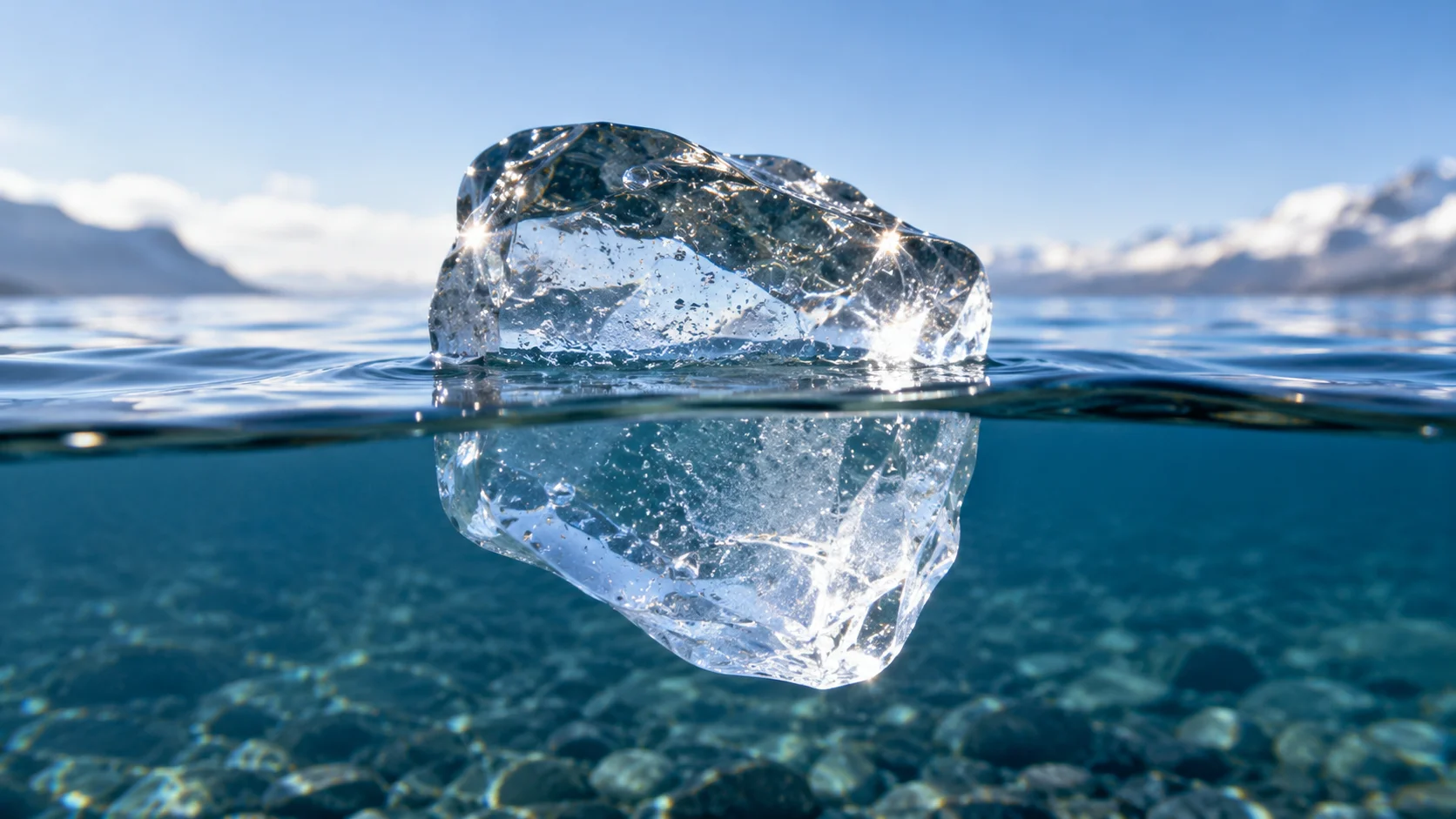
The same number of molecules occupy about 9 percent more volume in ice than in liquid water, so ice floats.
Hydrogen bonds
It All Comes Down to How Water Molecules Bond
Water molecules are polar: the oxygen end is slightly negative and the hydrogen ends are slightly positive. This lets neighboring water molecules attract each other through hydrogen bonds.
In liquid water, these bonds constantly form and break as molecules tumble past each other. When water freezes, the molecules slow down and the bonds become stable. The geometry of the molecule naturally creates an open crystal lattice.
That open space is what makes ice less dense. The chemistry is the same as liquid water, but the arrangement is different.
Myth vs reality
Myth vs Reality
What people think
Ice floats because it is cold and cold things are lighter
Temperature itself does not determine whether something floats. Density does. The reason ice floats is the structural change during freezing.
What actually happens
Ice floats because its crystalline structure is less dense
When water freezes, the lattice its molecules form takes up more space than the same molecules in liquid form. More volume for the same mass means lower density.
Liquid vs solid water
Liquid Water vs Ice: The Key Differences
Molecular arrangement
Liquid water: constantly shifting, randomly packed. Ice: rigid hexagonal lattice with fixed gaps.
Density
Liquid water at 0°C: approximately 1.00 g/cm³. Ice at 0°C: approximately 0.917 g/cm³.
Hydrogen bonds
Liquid water: bonds constantly break and reform. Ice: bonds are stable and hold the lattice in place.
Volume for the same mass
Ice takes up about 9 percent more volume than an equal mass of liquid water.
Quick answers
Common questions
Why does ice float instead of sinking like most solids? +
When water freezes, hydrogen bonds lock molecules into an open hexagonal lattice. This makes ice about 9 percent less dense than liquid water.
Why do pipes burst when water freezes? +
Water expands about 9 percent when it freezes. If it is trapped in a rigid pipe, this expansion generates enough pressure to crack the pipe.
At what temperature is water most dense? +
Liquid water is densest at 4°C. Below that temperature and above freezing, water becomes slightly less dense as it cools.
Why is only about 10 percent of an iceberg above water? +
Ice is only slightly less dense than seawater, so most of its volume must stay submerged to displace enough water for it to float.