Visual answer
Water's Role in the Human Body
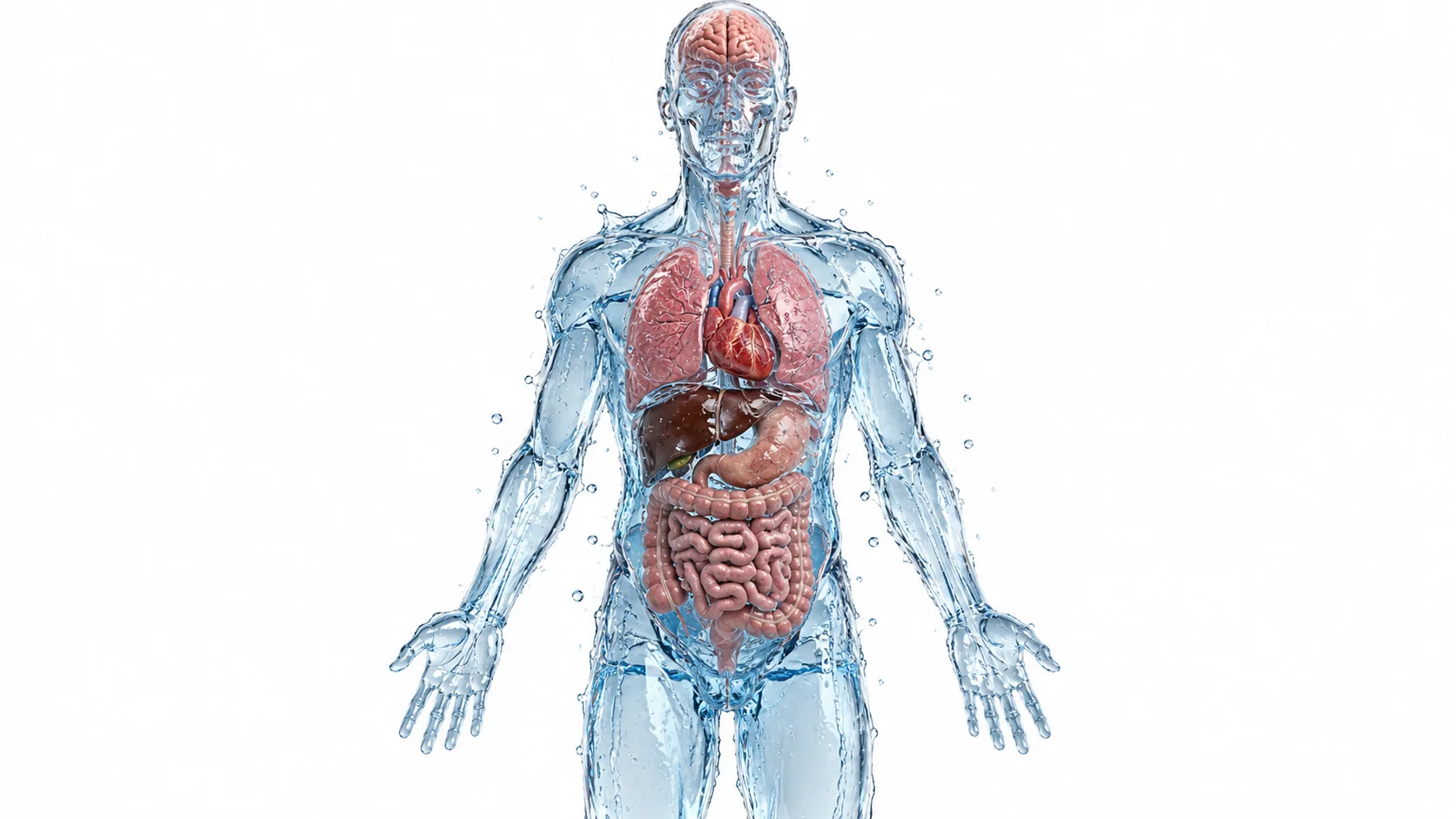
Water is not stored in one place. It is distributed throughout every system, performing different functions in each.
Intracellular fluid
About two-thirds of body water is inside cells, where it serves as the medium for every biochemical reaction.
Blood plasma
Water transports oxygen, nutrients, hormones, and waste products through the circulatory system.
Interstitial fluid
Water surrounds and bathes cells in tissues, enabling nutrient exchange between blood and cells.
Cerebrospinal fluid
Water cushions and protects the brain and spinal cord from mechanical shock.
Why water is special
Water Does Things No Other Molecule Can
Water is a terrible molecule on paper. Two hydrogen atoms and one oxygen. Nothing exotic. But the arrangement creates something unusual: the molecule has a slight positive charge on one side and a slight negative charge on the other, making it polar.
This polarity is the source of almost everything. Because water molecules are polar, they are attracted to each other and to other charged or polar molecules. This makes water an almost universal solvent, it pulls apart ionic compounds (like salts), dissolves gases (like oxygen), and carries polar molecules in solution.
Inside a cell, nearly every biochemical reaction takes place in water. Enzymes fold into functional shapes because of how they interact with water. Proteins are synthesized in aqueous environments. DNA replication happens in water. Remove the water and none of these processes can proceed.
It also has a remarkably high heat capacity, it resists temperature change better than almost any other common substance. For a warm-blooded organism trying to maintain a stable internal temperature against an unpredictable external environment, this is an enormous advantage.
Life began in water
Life Began in Water, And Never Really Left
The earliest life on Earth, simple single-celled organisms roughly 3.8 billion years ago, emerged in an aqueous environment. Water was not just the backdrop. It was the medium in which the chemistry of life became possible.
Early cells were essentially organized droplets: membranes enclosing water-based chemistry, keeping the right molecules concentrated and together long enough for reactions to occur. The cell membrane itself evolved partly to control what water and dissolved substances moved in and out.
When life eventually colonized land, it did not stop being aquatic. It brought its water with it, enclosed inside cells, tissues, and circulatory systems. Terrestrial animals are essentially walking oceans, maintaining an internal aqueous environment that mirrors the conditions where life first organized.
This is why dehydration is dangerous in hours when starvation takes weeks. You can survive without food because you have stored energy. You cannot store water in any meaningful reserve beyond what your tissues already hold.
Temperature regulation
Water Is How Your Body Manages Heat
Metabolic reactions generate heat as a byproduct. A lot of it. The body needs to dissipate this heat without cooking itself from the inside.
Water handles this in two ways. First, its high heat capacity absorbs heat without large temperature swings, blood acts as a thermal buffer, picking up heat from metabolically active organs and distributing it. Second, when water evaporates from the skin as sweat, it carries significant heat away with it.
Evaporative cooling is remarkably efficient. A single gram of water evaporating from your skin removes about 2,430 joules of energy. This is why sweating is such an effective cooling mechanism, and why humid environments feel so oppressive. When the air is already saturated with water vapor, your sweat cannot evaporate, and the cooling effect collapses.
Fever, your immune system deliberately raising body temperature to slow bacterial growth, works by overriding this system temporarily. But the water-based regulation is what brings the temperature back down.
What dehydration does
What Happens When the Water Level Drops
Lose 1% of your body water: thirst begins. You probably will not notice any cognitive effects yet.
Lose 2%: measurable decline in concentration, short-term memory, and fine motor skills. Physical performance begins dropping.
Lose 5%: significant headache, fatigue, and impaired decision-making. The body has begun restricting urine output to conserve water.
Lose 10%: muscle cramps, vision disturbances, confusion. Serious medical territory.
Lose 15-20%: fatal in most cases.
The severity is not surprising when you understand the role water plays. Every reaction slows, every transport system thickens, every membrane becomes less functional. Dehydration is not a shortage of one ingredient. It is the partial shutdown of the medium in which all biology operates.
Eight glasses a day?
Myth vs Reality
What people think
Everyone needs eight glasses of water a day
This number is so widely repeated that many people treat it as settled science. It is not. The eight-glasses rule has no robust scientific basis.
What actually happens
Water needs vary enormously by person, activity, climate, and diet
Much of daily water intake comes from food, fruits, vegetables, cooked grains, and meats all contain significant water. Thirst is a reasonably reliable guide for healthy people under normal conditions. Athletes, people in hot climates, and those with certain medical conditions have genuinely higher needs.
Quick answers
Common questions
Which organ in the body has the most water? +
The vitreous humor of the eye is about 99% water. Among major organs, the brain and kidneys are the most water-dense, each around 73-83%.
Can you drink too much water? +
Yes. Drinking water faster than the kidneys can process it dilutes blood sodium, leading to hyponatremia. Symptoms include headache, nausea, confusion, and in severe cases, seizures. This is rare but has occurred in endurance athletes who over-hydrate.
Why is water so important for the kidneys? +
The kidneys filter about 180 liters of fluid per day, reabsorbing most of it and excreting waste dissolved in urine. Without adequate water, waste concentrations rise, increasing the risk of kidney stones and eventually impairing kidney function.
Do other animals have the same water composition as humans? +
Roughly similar, yes. Most mammals are 60-70% water by mass. Jellyfish are around 95% water. Elephants and humans are surprisingly close. The range across all animals reflects differences in fat content and metabolic strategy more than fundamental biology.