Visual answer
Why Earth Has Two Tidal Bulges at Once
The moon's uneven gravitational pull across Earth creates simultaneous high tides on opposite sides.
Moon's gravity acts across Earth
The near-side ocean is closer to the moon than the far-side ocean, so the pull differs across the planet.
Near-side ocean bulges toward the moon
Water closest to the moon is pulled more strongly than Earth's center.
Far-side ocean is left behind
The moon pulls Earth's center more strongly than it pulls the far ocean, creating an opposite bulge.
Earth rotates through both bulges
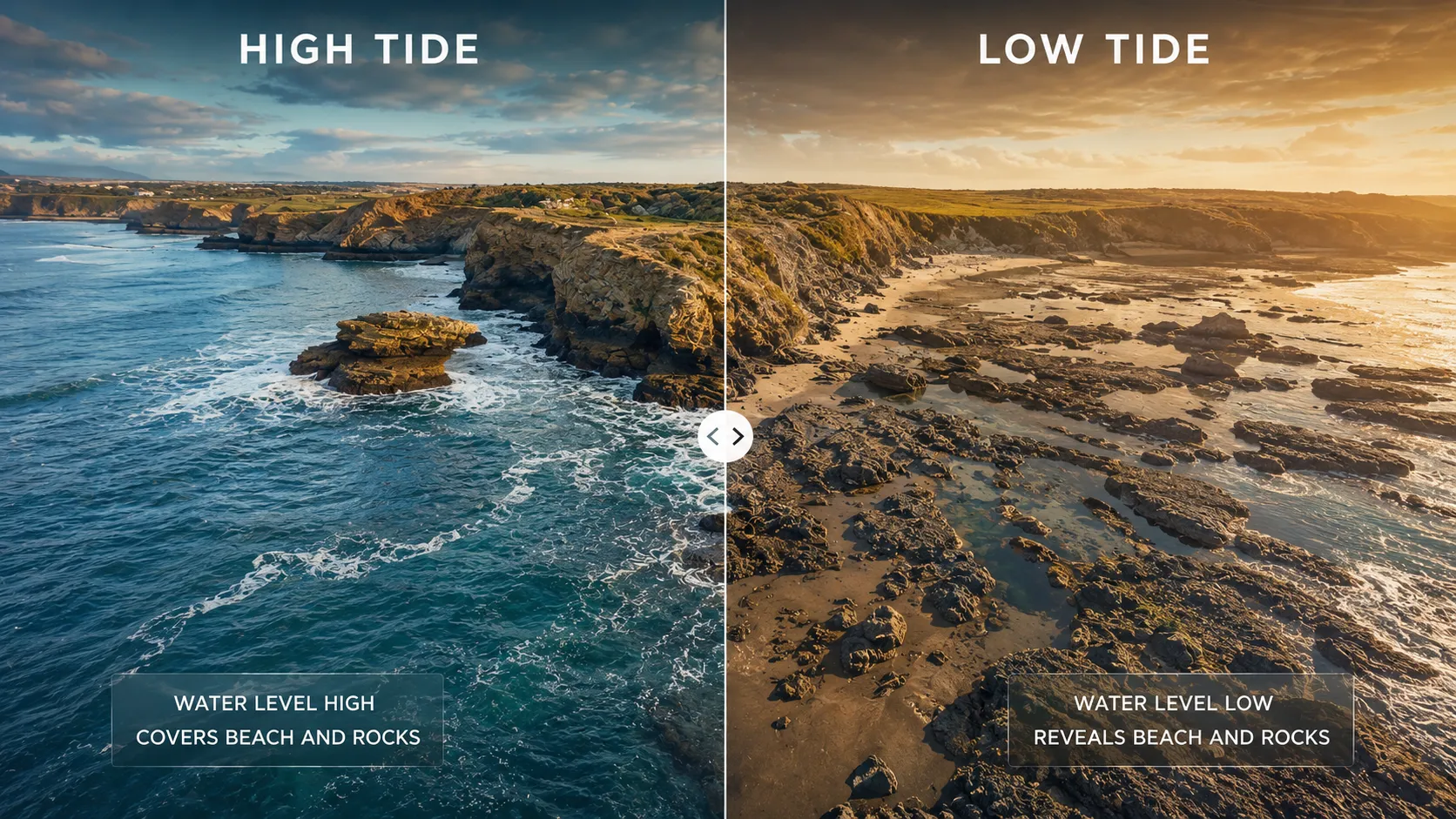
Coastlines pass through both bulges, producing two high tides and two low tides in many places.
Tidal force
Tides Are About Differences in Gravity, Not Just Gravity Itself
Gravity weakens with distance. The moon's gravity at Earth's near side is measurably stronger than at Earth's far side. This difference is the tidal force.
The ocean can flow in response to these differential forces. Solid rock also deforms, but by much less. Ocean tides become dramatic near coastlines because local geography can amplify them.
Funnel-shaped bays and shallow continental shelves can build very large tidal ranges, while the open ocean may change by less than a meter.
Myth vs reality
Myth vs Reality
What people think
The moon pulls ocean water upward like a magnet
Earth's own gravity is vastly stronger at the surface. Tides are not simple upward lifting.
What actually happens
Tides are a stretching effect
The tidal force stretches Earth and its oceans along the Earth-moon axis, producing horizontal water movement toward tidal bulges.
Spring vs neap tides
Spring Tides vs Neap Tides
When they occur
Spring tides occur at new and full moon. Neap tides occur during first and third quarter moons.
Tidal range
Spring tides are larger than average. Neap tides are smaller than average.
Cause
Spring tides combine solar and lunar tidal forces. Neap tides partially cancel them.
Name origin
Spring tides are not seasonal; the name refers to water springing or surging up.
Quick answers
Common questions
Why are there two high tides a day instead of one? +
The moon creates a tidal bulge on the side facing it and another on the opposite side. Earth rotates through both.
Why does high tide happen at a different time each day? +
The moon moves in its orbit, so Earth needs about 50 extra minutes each day to realign with it.
Do tides happen in lakes? +
Tiny tidal forces exist in large lakes, but most lakes are too small for noticeable water movement.
Why are tides higher in some places than others? +
Local coastline shape, seafloor depth, and basin resonance can amplify or reduce tidal range.