Quick Facts
Quick Facts
The main odor compound, octenal, is also produced when certain fats break down elsewhere in nature.
Sharks and some insects can detect blood-related compounds at astonishingly low concentrations.
Rusting metal produces a related but distinct effect: metal ions reacting with skin oils.
This is why touching an old coin can leave a similar metallic smell on your fingers.
Visual answer
How the smell forms
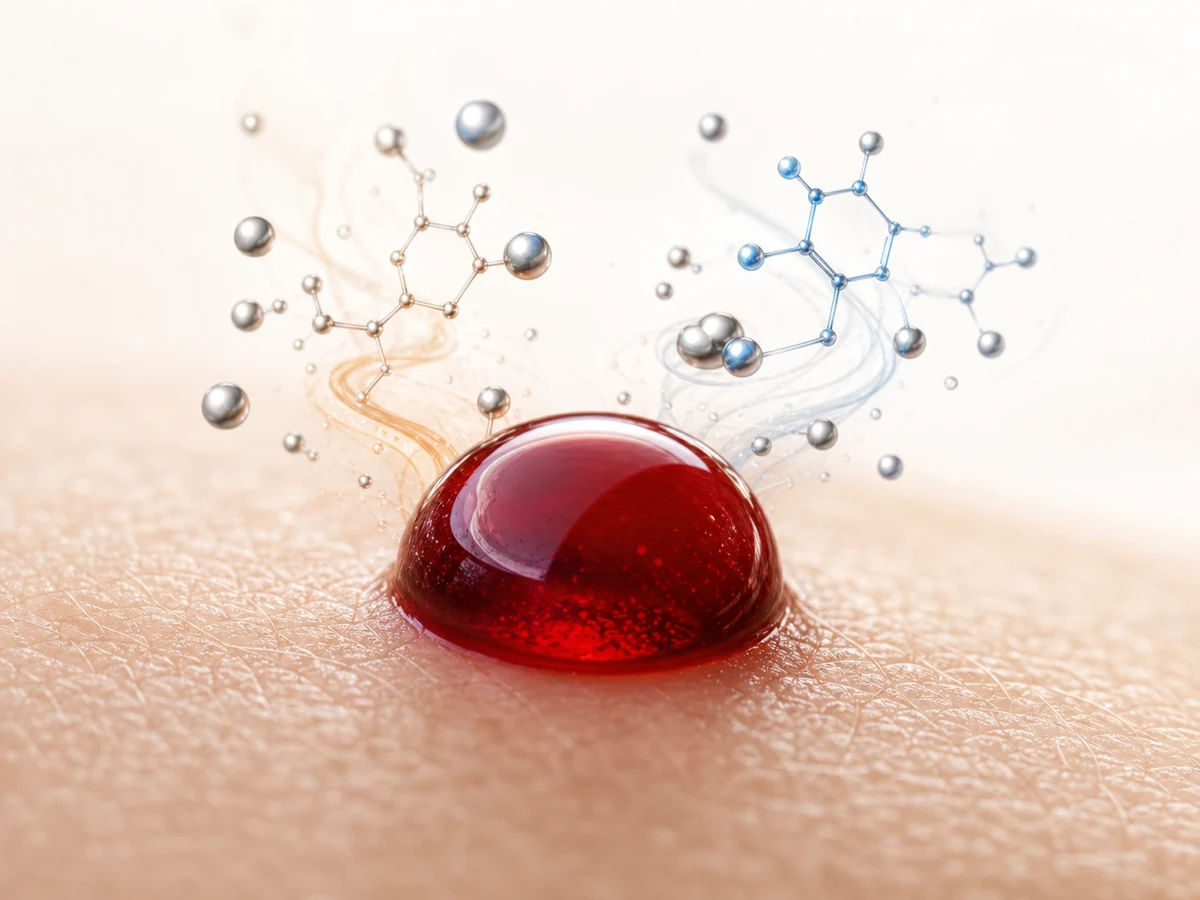
Blood's iron doesn't smell on its own—it needs to react with fats on your skin first.
Blood meets skin
Iron-carrying hemoglobin makes contact with oils on the skin's surface.
A reaction occurs
The iron breaks down fats in the skin, producing new odor compounds, chiefly octenal.
You smell it
Octenal is powerfully detectable by the human nose even in tiny amounts.
The Reaction
It Takes Two to Smell Like Metal
Blood carries iron inside hemoglobin, the molecule responsible for ferrying oxygen around your body. It's easy to assume that's where the smell comes from directly, given how strongly we associate the two.
But researchers who've actually tested pure iron found it to be nearly odorless. The metallic smell only shows up once that iron interacts with something else—specifically, the lipids, or fats, sitting on the surface of your skin.
That reaction breaks the lipids down into a handful of new compounds, the most prominent being octenal, an aldehyde with a sharp, metallic, faintly bloody character all its own. It's a smell created fresh, on the spot, rather than one carried in by the blood.
Rusty Coins
The Same Trick Behind Rusty Coins and Old Keys
This is also why handling old coins, keys, or iron railings can leave your fingers smelling metallic, even though the metal itself, freshly made, is essentially odorless.
In both cases, it's not the metal you're smelling—it's the small chemical aftermath of metal meeting the oils on your own skin.
Analogy
The Smell Is a Handshake, Not a Person
The familiar part
Two strangers can walk into a room without incident, but shake hands and something is exchanged—a bit of small talk, a business card, sometimes a cold.
How it applies
Iron and skin oil are much the same. Neither smells like much apart, but the moment they meet, a new compound is produced—and that compound is what your nose actually picks up.
Where the analogy breaks
Which is why a blood sample in a sealed lab tube, never touching skin, tends to smell far fainter than a fresh cut on your own finger.
Curiosity Notes
Details Most People Miss
Why this still matters
Why This Still Matters
The blood-smells-like-metal story is a neat reminder that our senses often mislead us about cause and effect—what feels like the most obvious explanation is sometimes almost entirely wrong.
Key Findings
- ✓Core findingPure iron is nearly odorless on its own.
- ✓Strong evidenceBlood's metallic smell comes mostly from octenal, formed when iron reacts with skin lipids.
- ⚠Main consequenceThe same effect explains why old coins and keys smell metallic after handling.
- ✓Wider legacyPredators like sharks are highly sensitive to these very compounds.
Final insight
A Last Thought
The smell of blood turns out to be less about blood, and more about you—a tiny chemical collaboration between iron and your own skin, staged fresh every time there's a cut to prove it.
Quick answers
Common questions
Does all blood smell the same? +
Roughly, yes—the core chemistry is the same across people, though diet, health, and the surface it lands on can subtly change the intensity.
Why doesn't blood in a sealed container smell as strong? +
Because the reaction that produces the metallic smell largely depends on contact with skin lipids, which a sealed tube simply doesn't provide.