Quick Facts
Quick Facts
Metals bounce or dent because their atoms can slide past each other without breaking bonds.
Glass is technically a liquid that cooled so fast its atoms couldn't form an orderly crystal structure.
The cracks in shattering glass travel at over 3,000 miles per hour.
Tempered glass is designed to shatter into tiny, dull cubes instead of jagged shards because it is pre-stressed.
Visual answer
Why glass shatters instead of bouncing
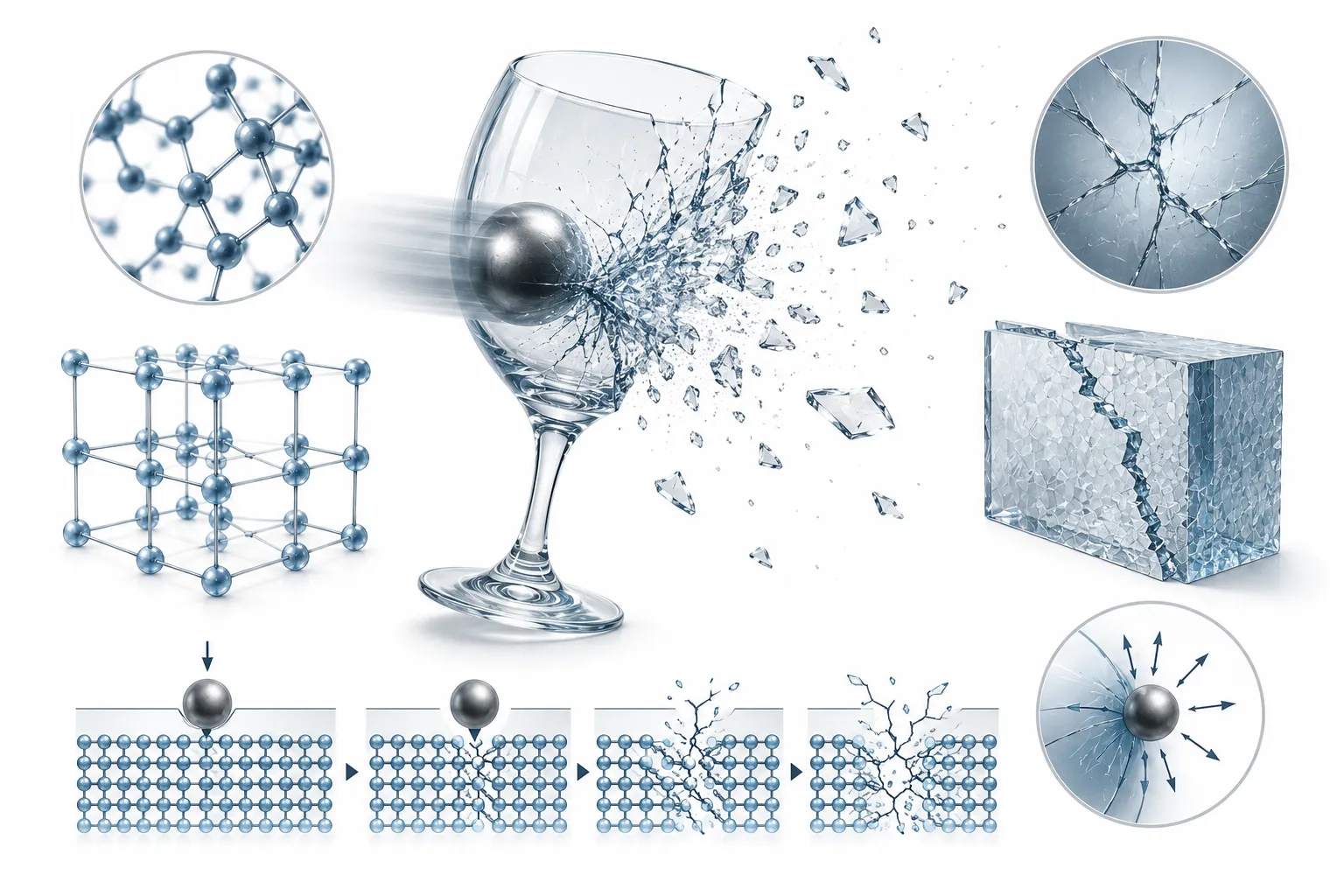
The diagram shows how cracks spread quickly through rigid glass instead of letting the material flex and rebound.
Impact
A hit concentrates force into a small region.
Cracks spread
Glass has little internal give, so tiny flaws grow fast.
No rebound
Energy goes into new crack surfaces instead of elastic bounce.
The Atomic Level
The Problem With Being Amorphous
Most solids in the world, like metal or ice, have a crystalline structure. Their atoms are arranged in neat, repeating grids, like a 3D checkerboard. When you hit a metal, the layers of atoms can slide over each other like sheets of paper. This absorbs the energy of the impact. That is why a steel ball bearing can bounce.
Glass is different. It is an 'amorphous solid.' When it cools from a liquid, its atoms freeze in a random, disorganized jumble. They don't form neat sheets. They are locked into a rigid, chaotic cage.
Because there are no neat layers to slide, the atoms cannot absorb energy by moving. When the floor pushes back against the glass, the energy has nowhere to go. The only way out is to break the chemical bonds holding the atoms together. The energy rips the material apart.
Analogy
The Trampoline vs. The Concrete
The familiar part
If you jump on a trampoline, the springs stretch, absorb your energy, and push you back up. If you jump off a roof onto a concrete sidewalk, the concrete does not stretch. It breaks.
How it applies
Rubber is the trampoline. Its polymer chains stretch to absorb the fall. Glass is the concrete. It absolutely refuses to flex. So the kinetic energy from your fall goes into destroying the concrete instead of bouncing you back.
Where the analogy breaks
Concrete actually doesn't shatter into a thousand pieces like glass because it has some internal compressive strength, but the principle of 'flex or break' holds true.
Curiosity Notes
Details Most People Miss
Why this still matters
Why This Still Matters
It teaches us that rigidity is a vulnerability. In engineering, biology, and even politics, systems that cannot bend, flex, or absorb shock are the ones that shatter spectacularly when pressure is applied. Glass is a physical metaphor for the danger of inflexibility.
Key Findings
- ✓Core findingGlass lacks a crystalline structure, making it 'amorphous.'
- ✓Strong evidenceWithout neat atomic layers to slide, it cannot absorb impact energy by bending.
- ⚠Main consequenceThe kinetic energy has nowhere to go, so it breaks the atomic bonds.
- ✓Wider legacyThis causes a shockwave that rips the glass apart into shards.
Final insight
A Last Thought
Glass is a tragic figure in the physics world. It is completely transparent, incredibly strong in compression, but utterly defenseless against a sudden shock. It refuses to compromise, refuses to bend, and because of that stubborn rigidity, it pays the ultimate price. Next time you drop a glass, don't blame yourself. Blame its chaotic atomic structure.
Quick answers
Common questions
Can glass ever bounce? +
Extremely thick, specialized glass (like Prince Rupert's drops) can bounce, but they still shatter if you snap their tail.
Is glass a liquid? +
No, it is a solid. It just has a disorganized atomic structure, which is why people used to think it flowed like a liquid over centuries.