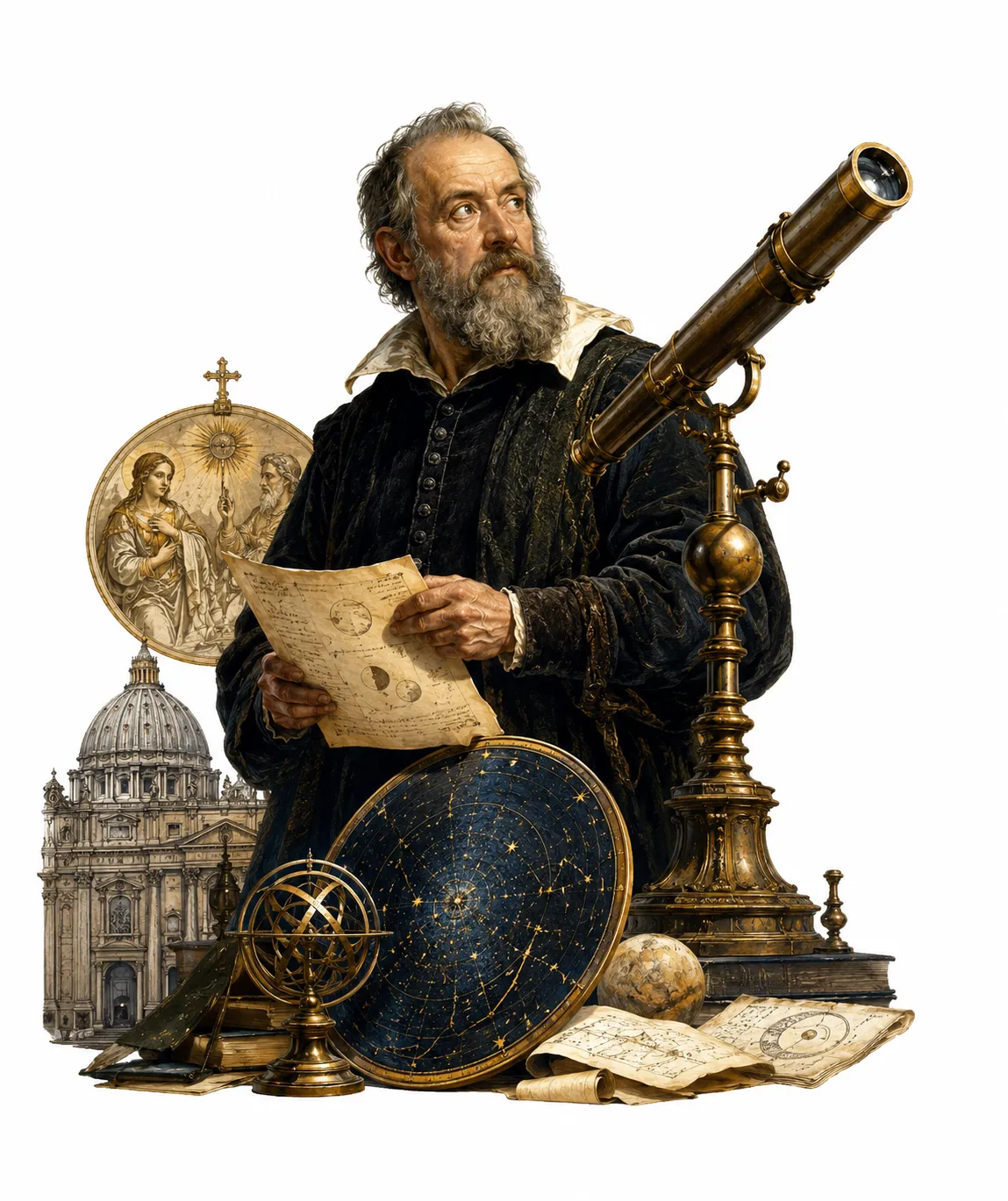
Quick Facts
Quick Facts
Galileo had been warned to stop promoting heliocentrism back in 1616 seventeen years before the trial.
The Pope who put him on trial was a personal friend who had initially given him permission to write the controversial book.
Galileo named the bumbling character in his book 'Simplicio.' The Pope thought it was him.
Only seven of the ten presiding cardinals signed the guilty verdict. The Pope's own nephew was one of the three who refused.
Galileo was never actually tortured, despite later legend. The threat was made; it was not carried out.
After one day in formal prison, his sentence was quietly downgraded to house arrest at his countryside villa.
Visual answer
How a Book Ended With a Trial
The slow-burning chain of events that took Galileo from celebrated astronomer to convicted heretic.
The 1616 Warning
Church authorities told Galileo to stop holding or defending heliocentrism. Whether this was a binding legal order would later become the entire basis of the trial.
A Friend Becomes Pope
Cardinal Barberini Galileo's ally became Pope Urban VIII in 1623. Galileo thought this gave him room to manoeuvre. It did, briefly.
The Ill-Fated Book
With the Pope's permission to write a 'balanced' treatment, Galileo published his Dialogue in 1632. It was not balanced.
The Pope's Argument, Meet Simplicio
Galileo put the Pope's own theological argument into the mouth of a dim-witted character named Simplicio. Urban VIII was not amused.
Summons and Conviction
In 1633 Galileo, now 68 and unwell, was convicted of 'vehement suspicion of heresy' and sentenced to house arrest for the rest of his life.
Story in brief
Story in Brief
1616
Galileo is warned not to hold or defend heliocentrism.
This order disputed, possibly informal would become the legal hook for everything that followed.
1623
His friend Cardinal Barberini is elected Pope Urban VIII.
Galileo believed he finally had a sympathetic ear at the very top of the Church.
1632
He publishes Dialogue Concerning the Two Chief World Systems.
The book was supposed to be neutral. It very obviously was not.
October 1632
The Inquisitor of Florence knocks on Galileo's door with a summons.
February 1633
Galileo, sick and elderly, travels to Rome to face trial.
June 22, 1633
Found guilty. Sentenced to house arrest for life. His book is banned.
1638
Completely blind by now, he publishes his finest work on physics from house arrest.
The Inquisition had silenced his voice on astronomy. It had not silenced his mind.
1642
Galileo dies at his villa in Arcetri.
The Charge
It Was Not About the Telescope
Here is the thing people usually get backwards about the Galileo trial: it was not, strictly speaking, about whether he was right about the solar system. It was about whether he had broken a legal order. Specifically, an order issued in 1616 telling him to stop promoting the heliocentric model.
Galileo's defence was straightforward perhaps too straightforward. He claimed he had no recollection of any binding injunction. He had, he said, merely been warned not to hold heliocentrism as a fact. His book, he insisted, presented both sides fairly. The judges looked at his book and then looked at him in the manner of people who have just been told something they find difficult to believe.
The problem was Simplicio. In the Dialogue, Galileo structured the debate between three characters. The heliocentric arguments were given to the sharp, witty one. The geocentric arguments including one that Pope Urban VIII had personally given Galileo in a private conversation in 1623 were handed to a character whose name translates, roughly, as 'the simpleton.' Urban was furious in the particular way that only someone who recognizes themselves in an unflattering portrait can be furious.
The Pope's Argument
"God could have caused birds to fly with their bones made of solid gold, yet we observe that He made them light and hollow. Who are we to say He could not arrange the heavens otherwise than we suppose?"
, Pope Urban VIII, argument given privately to Galileo, c. 1623
This was the Pope's philosophical position: that an all-powerful God could make the universe work any way He chose, regardless of what our telescopes suggested. Galileo gave this argument to Simplicio. The Pope took it personally. One can see why.
The Real Charges
What Galileo Was Actually Accused Of
He had violated the 1616 injunction by presenting heliocentrism as physical fact rather than hypothesis.
StrongHis Dialogue was a work of advocacy disguised as neutral debate.
StrongHe had misled Church officials when obtaining permission to publish.
ModerateThe character Simplicio was a mockery of papal authority.
ModerateKey Points
The Case So Far
The legal basis for the trial was a 1616 order Galileo later claimed to have forgotten or at least not fully understood.
The immediate cause was his 1632 book, which was neither neutral nor subtle.
The Pope's wounded pride played a significant role in how hard the Church pushed the case.
The political climate mattered too: the Church was fighting Protestantism across Europe and had little patience for internal challenges to authority.
The verdict was technically 'vehement suspicion of heresy' one rung below an actual heresy conviction, which would have carried far harsher consequences.
Analogy
He Had Permission Sort Of
The familiar part
Imagine asking your boss for permission to write a report presenting both sides of a dispute, then submitting a document in which one side is represented by a Nobel laureate and the other by a cartoon villain.
How it applies
Galileo had genuinely obtained the Pope's permission to write the Dialogue. What he submitted bore little resemblance to what he had described.
Where the analogy breaks
In 17th-century Rome the consequences of that gap were considerably more severe than a difficult conversation with HR.
Curiosity Notes
Details Most People Miss
Why this still matters
Why This Still Matters
The Galileo trial has become the shorthand example for what happens when institutions feel threatened by uncomfortable evidence. What the actual history shows is something more human and more instructive: that the clash was not between faith and science in the abstract, but between specific people with specific grievances, wounded pride, political pressures and a catastrophically misjudged fictional character named Simplicio.
Key Findings
- ✓Core findingThe trial was triggered by Galileo's 1632 book, not his telescope observations.
- ✓Strong evidenceThe legal basis was a disputed 1616 order to stop promoting heliocentrism.
- ⚠Main consequenceThe Pope's anger was personal: he believed Galileo had put his words in a fool's mouth.
- ✓Wider legacyThe verdict was 'vehement suspicion of heresy' technically less than full heresy.
- ★Bottom lineGalileo was never tortured, and spent his sentence at a comfortable country villa.
- ★Bottom lineHe continued working and published his greatest scientific book from house arrest.
Final insight
A Last Thought
It is worth noting that Galileo's most important scientific work the book that would help lay the foundations of classical mechanics was written while he was under house arrest, going blind, and officially silenced. Some people slow down when the world pushes back. Galileo apparently was not one of them.
Quick answers
Common questions
What exactly was Galileo charged with? +
Galileo was charged with 'vehement suspicion of heresy' specifically for defying a 1616 Church order not to hold or defend the idea that Earth moves around the Sun. He was not convicted of full heresy, which would have carried harsher consequences.
Was Galileo the first person to be tried for heliocentrism? +
No. The Church had been wrestling with Copernican heliocentrism since the 1540s. Galileo's trial was notable not because the topic was new, but because of his prominence, his books's reach, and the personal dimension involving Pope Urban VIII.
Did Galileo really say 'and yet it moves' after recanting? +
Almost certainly not. The phrase 'Eppur si muove' is a great story, but there is no contemporary evidence Galileo said it. It appears to have been invented well after his death and attached to him because it was too good not to.
Was Galileo excommunicated? +
No. He was convicted of 'vehement suspicion of heresy', which required him to formally recant. He was not excommunicated and remained a Catholic until his death. He even received last rites.
When did the Church officially admit it was wrong about Galileo? +
In 1992, Pope John Paul II formally acknowledged that the Inquisition had erred in condemning Galileo. The rehabilitation had taken 359 years, which is either a long time or a short time depending on how you feel about institutional self-reflection.