Visual answer
The Fluorescent Exchange
How a UV photon becomes a visible photon.
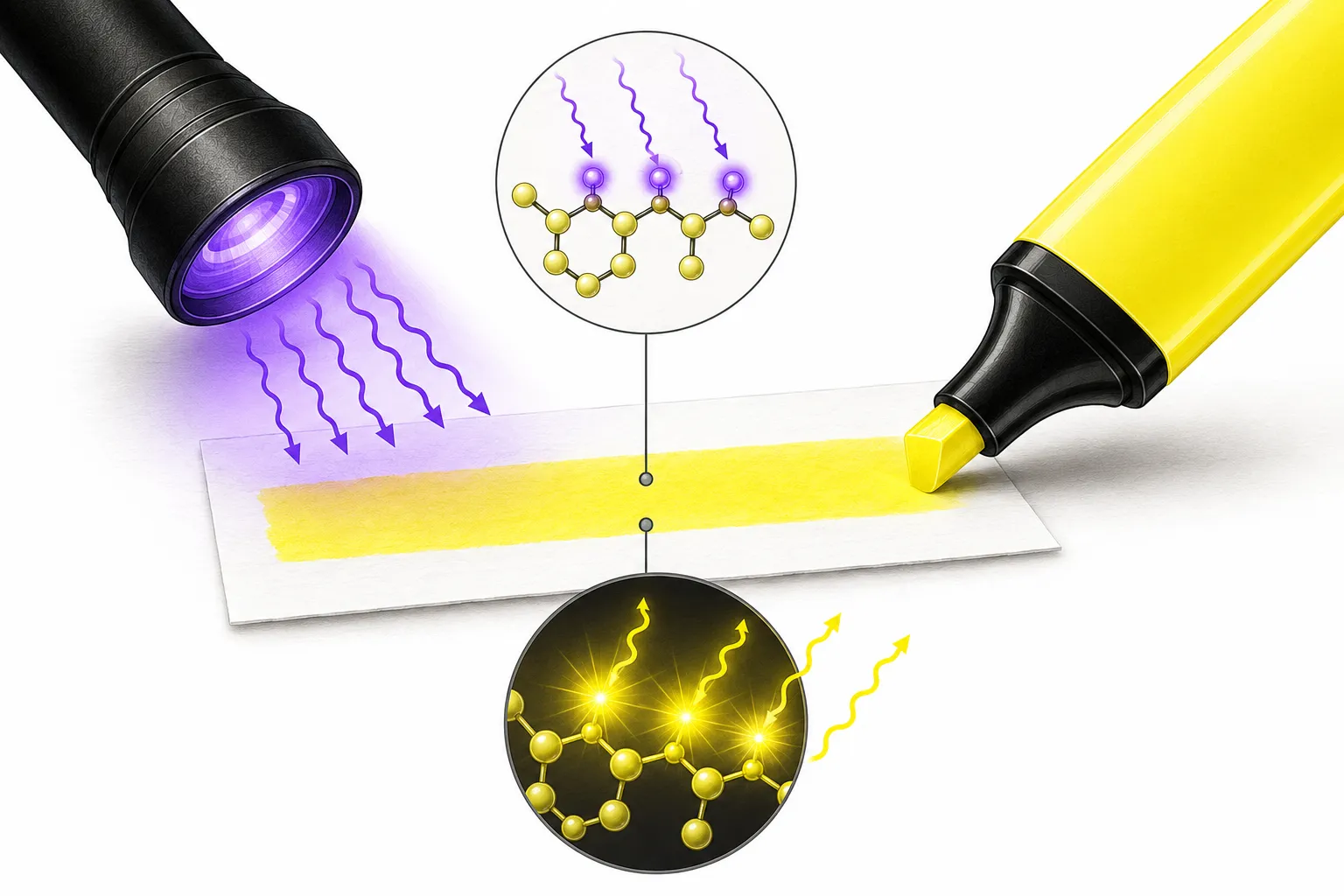
UV Photon Arrives
An invisible, high-energy ultraviolet photon strikes the fluorescent dye molecule.
Electron Excitation
The photon's energy is absorbed by an electron, which jumps to a higher, unstable energy state.
Energy Loss (Heat)
As the electron falls back down, a tiny bit of energy is lost as molecular vibration (heat). This is the Stokes Shift.
Visible Photon Emitted
The remaining energy is released as a new photon. Because it has less energy, it has a longer wavelength, falling into the visible spectrum as neon color.
Where We Stand
A Quantum Trick in a Plastic Tube
Current state
Fluorescence is a well-understood optical phenomenon governed by quantum mechanics. We have precisely engineered the organic dye molecules in highlighters to be exceptionally good at absorbing UV light and re-emitting it in the visible spectrum.
What supports this
This isn't a new discovery. Fluorescent dyes were synthesized in the mid-20th century. But their application in highlighters, originally called 'Hi-Liters' and pioneered by the Carter's Ink Company in 1963, was a stroke of applied genius. They realized that by making ink fluorescent, the printed text underneath would remain dark while the ink above blazed with extra, converted light, making it the perfect reading aid.
What could change this
The physics is fixed, but the chemistry evolves. There is a constant push to make fluorescent dyes more stable (they can degrade under prolonged UV exposure), less toxic, and more vibrant.
The Core Idea
Think of It Like a Currency Exchange
The familiar part
Imagine you have a stack of high-value, foreign currency (like a 100-Euro note), but you can't buy anything in your local store. You take it to an exchange booth. They take your Euro, keep a small commission, and hand you back a slightly smaller stack of usable local dollars.
How it applies
Ultraviolet light is high-energy 'foreign currency.' Your eyes can't use it; they can't see it. The fluorescent dye molecule is the exchange booth. It absorbs the high-energy UV photon (the Euro). It keeps a little bit of that energy as heat (the commission, this is called the Stokes Shift). It then hands you back a slightly lower-energy, but perfectly usable, visible photon (the dollars). You aren't creating light; you are changing its denomination into something your eyes can spend.
Where the analogy breaks
Unlike a currency exchange, this happens instantaneously, at the speed of light, inside a single molecule. And the 'commission' (energy lost as heat) is why the emitted visible light is always a lower frequency (redder) than the absorbed UV light.
The Physics
Stealing Light from the Invisible Spectrum
Light is made of particles called photons, and each photon carries a specific amount of energy. UV photons carry more energy than visible photons. When a UV photon hits a fluorescent dye molecule, it is absorbed by an electron in the molecule. This electron gets 'excited' and jumps up to a higher energy level.
But nature doesn't like excited electrons. They want to fall back down to their normal, relaxed state. When the electron falls back down, it has to release that extra energy. It does this by spitting out a new photon. Because some energy was lost along the way to molecular vibrations (heat), the new photon has less energy than the original UV photon. Less energy means a longer wavelength. A longer wavelength means it falls into the visible spectrum, usually bright yellow, green, or pink.
This is why highlighters look so unnaturally bright even in normal daylight. Sunlight contains UV rays. The dye is constantly absorbing the invisible UV portion of the sunlight and blasting it back into your eyes as visible color. It's literally brighter than the light hitting it, because it's adding converted UV light to the reflected visible light.
The Evidence
The Quantum Blueprint
Fluorescent dyes absorb high-energy UV and emit lower-energy visible light.
StrongThe 'Stokes Shift' explains why the emitted light is a different color than the absorbed light.
StrongHighlighters appear bright in daylight because sunlight contains UV radiation.
StrongThe ink is glowing because of a chemical reaction with the blacklight.
StrongThe Big Myth
The Most Common Misconception
What people think
"The blacklight is making the ink glow by reacting with it chemically."
It feels like the blacklight is a catalyst causing the ink to undergo a chemical change that produces light, like a glow stick.
What actually happens
It's a physical interaction, not a chemical one
A glow stick uses *chemiluminescence*, mixing chemicals to create light. Fluorescence is *photoluminescence*. The dye molecules are not changed, consumed, or degraded (at least not immediately) by the blacklight. They are just acting as tiny antennas, catching invisible light and broadcasting it on a visible frequency. Turn off the blacklight, and the dye is exactly the same as it was before.
What If It's True?
What If Humans Could See UV Light?
Imagine this
Imagine if our eyes had evolved to see the full ultraviolet spectrum, like bees or some birds do.
What would happen
If you could see UV light naturally, highlighters wouldn't look special at all. They would just look dark or muted, because they would be *absorbing* the light you could see and converting it to colors you might not find as impressive. The entire magic of fluorescence relies on our biological blindness to UV. The glow is a product of our limitation, not just the dye's property.
Why this matters
And maybe that's the beautiful part. So much of what we find wondrous in the universe, a sunset, a neon sign, a glowing highlighter, is just our specific, slightly flawed biological equipment trying to make sense of energies it wasn't built to fully process.
Final insight
Seeing the Unseen
A highlighter is a humble tool, but it is also a consumer-grade quantum optics device. Every time you drag that yellow tip across a page, you are laying down a microscopic array of molecules designed to perform a trick on your eyes, stealing light from a spectrum you can't see and spending it in a color you can. It's a tiny, everyday miracle of physics.
Quick answers
Common questions
What is the difference between fluorescence and phosphorescence? +
Fluorescence (like a highlighter) stops glowing the *instant* the blacklight is turned off. The energy is released immediately. Phosphorescence (like glow-in-the-dark toys) absorbs light and then releases it very slowly over time, so it continues to glow in the dark after the light source is gone.
Do all highlighter colors glow? +
Most standard highlighters (yellow, pink, green, orange) use fluorescent dyes and will glow under a blacklight. Blue highlighters sometimes use a non-fluorescent dye because a fluorescent blue is hard to distinguish from a regular bright blue, so they might not glow as intensely.
Is the blacklight actually 'black'? +
A true blacklight emits almost entirely ultraviolet (UVA) light, which is invisible to us. The purple glow you see from the bulb itself is just a tiny leakage of visible light from the spectrum. A perfect blacklight would look completely dark when turned on.
Can you make invisible ink with highlighters? +
Yes! If you draw on a white piece of paper with a yellow highlighter and let it dry, it's often very hard to see in normal light. But take it into a dark room with a blacklight, and your message will blaze into view. This is a classic 'fluorescent ink' experiment.